Planck discovers filament of hot gas linking two galaxy clusters
20 November 2012
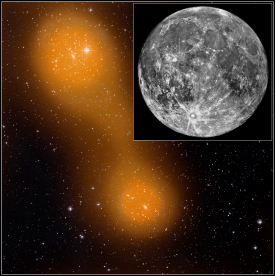
Scanning the sky at microwave and sub-millimetre wavelengths with Planck, astronomers have unambiguously detected a 'bridge' of hot gas connecting two galaxy clusters, Abell 399 and Abell 401. The filament extends over about 10 million light-years and contains gas with a temperature of about 80 million K. At least part of this gas might derive from the warm-hot intergalactic medium (WHIM) - the elusive web of gaseous filaments which is believed to pervade the Universe.
 |
|
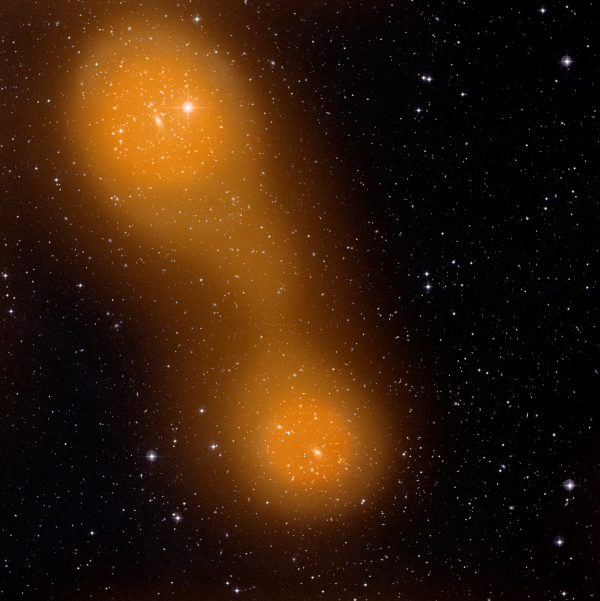
A bridge of hot gas between galaxy clusters Abell 399 and Abell 401. Credit: Sunyaev-Zel'dovich effect (orange): ESA & Planck Collaboration; optical image: STScI Digitized Sky Survey |
The current understanding of cosmology suggests that the Universe is dominated by dark matter and dark energy. The remaining 'normal' matter – or baryonic matter – of which stars and planets are made, accounts for just a tiny fraction of the cosmic budget, less than five per cent. Baryonic matter can, in principle, be detected through the electromagnetic radiation it releases. But there's a problem: the amounts of baryonic matter detected via astronomical observations in the distant, ancient Universe and in the nearby one do not match. Astronomers have struggled to locate about half of the baryonic matter expected to be present in the local Universe.
 |
|
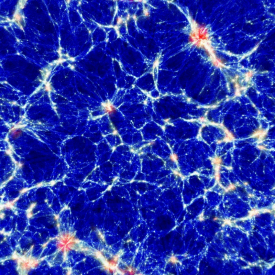
Simulation of the cosmic web showing how matter in the Universe is arranged on very large scales. Image courtesy of Klaus Dolag, Universitäts-Sternwarte München, Ludwig-Maximilians-Universität München, Germany |
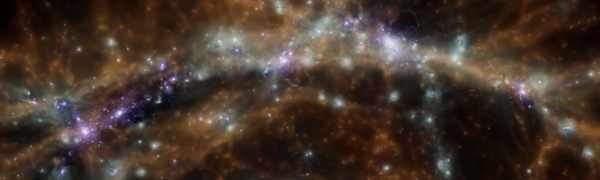
A leading candidate for the location of these so-called 'missing baryons' is the warm-hot intergalactic medium or WHIM. The WHIM is the baryonic component of the cosmic web, a filamentary network of both dark and baryonic matter that is believed to pervade the Universe. Numerical simulations of the formation of cosmic structure predict that galaxies and galaxy clusters are embedded in the cosmic web, and that the WHIM might account for most of the baryonic matter in the local Universe. This network of tenuous gas ranges in temperature from 100,000 to several tens of millions of K and due to its extremely low density has proved very hard to detect.
In the past decade, astronomers have started to collect evidence supporting the WHIM hypothesis, mainly via X-ray observations and optical/ultraviolet spectroscopy. A recent study using data from ESA's Planck satellite has brought a new insight to the debate, opening a new spectral window for the study of the missing baryons based on observations at microwave and sub-millimetre wavelengths.
"Although the WHIM is mainly organised in long and diffuse filaments, we expect to find it also in the proximity to galaxy clusters, which are the largest gravitationally-bound structures in the Universe," explains José M. Diego, a Planck Collaboration scientist from the Instituto de Fisica de Cantabria (UC-CSIC) in Santander, Spain.
"Planck can detect galaxy clusters across the sky because the hot gas that fills them imprints a characteristic signature on the Cosmic Microwave Background known as the Sunyaev-Zel'dovich effect," Diego adds. "Based on the same principle, Planck could be sensitive to gas from the WHIM, too".
Astronomers in the Planck collaboration have been exploiting the Sunyaev-Zel'dovich effect in the search for galaxy clusters. The first results of Planck's hunt for these gigantic cosmic structures were presented in 2011, along with the public release of an extensive catalogue of clusters. Careful analysis of this rich data set is now starting to reveal the properties not only of galaxy clusters, but also of their surroundings.
"Detecting the WHIM via the Sunyaev-Zel'dovich effect is extremely challenging due to its low density," comments Juan Macias-Perez, a Planck Collaboration scientist from the Laboratoire de Physique Subatomique et de Cosmologie in Grenoble, France. "The best chance to detect it is to look at the regions between pairs of nearby galaxy clusters that are interacting with one another: as they approach each other, gas in the inter-cluster region becomes denser and hotter, hence easier for us to spot," he adds.
 |
|
Simulation showing galaxy clusters embedded in the cosmic web. |
With this aim, astronomers from the Planck Collaboration inspected the catalogue of clusters compiled from data collected by Planck during its first two surveys, and the beginning of the third. "We looked for pairs of clusters which are close enough for a possible intervening filament to be detected, but also separate enough, on the plane of the sky, for Planck to resolve them as individual sources," explains Macias. The astronomers then identified a handful of candidates, which are all at very low redshifts – hence cosmologically short distances – to fulfil these requirements.
"A careful analysis revealed a 'bridge' of hot gas connecting two of the clusters in the sample: Abell 399 and Abell 401," comments Diego. These two clusters are located at redshift z~0.07 – about one billion light-years away from us. In contrast, the bridge has a length of about 10 million light-years.
 |
|
Planck discovered a bridge of hot gas between galaxy clusters Abell 399 and Abell 401. The full Moon is shown for scale. |
Hot gas can also be detected via its direct emission at X-ray wavelengths. A previous study of Abell 399 and Abell 401, based on X-ray data from ESA's XMM-Newton space observatory, hinted at the presence of hot gas not only within, but also between the clusters, but the evidence was not conclusive. The result based on Planck data is much more robust and confirms that the two structures are indeed connected by a bridge of material; this also represents the first detection of inter-cluster gas obtained via the Sunyaev-Zel'dovich effect.
"By combining Planck data with archival X-ray observations from the German satellite ROSAT, we estimated the temperature of gas in the bridge as about 80 million K," notes Torsten Enßlin, a Planck Collaboration scientist from the Max-Planck-Institut für Astrophysik in Garching bei München, Germany. This value is of the same order as the temperature of gas in the two clusters. Although it may be part of the WHIM, the origin of this inter-cluster gas is, as yet, unclear.
"It is still debated whether the gas derives from the WHIM or from the gas that was previously part of the two clusters; numerical simulations suggest that it could well be a mixture of both," explains Enßlin. "Further analysis of the complete Planck data might help to clarify this issue by revealing additional examples," he adds.
The astronomers have already identified another promising candidate: the composite system Abell 3391-Abell 3395, which is highly substructured and may in fact consist of three or four clusters. This system exhibits what appears to be a bridge of material linking its various components. Due to the complex nature of this object, a more detailed investigation will be needed to confirm this second detection.
"This discovery highlights the ability of Planck to probe galaxy clusters out to their outskirts and even beyond, allowing us to investigate the connection between intra-cluster gas and gas that is part of the cosmic web," concludes Jan Tauber, Planck project scientist at ESA.
Notes for editors
The study presented here is based on data gathered by ESA's Planck satellite at microwave and sub-millimetre wavelengths. In particular, it is based on the survey performed with Planck during its first 15.5 months, which covered the sky a little more than twice over, yielding hundreds of detections of galaxy clusters via the Sunyaev-Zel'dovich effect.
Scientists in the Planck Collaboration have examined this catalogue of clusters and selected a set of 25 galaxy cluster pairs. After further investigation of the seven pairs in this set with best signal-to-noise properties, they identified two pairs of galaxy clusters that show evidence for intra-cluster emission between them: the couples Abell 399-Abell 401 and the composite system Abell 3391-Abell 3395. Archival X-ray data from the German ROSAT satellite were also used in the study. The galaxy clusters Abell 399 and Abell 401 are located at redshift z~0.07, whereas the system Abell 3391-Abell 3395 is at z~0.05. The detection of intra-cluster gas between Abell 399-Abell 401 is robust, whereas the case of Abell 3391-Abell 3395 – which is in fact a highly substructured system consisting of three or four clusters – requires further modelling before the detection is confirmed.
ESA's Planck mission maps the sky in nine frequencies using two state-of-the-art instruments, designed to produce high-sensitivity, multi-frequency measurements of the diffuse sky radiation: the Low Frequency Instrument (LFI) includes the frequency bands 30–70 GHz, and the High Frequency Instrument (HFI) includes the frequency bands 100–857 GHz. The HFI ceased gathering data in January 2012 after five full surveys of the sky – well beyond its originally planned objective.
The Planck Scientific Collaboration consists of all the scientists who have contributed to the development of the Planck mission, and who participate in the scientific exploitation of the Planck data during the proprietary period. These scientists are members of one or more of four consortia: the LFI Consortium, the HFI Consortium, the DK-Planck Consortium, and ESA's Planck Science Office. The two European-led Planck Data Processing Centres are located in Paris, France and Trieste, Italy. The U.S. Planck Data Center (USPDC) is in Pasadena, California, U.S.A.
The results are reported in the paper "Planck intermediate results. VIII. Filaments between interacting clusters", published in the journal Astronomy & Astrophysics. The Planck maps from which the cluster data have been extracted will be released to the public in early 2013.
Contacts
Jose M. Diego
Instituto de Fisica de Cantabria (UC-CSIC)
Santander, Spain
Email: jdiego ifca.unican.es
Phone: +34-942201452
Juan Macias-Perez
Laboratoire de Physique Subatomique et de Cosmologie
Grenoble, France
Email: Juan.Macias-Perezlpsc.in2p3.fr
Phone: +33-476284152
Torsten Enßlin
Max-Planck-Institut für Astrophysik
Garching bei München, Germany
Email: ensslinmpa-Garching.mpg.de
Phone: +49-89-30000-2243
Jan Tauber
ESA Planck Project Scientist
Research and Scientific Support Department
Directorate of Science and Robotic Exploration
ESA, The Netherlands
Email: jan.tauberesa.int
Phone: +31-71-565-5342