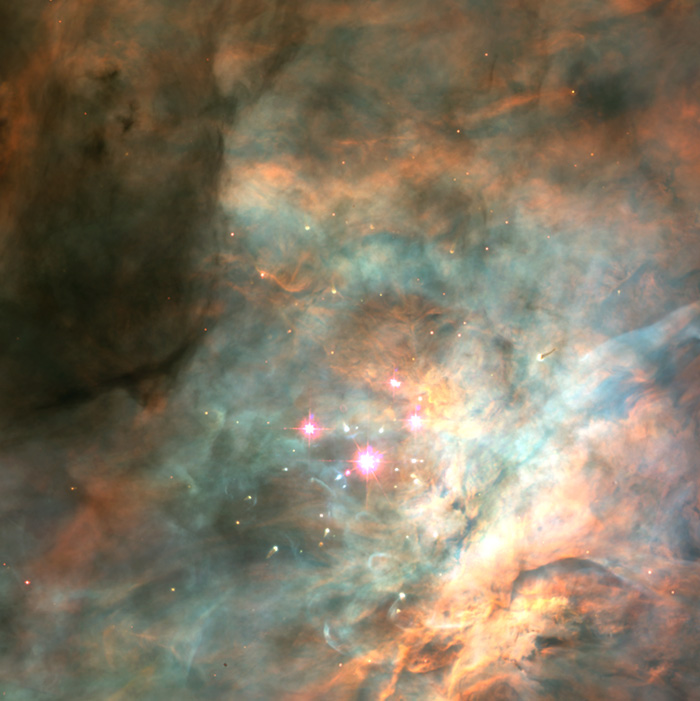
Trapezium Cluster in the Orion Nebula
 Depicts: Trapezium Nebula, the Great Nebula in Orion
Copyright: C.R. O'Dell and S.K. Wong (Rice University) and NASA
Show in archive: true
The brown dwarfs are too dim to be seen in a visible-light image taken by the Hubble
telescope's Wide Field and Planetary Camera 2. This view also doesn't show the
assemblage of infant stars seen in the near-infrared image. That's because the young
stars are embedded in dense clouds of dust and gas. The Hubble telescope's near-infrared
camera, the Near Infrared Camera and Multi-Object Spectrometer, penetrated those clouds to
capture a view of those objects.
Depicts: Trapezium Nebula, the Great Nebula in Orion
Copyright: C.R. O'Dell and S.K. Wong (Rice University) and NASA
Show in archive: true
The brown dwarfs are too dim to be seen in a visible-light image taken by the Hubble
telescope's Wide Field and Planetary Camera 2. This view also doesn't show the
assemblage of infant stars seen in the near-infrared image. That's because the young
stars are embedded in dense clouds of dust and gas. The Hubble telescope's near-infrared
camera, the Near Infrared Camera and Multi-Object Spectrometer, penetrated those clouds to
capture a view of those objects.
Last Update: 1 September 2019