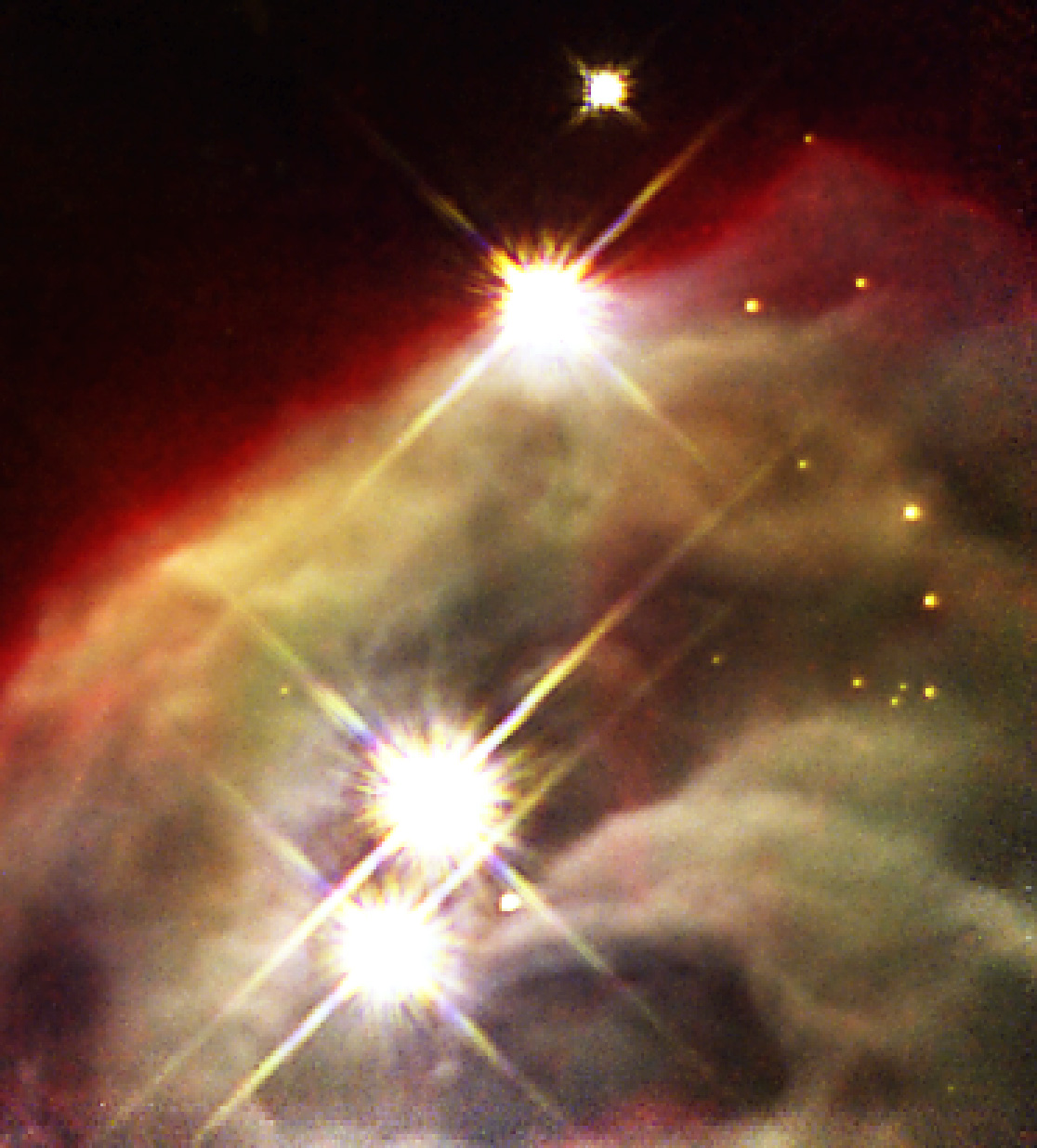
NICMOS uncovers dust layers to show inner region of dusty nebula (NICMOS image)

Depicts: Cone Nebula, NGC 2264
Copyright: NASA, ESA, the NICMOS Group (STScI, ESA) and the NICMOS Science Team (Univ. of Arizona)
This NICMOS image shows the Cone Nebula (NGC 2264), so named because, in ground-based images, it has a conical shape. NICMOS enables the Hubble telescope to see near-infrared wavelengths of light, so that it can penetrate the dust that obscures the nebula's inner regions. However, the Cone is so dense even the near-infrared 'eyes' of NICMOS cannot penetrate all the way through it.
The human eye cannot see infrared light so colours have been assigned to correspond to near-infrared wavelengths. The blue light represents shorter near-infrared wavelengths and the red light corresponds to longer wavelengths.
The NICMOS colour composite image was made by combining photographs taken through J-band, H-band, and Paschen-alpha filters. The NICMOS images were taken on 11 May 2002.