
Engineering
Design requirements
The original Cluster mission had a unique set of design requirements:
- The four spacecraft had to be identical, the first time that ESA had been required to build spacecraft in true series production
- To reach their operational orbits and to maintain the predefined separation distances between the satellites requires large quantities of propellant, more than half the spacecraft's mass
- The mission orbits selected impose eclipse durations of up to four hours, a major design driver for the thermal-control, power and structural subsystems
- The scientific payload required a high degree of electromagnetic cleanliness
Most design elements remain essentially unchanged for the replica Cluster mission, except for those elements directly affected by the change of launch vehicle to two Soyuz rockets.
Key parameters
Spin rate: |
15 rpm |
Spacecraft diameter: |
2.9 m |
Spacecraft height: |
1.3 m |
Dry mass: |
550 kg |
Propellant mass: |
650 kg |
Mass allocated to payload: |
72 kg |
Solar array power: |
224 W |
Silver Cadmium battery capacity: |
80 Ah |
Power allocated to payload: |
47 W |
Telemetry downlink bit rate: |
2 to 262 kbit/s |
Design in Detail
 |
|
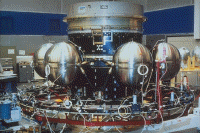
The Cluster central cylinder integrated with the RCS |
The body is cylindrical, optimising the field of view of the experiments, which are accommodated around the rim of the main equipment platform on the upper side of the spacecraft. The spacecraft body is 2.9 m in diameter and 1.3 m high. The height was kept to a minimum to make optimal use of the fairing volume offered by the original launch vehicle.
This compact primary structure provides mass-efficient load paths to its mechanical interfaces. It consists of:
- The central cylinder - a carbon-fibre reinforced plastic (CFRP) skinned honeycomb sandwich
- The main equipment platform - an aluminium-skinned honeycomb panel reinforced by an outer aluminium ring, supported by CFRP struts connected to the central cylinder
- A tank support structure
- A platform internal to the central cylinder
- A Reaction Control System (RCS) support ring
The overall design allows for parallel integration of all equipment with the MEP on one side and the central cylinder with the RCS components on the other.
Six cylindrical titanium propellant tanks with hemispherical ends are each mounted to the central cylinder via four CRFP struts and a boss. 650 g (of the total 1180 kg) of propellant is carried in these tanks.
Six curved solar-array panels together form the outer cylindrical shape of the spacecraft body and are attached to the Main Equipment Platform. The MEP provides the mounting area for most of the spacecraft units, the payload units being accommodated on the upper surface and the subystems, in general, on the lower surface. The five batteries and their associated regulator units that power the spacecraft during eclipse are mounted directly on the central cylinder.
At their lower ends, the solar-array panels support a ring accommodating many of the RCS components, including four radial 10 Newton thrusters. Four axial 10 Newton thrusters are mounted on studs on the upper and lower faces of the spacecraft. All thruster positions were carefully chosen to minimise the chances of contamination to the experiments.
Because the solar-array panels experience extremely low temperatures during eclipse, special care had to be taken in designing their attachments to the structure and the thermal insulation of their inner faces, in order to minimise the on-board heating requirements in eclipse. The inner equipment panel inside the central cylinder supports the single main engine, two high-pressure tanks and associated propellant-management hardware.
 |
|
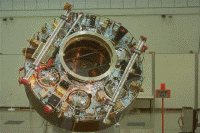
Cluster spacecraft with folded booms |
The central cyclinder carries aluminium interface rings at both its upper and lower ends. The lower ring is compatible with the Ariane 1.194 m diameter adaptor and separation mechanism (unchanged for Soyuz). The upper ring simulates the interface offered by the adaptor and is equipped with a separation mechanism. This allows two spacecraft to be stacked on top of one another, whilst themselves remaining identical to the maximum extent possible.
Two rigid, double-hinged radial booms on the upper surface of the Main Equipment Platform carry payload sensors. These booms are stowed for launch (as can be seen in the picture), as are the four payload wire booms and the two rigid, single-hinged antenna booms carrying the S-band antennas. The rigid booms consist of CFRP tubes with titanium-alloy end fittings and deployment mechanisms. The radial booms will be deployed mainly by the centrifugal force developed by the spinning spacecraft, while the antenna booms are driven by redundant springs.
Data process
The On-Board Data Handling (OBDH) subsystem, which performs the primary spacecraft control functions, is based on an ESA standard approach and remains unchanged from the original Cluster mission. It consists of:
- A Central Data Management Unit (CDMU)
- A Remote Terminal Unit (RTU)
- One Solid-State Recorders (SSR)
The CDMU and RTU are internally redundant; the SSR provides memory for about 5 Gbit of data at beginning of life. The OBDH decodes and distributes commands, received by the telecommunication subsystem at a command bit rate of 2 kbit/s, and acquires and encodes telemetry from payload and subsystem units. This telemetry is delivered either to the telecommunications subsystem for real-time transmission to ground, and/or to the SSR for later transmission. Dedicated high-data-rate interfaces are provided to the Wide-Band Data (WBD) experiment and the SSR. Stored data will be played back at a much higher rate than real-time data, in order to reduce the duration of the downlink during the limited ground-station visibility periods. WBD telemetry will only be transmitted in real-time.
Telemetry-stream bit rates are fixed at about:
- 2 kbit/s for housekeeping telemetry
- 22 kbit/s for nominal science telemetry
- 131 kbit/s for burst science-data/recorder playback
- 262 kbit/s for WBD transmission/recorder playback
The OBDH also provides timing and synchronisation signals to payload and subsystem units, as well as AOCMS data to the payload. It will perform a surveillance function using on-board software to provide the autonomy required because of the extended non-visibility periods.
Telecoms
Communications with the spacecraft are established through the telecommunications subsystem, which includes uplink and downlink capabilities to support the telemetry and tracking functions. It interfaces with the ESA ground segment and the NASA Deep Space Network.
The subsystem includes:
- Three low-gain antennas
- A redundant set of transponders (including a NASA-supplied 10 W RF amplifier)
- An RF distribution unit and associated RF harnesses
Two low-gain antennas are mounted on deployable booms attached to the upper and lower faces of the spacecraft. They ensure full spherical coverage for uplinking and hemispherical coverage for downlinking. A third antenna mounted on the lower side of the spacecraft is used until the in-orbit deployment of the lower antenna boom.
Electrical power
Electrically, the spacecraft is configured in four major functional areas:
- Power-supply subsystem, including a pyrotechnics unit
- On-board data-handling subsystem
- Attitude and orbit control and measurement subsystem
- Telecommunications subsystem.
Dedicated, physically separated and carefully shielded harnesses interconnect the various subsystem and payload units. The payload includes a separate experiment interconnection harness.
Guidance and navigation
Maintenance of the orbit and attitude of the spacecraft is performed by the Attitude and Orbit Control and Measurement Subsystem (AOCMS). Spacecraft attitude and spin data are provided by an internally redundant star mapper and an internally redundant X-beam Sun sensor. The reconstitution of attitude data, such as inertial attitude, spin rate and spin phase, is performed on the ground. This information is essential for the interpretation of the payload science data. The necessary accuracies for these attitude data are comfortably met by the subsystem.
Orbit and attitude maintenance are performed by using control thrusters, both semi-radial and axial, together with the main engine, which are used to perform the large orbital change manoeuvres required to reach the polar mission orbit from geostationary transfer orbit.
Propulsion
The Cluster Reaction Control Subsystem (RCS) is configured as a conventional bi-propellant system, based on a single 400 Newton main engine and eight 10 Newton thrusters. It is arranged in two redundant branches (with the exception of the main engine), each of which is capable of performing a complex mission profile. Electrical cross-coupling permits the operation of either of the two branches from either redundant half of the Attitude Determination and Control Electronics (ADCE).
The propellant is stored in six titanium tanks - three for the nitrogen tetroxide oxidiser (NTO) and three to hold the monomethylhydrazine (MMH) fuel - pressurised by helium which is stored in two smaller spherical tanks. Pressure-regulation and propellant-delivery systems manage the pressurant and propellant conditioning and distribution functions.
During launch, the pressurant, fuel, oxidiser and the manifold will be isolated from each other by pyrotechnically operated valves, to comply with launch-vehicle safety requirements. After each manoeuvre, the main engine and thrusters will also be isolated by additional latching valves, thereby increasing reliability by eliminating potential leak paths.
Thermal control
The passive thermal control of the Cluster spacecraft is based on a low-emissivity concept, insulating the spacecraft from the exterior environment to the extent needed to survive the four hour eclipses in mission orbit, whilst still allowing the internally generated heat to be rejected. The thermal closeout is provided by three types of hardware: low-emissivity double foil shields on the upper and lower surfaces of the spacecraft; multi-layer insulation (MLI) on the top and bottom of the central cylinder, below the RCS ring and around the upper part of the satellite, enclosing the experiments; and thermal insulation of the inner sides of the solar-array panels and of the 400 N main engine. An Optical Surface Reflector (OSR) radiator is integrated into the top surface to allow for the high dissipation of the RF power amplifiers. An External Power Dumper (EPD) radiator located in the upper thermal shield within the central cylinder dissipates excess power generated by the solar arrays. Heaters are used to keep equipment within specified temperature ranges throughout all mission phases, including eclipses. Temperature control is achieved by a combination of thermostats with thermistor surveillance and of thermistor-guided software control.
The thermal design has been optimised for the almost constant solar-aspect-angle (SAA) range (90o< SAA < 96o) that will apply throughout the nominal mission phase. During the orbit transfer manoeuvres, however, the spacecraft may experience a much wider SAA range (65o < SAA < 115o). The heat-rejection concept that has been selected therefore permits the satellite to dissipate heat through either the upper or the lower thermal shield. With these precautions, Cluster can safely withstand the complete range of solar aspect angles that will be encountered.
A heated-environment concept has been chosen for the lower spacecraft compartment, comprising RCS equipment, batteries and battery regulators. The complexity and duration of the assembly and integration activities were greatly reduced by this approach compared to a solution with insulated components, but it requires somewhat more heater power during eclipses.
All external surfaces, including the solar cells, blankets, double foils and radiator will again be finished with an electrically conductive Indium Tin Oxide (ITO) coating to comply with the electrostatic requirements.