
Instruments
Instrument Overview
EXOSAT was the European Space Agency's first three-axis stabilised spacecraft. All three instrument packages were co-aligned, although the individual quadrants of the ME (Medium-energy instrument) could be pointed off-axis to assist in background subtraction.
Together, the three instrument packages gave coverage over a wide energy band pass between 0.05 and 50 keV. The LE (Low-energy imaging telescopes) had the highest sensitivity.
Two LE telescopes (Low-Energy Imaging telescopes)
- double nested Wolter Type 1 grazing-incidence optics
- CMA (Channel-multiplier array) or PSD (position sensitive proportional counter) could be moved into the focus ME
 |
|
Low-energy imaging telescopes (LE): 0.05-2.0 keV . Laboratory for Space Research (Leiden), Space Research Laboratory (Utrecht), Mullard Space Science Laboratory (UCL, London) |
(Medium-Energy instrument)
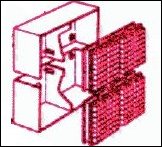
- four independently-movable quadrants, each equipped with two proportional counters
- typically two quadrants on target, while other two offset to observe adjacent areas of empty sky
 |
|
Medium-Energy instrument (ME): 1-20/5-50 keV. University of Leicester, Max Planck Institute (Garching), University of Tubingen |
GSPC (Gas Scintillation Proportional Counter)
- had better spectral resolution than ME, but smaller effective area
 |
|
Gas Scintillation Proportional Counter (GSPC): 2-16/2-32 keV. ESA/SSD, MSSL, Universities of Palermo and Milan. |
The Low Energy Telescope
The two LE telescopes and detectors assemblies were identical. The telescopes consisted of double nested gold coated Wolter type I grazing incidence optics, with a focal length of 1.1 meter and an outer diameter of 0.3 meters. The telescope parameters give a high energy cut-off of ~2 keV.
The on-axis half energy width of the point spread function is 24 arc seconds, which degrades to 4 arc minutes 1 degree off-axis. Vignetting in the telescopes reduces the off-axis effective area to 45 % of its peak value 1 degree off-axis. In the focal plane of each telescope either a CMA, or a PSD detector was interchanged. Also a transmission grating spectrometer (TGS) could be inserted behind each telescope and the dispersed spectrum imaged by each CMA. The gratings were 500 lines mm-1 in one telescope (LE2+CMA2 8-400 Å) and 1000 line mm-1 in the other (LE1+CMA1 8-200 Å) with a spectral resolution of 2 Å and 1 Å respectively for energies > 0.25 keV, and 5 Å at 304 Å in both telescopes.
The CMA detector has no intrinsic energy resolution in the X-ray band, but a number of different filters gave coarse spectral information (analogous to UBV photometry). The choice of filter dictates the energy response with the overall energy window covered by the filter combinations ranging from 0.05 to 2.0 keV. The detection efficiency of the CMA 's decreases of 30% at 0.15 keV to 7% at 1.5 keV. The combined telescope and CMA on-axis effective area is shown in figure as function energy for each filter.
The CMA's are sensitive to ultraviolet photons and this caused contamination by bright O and B stars, pointed or serendipitous, in the field. Filters were used to determine the degree of contamination. The boron filter was free of UV contamination and relatively safe, as was the Al/P, except for very brightest and earliest stars. Also, the sum signal distribution of events in the CMA provided a crude method of differentiating between X-ray and UV sources. The most commonly used filters during the mission were 3000 Lexan , Al/P and boron.
The CMA particle background counting rate was typically 8 X 10⁻⁶ counts-1pixels-2 (a pixel is 4 arcsec) in the central region. The background counting rate depends on the strength of the solar wind. In 90% of the observations the average background counting rate is within a factor of 2 of the quiescent value. The average source detection threshold for a 104 second exposure (a typical minimum observation time) within the central 12 arc minute radius region of the detector, using the 3000 Lexan filter, was 2 X 10⁻³ counts per second. For observations longer than a few thousand seconds the sensitivity of the CMA is background limited. Source positions can be estimated to 6 arc seconds and 8 arcsec error radius at 67% and 90% confidence levels, respectively within the central 12 arc min.
There were a number of notable problems with the instrumentation associated with the LE's. Both PSD's failed early on during the performance verification phase. One of the CMA (CMA2) failed on 1983 October 28. The mechanism to insert the grating behind the other telescope (LE1) failed in 1983 September 15, eliminating this spectroscopic capability. The surviving CMA functioned well until the end of the mission.
The Medium Energy Instrument
The Medium Energy (ME) instrument consisted of an array of eight proportional counter, with a total geometric area of 1600 cm2 and 45 arcmin FWHM field of view, providing spectral and temporal data in the 1-50 keV energy range.
Each proportional counter had two gas chambers separated by a 1.5 mm beryllium window with argon in the top layer and xenon in the lower. Each proportional counter used a multi-wire design with a ∆E/E of 21% (6 keV) FWHM for the argon chambers and ∆E/E of 18% (22 keV) FWHM for the xenon chambers. The argon and xenon spectra were pulse height analysed into 128 channels each, sensitive to 1-20 keV and 5-50 keV energy range respectively.
The ME background was very stable and dominated by particle events from the solar wind and radioactive lines caused by the decay of residual plutonium in the Beryllium windows and detector bodies. The background count rate per detector were in the argon chamber 2.4, 4.3 and 9.4 counts-1 in the energy range 1-6, 1-10 and 1-20 keV, respectively, and 40.6 and 59.1 counts-1 in the xenon chamber in the 10-30 and 10-50 keV energy range, respectively. Occasional background flares occur in both the aligned and offset halves caused by enhancements in the solar wind. A major solar storm typically happened every six months, causing the background to increase by several order of magnitude. The detectors were turned off during these events.
To optimise the background subtraction each half of the ME array detector could be offset from the source, pointing a source-free region of the sky to monitor the particle background. The offset half was alternated every few hours (known as 'array swap'). Since the background obtained from the offset half was slightly different for the half of the detector on source, Difference spectra were created to correct this effect. Background was also obtained using the slew on and/or off the source. This technique was used when the detector halves were coaligned and no array swaps made during the observation.
In 1985 August 20 one of the detectors in half-1 failed. Occasionally because of small detector breakdown and/or reduction in the gain, observations were carried out with one or more detectors off for a few hours.
An important component in the operation of the ME instrument was the usage of the OBC. Depending on the objective of the observation, the OBC programs traded time resolution against spectral information and telemetry load. Two or three ME programs were typically run simultaneously. The table gives an overview of most commonly used ME OBC mode.
| Program | Output | Time resolution | No of PHA Channels | Comment |
| HER4 |
Spectral |
10, 5 or 2.5s |
128 + 128 | det, quad, or half summed over Ar+Xe |
| HER5 | Spectral Intensity |
1s 0.31s |
selectable | only half summed over Ar |
| PULS | Spectral | fold over period | selectable | for fast pulsars |
| HTR3 | Intensity | 4,8 or 16ms | Ar and/or Xe | low OBC usage |
| HTR4 | Intensity | 0.25ms | 1 | selectable channel |
| HER6 | Intensity | typically 4ms | 1 or 2 | selectable channel |
| HER7 | Intensity | typically 4ms | 1, 2 or 4 | selectable channel |
The Gas Scintillation Proportional Counter
The gas scintillation proportional counter, GSPC, on EXOSAT has a deltaE/E of 4.5(E/6 keV)-0.5 % FWHM, (a factor of 2 better than the ME experiment) with a peak effective area of ~100 cm2. The energy spectra were pulse height analysed into 256 channels.
Three different electronic gain modes were used: gain 1 = 2-32 keV, gain 2 = 2-16 keV and gain 0.5 = 2-64 keV. The latter was only used on the very bright source Sco X-1. Variations in the intrinsic detector gain caused by temperature variations were removed using two background line features at 10.54 and 12.70 keV caused by fluorescence in the lead collimator and the radioactive decay of residual plutonium in the beryllium window. In addition a Xenon L feature at 4.78 keV could also be used for bright sources to calibrate the gain.
The particle background rejection used burst length discrimination, which rejects events which have exceptionally long or short duration. The background shape spectrum remains constant during the short timescale variations, but shows small changes on longer timescales. The standard OBC mode used in the GSPC gives 256 channel spectra every 8 seconds. Higher time resolution was used only for bright sources and if the telemetry needs of the other experiments was low. The GSPC worked perfectly for the entire mission.