
Summary
About the mission
BepiColombo, an ESA mission being conducted in cooperation with Japan, will explore Mercury, the planet closest to the Sun. Europe's space scientists have identified the mission as one of the most challenging long-term planetary projects, because Mercury's proximity to the Sun makes it difficult for a spacecraft to reach the planet and to survive in the harsh environment found there. The scientific interest in going to Mercury lies in the valuable information that such a mission can provide to enhance our understanding of the planet itself as well as the formation of our Solar System; information which cannot be obtained with observations made from Earth.
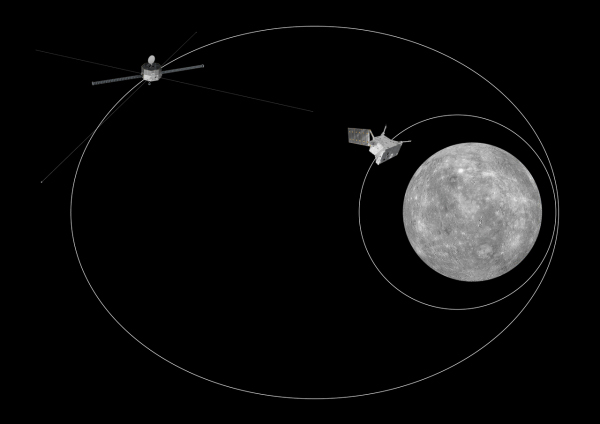 |
| BepiColombo spacecraft in orbit around Mercury. Credit: ESA/ATG medialab |
Mysterious Mercury – key to understanding Solar System formation
Mercury is a poorly explored planet. So far, only two spacecraft have visited the planet: NASA's Mariner 10, which flew past three times in 1974–5 and returned the first close-up images of the planet, and NASA's MESSENGER spacecraft, which performed three flybys (two in 2008 and one in 2009) and then studied the planet from orbit between March 2011 and April 2015. The information obtained when BepiColombo arrives will throw light not only on the composition and history of Mercury, but also on the history and formation of the inner planets in general, including Earth.
Two spacecraft to provide a comprehensive view of the smallest planet
BepiColombo's science mission consists of two separate spacecraft that will orbit the planet. ESA has built one of the main spacecraft, the Mercury Planetary Orbiter (MPO), and the Institute of Space and Astronautical Science (ISAS) at the Japan Aerospace Exploration Agency (JAXA) has contributed the other, the Mercury Magnetospheric Orbiter (also referred to as Mio).
The MPO will study the surface and internal composition of the planet, and Mio will study Mercury's magnetosphere, that is, the region of space around the planet that is influenced by its magnetic field.
For launch and the journey to Mercury, the MPO and Mio are carried as part of the Mercury Composite Spacecraft (MCS). The MCS comprises, in addition to the two orbiters, the Mercury Transfer Module (MTM), which provides solar-electric propulsion and all services not required in Mercury orbit, and the Magnetospheric Orbiter Sunshield and Interface Structure (MOSIF), which provides thermal protection and the mechanical and electrical interfaces for Mio. ESA built the MTM and the MOSIF. Shortly before Mercury orbit insertion, the MTM is jettisoned from the spacecraft stack. The MPO provides Mio with the necessary resources and services until it is delivered into its mission orbit, when control is assumed by JAXA.
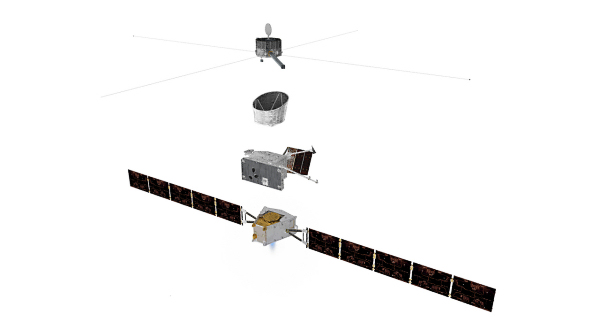 |
| Elements of the BepiColombo Mercury Composite Spacecraft. From bottom to top: the Mercury Transfer Module (MTM), Mercury Planetary Orbiter (MPO), Magnetospheric Orbiter Sunshield and Interface Structure (MOSIF), and Mercury Magnetospheric Orbiter (Mio). The spacecraft are shown with solar arrays and instruments deployed. Credit: ESA/ATG medialab |
Technological challenges
With two spacecraft, BepiColombo is a large and costly mission, one of the 'cornerstones' in ESA's long-term science programme. The mission presents enormous, but exciting challenges. All of ESA's previous interplanetary missions have been to relatively cold parts of the Solar System. BepiColombo is the Agency's first experience of sending a spacecraft to a region even hotter than Venus.
The way the journey from Earth to Mercury is being carried out is also a first. After launch into Earth-escape orbit, the MCS underwent a near-Earth commissioning phase. Leaving Earth on its way to Mercury, the spacecraft must decelerate against the Sun's gravitational attraction, which increases as it approaches the Sun. This is in contrast to accelerating away from the Sun, as is the case with journeys to the outer Solar System. In addition, the spacecraft orbital plane shall be changed to that of Mercury. BepiColombo will accomplish this deceleration and plane change by making clever use of the gravity of the Earth, Venus and Mercury itself, and by using solar-electric propulsion (SEP). ESA's technology mission, SMART-1, has demonstrated this innovative combination of low-thrust space propulsion and gravity assist.
When approaching Mercury, the spacecraft will use the planet's gravity in combination with conventional bipropellant thrusters to insert itself into a polar orbit. A special 'weak stability boundary' capture technique will be employed. This gives flexibility and is more robust against failures when compared to using the more traditional 'big kick', or single-burn capture, approach. Mio will be released into its operational orbit, then the MOSIF will separate and the chemical propulsion system will bring the MPO to its lower orbit. Observations from orbit are scheduled to last for one Earth year, with a possible one-year extension.
Who was Giuseppe (Bepi) Colombo?
 |
|
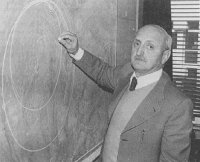
Giuseppe (Bepi) Colombo |
Giuseppe (Bepi) Colombo (1920-1984) was a mathematician and engineer of astonishing imagination, whose bald head and grey moustache were familiar in the corridors of both ESA and NASA. Apart from his work on Mercury, Colombo invented tethers for linking satellites together. As one of the initiators of ESA's mission to Halley's Comet he suggested its name, Giotto, but he died before that project was accomplished. At the University of Padua his work continues in CISAS, the Centro Interdipartimentale di Studi ed Attività Spaziali "G. Colombo".
At the meeting in Naples (20-23 September 1999), the European Space Agency's Science Programme Committee recognised the achievements of the late Giuseppe Colombo of the University of Padua by adopting his name for the Mercury project which was then under consideration. Almost everything known until now about the planet Mercury comes from three passes by NASA's Mariner 10 in 1974-75, which were inspired by Colombo's calculations. He suggested how to put that spacecraft into an orbit that would bring it back repeatedly to Mercury. The Italian scientist also explained, as an unsuspected resonance, Mercury's peculiar habit of rotating three times in every two revolutions of the Sun.
The mission to Mercury, now named after Professor Colombo, is one of ESA's science programme's 'Cornerstones'. In the course of the comprehensive Horizon 2000 Plus review of the programme in 1994, it was identified by Europe's space scientists as one of the most challenging long-term planetary projects. Mercury is the least known of the inner planets. Its orbit close to the Sun makes it difficult to observe from a distance and hard to reach by space flight. As a result, big questions raised by the Mariner 10 flybys of a quarter of a century ago remain unanswered.
"I am very pleased we have given the name of BepiColombo to our Mercury Cornerstone. Bepi was a great scientist, a great European and a great friend; we could do no better than name one of our most challenging and imaginative missions after him," said Roger Bonnet, Director of ESA Science Programme (1983 - 2001).
In 1985 to commemorate this great scientist, ESA created a 'Colombo fellowship' to be granted to European scientists working in the fields of science explored by G. Colombo.

