
Orbit/Navigation
Herschel was carried into space on 14 May 2009, at 13:12:02 UTC, by an Ariane 5 ECA launcher, from the Guiana Space Centre, Kourou, French Guiana. Herschel was launched together with ESA's Planck spacecraft.
Within 30 minutes after launch, and about two minutes from each other, the two spacecraft were released and each placed on their individual escape trajectory toward L2. Upon separation, Herschel was three-axis stabilised.
The next day, 15 May 2009, a trajectory control manoeuvre (TCM) was performed as planned to fine-tune Herschel's trajectory.
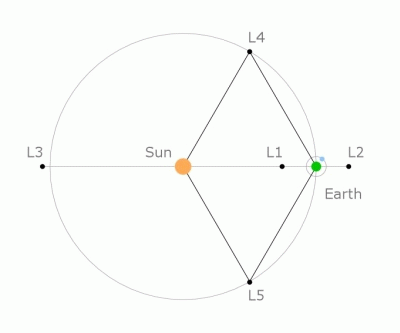
The Herschel spacecraft took about sixty days to reach its orbit around L2, the second Lagrange point of the Sun-Earth system, 1.5 million kilometres away from the Earth in the anti-Sun direction.
 |
|
Location of L2 (not to scale) |
At L2, Herschel entered a large Lissajous orbit about the Lagrange point. Lissajous orbits are the natural motion of a satellite around a collinear libration point in a two-body system and require less momentum change to be expended for station keeping than halo orbits, where the satellite follows a simple circular or elliptical path about the libration point.
Herschel's orbit around L2 has an average amplitude of about 700 000 km, and a period of about 178 days. The chosen orbit takes Herschel about 500 000 kilometres above and below the plane of the ecliptic with a maximum azimuthal excursion of around 800 000 kilometres either side of the Lagrange point. The Earth to spacecraft distance varies from approximately 1.2 to 1.8 million kilometres. No insertion manoeuvre is needed to achieve this orbit.
Orbits about L2 are dynamically unstable; small departures from equilibrium grow exponentially with a time constant of about 23 days. Herschel will use its propulsion system to perform orbit maintenance manoeuvres roughly once each month.
Why L2?
The Sun, Earth and Moon are intense sources of both straylight and thermal modulation, and reducing their effects drove the choice of orbit for Herschel. Near Earth orbits were eliminated mainly because the large thermal influx would render it extremely difficult to reach temperatures below 100 K in the spacecraft's focal plane, or to achieve the required thermal stability. The nearest far-Earth orbit possible would have been that around one of the Lagrange points of the Earth-Moon system; such an orbit however (which shares the Lunar motion around the Earth) suffers from the fact that the Earth or the Moon are often not very far from the telescope line-of-sight.
The optimal choice of orbit for Herschel, resulting from a trade-off of the various payload requirements, several spacecraft technical constraints (most importantly related to telecommunications to ground), and the transfer-to-orbit cost, is a Lissajous orbit around the L2 Lagrange point of the Sun-Earth system. At this location the Sun, the Earth, and the Moon are all easily shielded from the payload.