Cluster discovers internal origin of the plasma sheet oscillations
23 June 2004
The plasma sheet oscillations have their source localized in the magnetotail centre and their excitation might be linked to the substorm process, according to a statistical study based on Cluster data. Published 06 March 2004, in Geophysical Research Letters, this study presents observational evidence not explained by any previous theoretical model and has triggered a burst of numerical modeling activity.
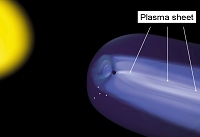 |
|
Animation 1: Full orbit of the Cluster space fleet over a simulated Earth's magnetosphere responding to the Sun's activity (Copyright: ESA) |
[NB: Hereafter in this article, no distinction will be made between plasma sheet and current sheet].
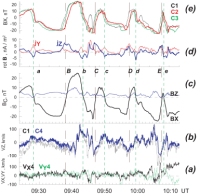
Rapid large-amplitude magnetic variations (Image 1) are frequently observed in the centre of the magnetotail. These variations indicate up and down (north-south) oscillating current sheet motions, known as current sheet flapping motions. Two possible origins of these motions have been proposed in the past: external (inhomogeneous solar wind) or internal (large-scale wave, emitted in the current sheet and/or propagating in the tail).
 |
|
Image 1: Overview of Cluster observations on 20 October 2001, including: Ion plasma flows from CIS-CODIF (a, b) ; Bx-components at spacecraft C1, C2 and C3 (e) ; Magnetic field x- and z- component computed at the Cluster baricenter (c) ; |
 xB estimates by curlometer technique (panel d, only samples with
 "Previous studies [...] suggested that substorms* play some role in the excitation of the flapping waves", reminds Prof. Victor Sergeev, lead author on this research, performed in close collaboration with the Space Research Institute /Austrian Academy of Sciences, Graz, and the Centre d'Etude Spatiale des Rayonnements (CNRS/Université Paul Sabatier), Toulouse, published 06 March 2004, in Geophysical Research Letters.
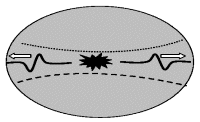
"This new finding not only supports this view, it also provides some constraints to the (yet) unknown mechanisms which destabilize the tail sheet in the substorm process and launch the kink waves", he added. (Image 2).
 |
|
Image 2: Interpretation scheme of kink waves launched during a substorm process (courtesy of Prof. V. Sergeev). |
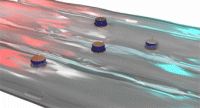
This new result is far from being the only one found by Cluster in the Earth's magnetotail. In particular, Cluster has provided the first observational evidence of a very thin current sheet (few thermal ion gyroradii) [Nakamura et al., 2002], at times split into two layers, also called bifurcated current sheets [Runov et al., 2003]. In the latter case study, the two current sheets were also vertically flapping in the north-south direction.
"Finding bifurcated current sheets (BCSs) in the Earth's magnetotail and the detailed description of their 3D spatial structure and flapping motions has become one of the most significant accomplishments of the unique four-spacecraft Cluster mission", underlined Dr. Mikhail Sitnov in a recent paper, published 8 May 2004 in Geophysical Research Letters.
 |
|
Image 3: 3D numerical simulation of the 4 Cluster satellites embedded in the flapping motion of the current sheet (courtesy of Dr. J. Buechner, Max Planck Institut für Aeronomie, Katlenburg-Lindau, Germany). |
* Substorms: violent reconfigurations of the Earth's magnetic tail which, by change in the magnetic topology, convert magnetic energy to energize ions and electrons, inject some of them into the ring current, and greatly increase the rate at which energy is released in the magnetosphere.
Sergeev, V., A. Runov, W. Baumjohann, R. Nakamura, T.L. Zhang, A. Balogh, P. Louarn, J.-A. Sauvaud, and H. Rème (2004), Orientation and propagation of current sheet oscillations, Geophys. Res. Lett., 31, L05807, doi:10.1029/2003GL019346, 2004.
Related articles
Nakamura, R., W. Baumjohann, A. Runov, M. Volwerk, T.L. Zhang, B. Klecker, Y. Bogdanova, A. Roux, A. Balogh, H. Rème, J.A. Sauvaud, H.U. Frey: Fast Flow during current sheet thinning. Geophys. Res. Lett., 29, 2140, doi:10.1029/2002GL016200, 2002
Runov, A., R. Nakamura, W. Baumjohann, T. L. Zhang, M. Volwerk, and H.-U. Eichelberger (2003), Cluster observation of a bifurcated current sheet, Geophys. Res. Lett., 30(2), 1036, doi:10.1029/2002GL016136, 2003.
Sitnov, M. I., M. Swisdak, J. F. Drake, and P.N. Guzdar (2004), A model of the bifurcated current sheet: 2. Flapping motions, Geophys. Res. Lett., 31, L09805, doi:10.1029/2004GL019473, 2004.
Contact
Victor Sergeev, Faculty of Physics, St Petersburg State University,St Petersburg, Russia
Tel +7-(812)-428-4633
Web story author
Arnaud Masson, SCI-SH division, RSSD, ESA, The NetherlandsTel: +31-71-565-5634
Web story editor
Philippe Escoubet, SCI-SH division RSSD, ESA, The NetherlandsTel: +31-71-565-3454