
Cosmology
Olbers Paradox
Isaac Newton believed gravity demands that the Universe be without a centre or an edge, and of infinite extent in all directions. According to Newton, a finite and bound Universe would 'fall down into the middle of the whole space, and there compose one great spherical mass'. In an infinite Universe, he believed, 'the fixed stars, being equally spread out in all points of the heavens, cancel out their mutual pulls by opposite attractions.'
Olbers' paradox
The Universe as Newton saw it gave rise to a paradox, known as Olbers' paradox after Heinrich Olbers, who raised the issue in 1823. He deduced that in an infinite Universe of infinite age, there would be an infinite number of stars. If you were, therefore, to look in any direction in the sky, your line of sight would eventually hit on a star's surface. Since every direction would lead to a star, and given the absolute luminosity of a star and the inverse square law for the dimming of light with distance, the night sky would be infinitely bright. Olbers' paradox asks the question "why is the night sky dark?"
Solutions to Olbers' paradox
The German astronomer Johannes Kepler had first pondered the problem of the dark night sky in 1610, and came up with his own solution to it: that the Universe of stars extends only to a finite distance, beyond which the viewer encountered only empty space. Of course, this solution prompts the questions: how far away is the boundary and what lies beyond it?
Olbers himself suggested that starlight is gradually absorbed while travelling through space, and that this cuts off the light from any stars beyond a certain distance. This does not, however, solve the problem, because any absorbing gas or dust would simply heat up until the starlight it had absorbed would be reradiated. Ultimately, the energy we would detect as light from Earth would be the same.
It was the American poet Edgar Allan Poe who came up with one of the first scientifically reasonable solutions to the paradox. He suggested that the Universe is not old enough to fill the night sky with light. He reasoned that while the Universe may be infinite in size, there has not been enough time since it first came into being for starlight to reach us from the farthest corners of space.
Astronomers now conclude that the Universe began some 12-15 billion years ago. We are, however, only seeing the part of it that lies within 12-15 billion light years from us, with the rest of the stars beyond our sight. The number of stars whose light reaches us is not enough to fill the sky with light. In addition, astronomers now argue that while the Universe is infinite, there are a finite number of stars filling it, and the expansion of the Universe explains the lack of absolute starlight in the night sky.
Redshift
Early in the 20th century, astronomers noticed that features in spectra from distant galaxies were shifted towards the red end of the spectrum. The degree of redshift is related to the velocity of recession, or how fast away from us the galaxy is moving. In 1929 astronomer Edwin Hubble produced a paper that plotted the relationship between the velocity of recession and the distance.
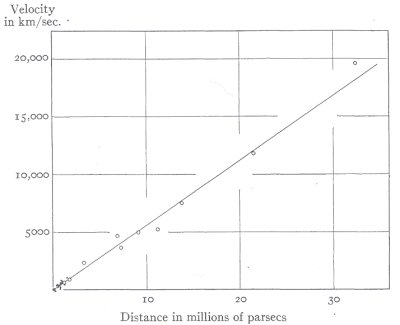 |
Figure 4.1: Recreation of Hubble's Original Data
The gradient of the plot can be expressed as shown below:
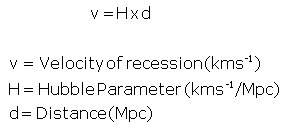 |
The Hubble Parameter has the effective unit of 1/Time, which means that determining the value of the Hubble Parameter will give the age of the Universe. The current value is:
|
|

Hubble's observations suggested that the farther away the galaxy the faster the recession. This phenomenon is described as the Doppler redshift. It is similar to the effect that makes a car sound lower-pitched as it travels away from you. A similar effect applies to light as well, so that if an astronomical object is travelling away from the Earth, its light will be shifted to longer, red wavelengths.
It is this Doppler red shift in the spectra of distant galaxies that leads scientists to conclude that the Universe is expanding.
Big Bang
In 1948, Russian-born physicist George Gamow came up with the idea that if all galaxies are travelling away from each other at high speed, there must have been a point way back in the past when the entire Universe was concentrated in a single point. The term "the Big Bang" was originally coined in order to disparage this theory, but inevitably the phrase has entered our vocabulary as a description of the creation event, when space and time originated.
The Big Bang model proposes that around 12 to 15 billion years ago the mass of the Universe was contained in an infinitely small volume. Some unknown mechanism caused this volume to expand rapidly and form the Universe we see today. The very early Universe (fractions of a second after the initial event) was extremely hot, whereas the Universe we live in today has cooled to just a few degrees above absolute zero.
One of the hardest concepts to grasp is that the Universe is everything that there is, all the matter and energy, and dimensions. There is no 'outer edge' to the Universe, and it is not expanding into a void. This is because the dimensions that we normally use here on Earth (three spatial and one time) are not valid when we consider the Universe.
Cosmic Microwave Background
According to the Big Bang theory, the early Universe was an extremely hot place, which has been expanding ever since, as the gas within it cools. Scientists in the late 1940s and 1950s started to realise that if this were true, the Universe should be filled with radiation that the remnant heat left over from the Big Bang. This relic radiation is known as the Cosmic Microwave Background (CMB).
The discovery of the existence of the Cosmic Microwave Background was the result of a happy accident. Two scientists at the Bell Laboratories in the US, Arno Penzias and Robert Wilson, were using a 6 metre microwave horn antenna to calibrate radio sources. The antenna had originally been designed to communicate with satellites and, by chance, operated in a very narrow band. Through all their observations, and those of previous operators, a consistent offset in the temperature of the system of 3.3 K was observed. They had no idea of the cause and spent the best part of a year investigating the problem – including the removal of a couple of nesting pigeons!
They discussed the problem with leading scientist Robert Dicke then at Princeton University. He, along with a number of other scientists, had embarked on a programme to search for background emission at 10K using highly sophisticated equipment. The group realised the nature of the emission and that it represented an afterglow of the Big Bang. Penzias and Wilson received the Nobel Prize for physics in 1978 for their findings.
A Uniform Background
One of the basic tenets of the Big Bang model is that the Universe is expanding, which automatically implies that it was smaller, denser and hotter in the past. Thus, if we know how old the Universe is and its expansion rate, we can also estimate what its current thermodynamic temperature must be, and consequently its radiation frequency. Scientists have calculated that the expansion of the Universe has led to a background radiation of a temperature of 2.73 K, which falls into the microwave region of the temperature spectrum.
Human eyes cannot see the microwaves from the CMB, although detectors such as those to be carried by ESA's Planck mission is able to detect them. CMB is the farthest and oldest light that any telescope can detect.
Open, Flat or Closed?
The shape of the Universe is finely balanced between two forces:
- a) the momentum of expansion and
b) the pull of gravity
The strength of this gravity depends on the density and pressure of the matter contained within the Universe. The ultimate fate of the Universe, therefore, depends on how much mass it contains.
If there is sufficient mass, then the gravity of the material will inevitably stop the expansion of the Universe, causing it to eventually collapse in on itself. This is referred to as a 'closed' Universe.
When scientists refer to an open Universe, this refers to the prospect of there not being sufficient mass to stop its expansion, which will continue forever.
Finally, a 'flat' Universe is one in which there is exactly the right amount of mass to stop expanding at some point in the future, but not enough to cause a contraction. Many scientists view this as an aesthetically pleasing solution.
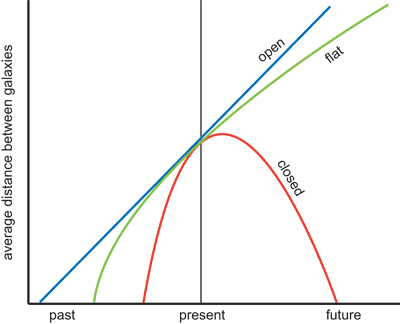 |
Figure 4.2: The Different Fates of the Universe Depending on Critical Density
Critical Density
The critical density is the minimum density that ensures that the Universe could not expand forever, but will not collapse back on itself either. The value of critical density is defined as:
 |
The derived value of critical density is, therefore, dependent on the Hubble Constant. The greater the accuracy of H the more precise the value for ρc.
Another useful equation relates to the matter density parameter, Ω , the critical value of which is defined as
 |
where ρ is the observed density of the Universe and ρc the critical density. The fate of the Universe can then be defined in terms of Ω.
- Ω < 1 »»» open universe
Ω = 1 »»» flat universe
Ω > 1 »»» closed universe
Dark Matter
It is small wonder that cosmologists are fascinated by the opportunities that exist to determine the critical density of the Universe. Scientists already have a good measure of the likely mass of the Universe from their observations of other galaxies. However, the gravity that can be measured indicates that the likely mass in the Universe is quite different.
Scientists are seeking to solve this dilemma by looking at other aspects of our Universe for clues as to its actual mass, and the density of this mass.
One of the aspects currently being studied is dark matter. Scientists have been accumulating evidence that there is a form of matter in the Universe that cannot be seen, and is not made up of ordinary material in the form of protons, neutrons and electrons (which is known as 'baryonic matter'). They have come to this realisation after estimating the mass of distant galaxies by measuring the speed of their rotation. They found that their estimates of the mass of these galaxies, including our own, are roughly ten times larger than can be explained purely by the presence of stars, gas and dust. Consequently, they argue, there must be something else present, and they have given it the name 'dark matter'.
When trying to understand the nature of this dark matter, scientists have come up with a number of possible explanations. One of these relates to objects that have been nicknamed MACHOs (MAssive Compact Halo Objects). These are objects that have a mass that is less than one twentieth of our Sun, and which consequently shine only dimly. They are not luminous enough to be directly detectable by our telescopes. Scientists think they may be responsible for gravitational lensing, the bending of light predicted by Einstein's theory of general relativity.
Scientists also speculate that new forces or new types of particles could make up much of the dark matter. They have called these particles WIMPs, or Weakly Interacting Massive Particles, which could have been produced shortly after the Big Bang.