
Formation Flying
 |
|
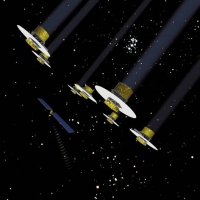
Artist's impression of a formation flying space interferometer |
Autonomous Formation Flight is intended to allow satellites to fly in formation using advanced positioning and control loop technology. Multiple spacecraft configurations enable the formation to reconfigure, adapt baselines and acquire targets. Moreover, in case of failure of one satellite, it is easier to replace one of the spacecrafts during the mission instead of repairing a subsystem of a big assembly in space.
By now, ESA is implementing or assessing several space missions involving formation flight aspects:
| Mission Name |
Mass [kg] |
Projected launch year |
| LISA Pathfinder |
470 |
2008 |
| SWARM |
1000 |
2009 |
| PROBA-3 |
150 |
2009 |
| MAX |
200 |
2010 |
| XEUS |
tbd |
2015+ |
| NIRI (DARWIN) |
500 |
2015+ |
Last Update: 1 September 2019