• → European Space Agency

    • About Science & Technology

    • For Public

    • For Educators

    • ESA

    • Science & Technology

    • Cosmic Vision

    • Missions
    • Show All Missions
    • Cosmic Vision 2015‑2025
    • Cosmic Vision
    • Candidate Missions
    • M-class Timeline
    • L-class Timeline
    • The four themes
    • Planets and Life
    • The Solar System
    • Fundamental Laws
    • The Universe
    • S-class mission
    • CHEOPS
    • M-class missions
    • Euclid
    • Solar Orbiter
    • M-class candidates
    • EChO
    • LOFT
    • MarcoPolo-R
    • PLATO
    • STE-QUEST
    • L-class mission
    • JUICE
    • Mission of opportunity
    • SPICA
    • Previous candidate missions
    • ATHENA
    • Cross-Scale
    • EJSM-Laplace
    • IXO
    • LISA
    • Marco Polo
    • NGO
    • TandEM/TSSM
    • Resources
    • News Archive
    • Announcement Archive
    • Multimedia Gallery
    • Publication Archive
    • Calendar of Events
    • Services
    • Contact Us
    • Subscribe
    • Terms and Conditions
    • Bookmark and Share

    Cosmic Vision: Space Science for Europe 2015-2025

    Publication date: 15 Oct 2005

    Journal: ESA Brochure
    Volume: BR-247
    Page: pp. 1-111
    Year: 2005

    Copyright: ESA
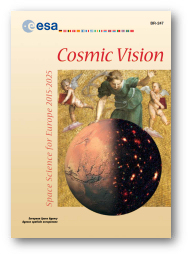
    Ten to twenty years from now, a succession of clever new spacecraft will need to be ready to fly in ESA's continuing Science Programme, now called Cosmic Vision. They will tackle some of the big scientific questions that are high on the agenda of research across Europe (and, indeed, worldwide) concerning the Universe and our place in it:

    • what are the conditions for planet formation and the emergence of life?
    • how does the Solar System work?
    • what are the fundamental physical laws of the Universe?
    • how did the Universe originate and what is it made of?

    This brochure gives a detailed overview of the Cosmic Vision 2015-2025 plan. The opportunities under the above four main headings are presented, and specific aspects of each general theme that are judged to be especially ripe for investigation by new space tools in the period 2015-2025 are identified. A review of the technology that will have to be developed is given.

    The presented planning on behalf of the scientific community and aerospace industry takes into account the Science Directorate's preliminary reckoning of the practical constraints of technology. In the section 'Proposed Strategies and Their Implementation', the outcome of these deliberations is summarised in four tables that correspond to the above four key questions.

    Link to Publication

    Last Update: 19 Mar 2013

    • Shortcut URL
    • http://sci.esa.int/CVplan

    Connect with us

    • RSS
    • Youtube
    • Twitter
    • Flickr
    • Google Buzz
    • Livestream
    • Subscribe
    • App Store
    • ESA Science Twitter

    Follow ESA science

    • Copyright 2000 - 2013 © European Space Agency. All rights reserved.

    • Terms and Conditions