
Herschel's sneak preview: PACS images of M51
19 June 2009
On 14 June 2009, precisely one month after launch, Herschel opened its eyes as the cryocover, the cryostat lid, was commanded to open. The images obtained by the PACS instrument during the remainder of the operational day (14-15 June) are shown below.In addition to providing a tantalising hint of the capabilities of Herschel, these test observations have also provided some preliminary and very encouraging qualitative assessments of the optical performance of the telescope. For more information about the test observations and the images please see the report "Herschel's sneak preview: a glimpse of things to come" by Göran Pilbratt (Herschel Project Scientist) and Albrecht Poglitsch (PACS Principal Investigator).
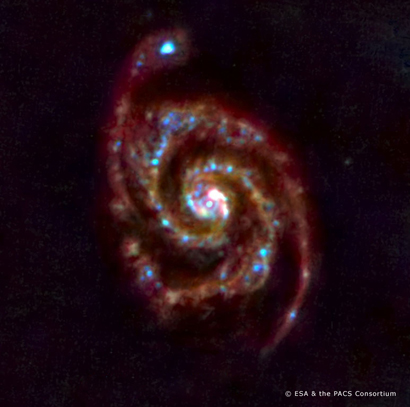
Herschel's test view of M51 | |
 | |
|
A three-colour far-infrared image of M51, the ‘whirlpool galaxy’. Red, green and blue correspond to the 160-micron, 100-micron and 70-micron wavelength bands of the Herschel’s Photoconductor Array Camera and Spectrometer, PACS. Glowing light from clouds of dust and gas around and between the stars is visible clearly. These clouds are a reservoir of raw material for ongoing star formation in this galaxy. Blue indicates regions of warm dust that is heated by young stars, while the colder dust shows up in red. Credit: ESA and the PACS Consortium. | |
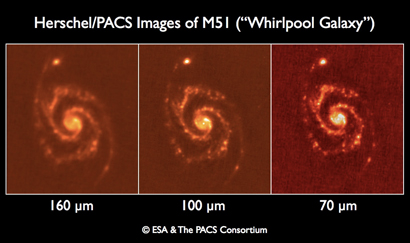
M51 Herschel image at 160, 100 and 70 micron | |
 | |
|
Far-infrared image of M 51, the 'whirlpool galaxy' at three different wavelengths (160, 100 and 70 microns), taken by the Herschel Photoconductor Array Camera and Spectrometer, PACS. Credits: ESA and the PACS Consortium | |
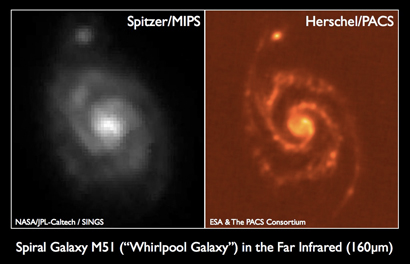
M51 seen by Spitzer (left) and Herschel (right) | |
 | |
|
Comparison of M51 imaged with the Spitzer Space Telescope (left panel) and an image of the same galaxy taken with the Herschel Space Observatory (right panel), launched just a month ago. The obvious advantage of the larger size of the telescope is clearly reflected in the much higher resolution of the image: Herschel reveals structures that cannot be discerned in the Spitzer image. Both images were taken at the wavelength of 160 microns. Credits: Left panel: NASA/JPL-Caltech/SINGS, Right panel: ESA and the PACS Consortium | |