
XMM-Newton weighs up a rare white dwarf and finds it to be a heavyweight
4 September 2009
XMM-Newton observations of the X-ray pulsator RX J0648.0-4418, timed to also cover the phase when the source was expected to be eclipsed by its companion, have resulted in a solid, model-independent mass estimation of this object. It appears to be a rare, ultra-massive white dwarf, whose continued study promises to provide sensitive tests for stellar evolution theories. Sandro Mereghetti and colleagues present these results in the 4 September issue of Science.The X-ray pulsator RX J0648.0-4418 and the subdwarf star HD49798 form a binary system with unique properties. The subdwarf star is a bright object in the optical and UV bands, and is well characterized. The orbital period of the system is accurately known, and the discovery in 1996 of a 13.2 s periodicity in X-rays made it clear that the companion must be either a neutron star or a white dwarf.
Binary systems are key test cases for stellar evolution models
Binary systems can be considered as a kind of astrophysical laboratory. Measuring the orbital motion of the two objects in the system allows one to derive information about the mass of the objects themselves in a model-independent manner which is based solely on the application of Kepler's laws, and which does not rely on any assumptions about the state, dimensions, or evolution of the system. This sort of measurement provides astrophysicists with an independent piece of data that can be used to constrain stellar evolution models.
Often though, only information about one of the objects in the system (usually the brighter one) is known. This can be used to derive the mass function of the system, a combination of the two masses and the inclination of the orbital plane with respect to the line of sight.
When similar information about the other object can be obtained, either spectroscopically or by measuring the time delays in the pulsations induced by the orbital motion, then the two masses can be calculated - if a good estimation of the inclination can be obtained. The latter can be constrained quite accurately if one of the objects is periodically eclipsed by the other.
A model-independent mass estimate points to a rare, massive white dwarf
 |
|
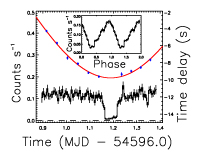
The XMM-Newton X-ray light curve of RX J0648.0-4418 showing the eclipse. |
This is exactly what Mereghetti and colleagues have managed to do. By making use of recent XMM-Newton observations timed to coincide with the expected eclipse of the X-ray source, the authors have been able to accurately determine the mass function of the X-ray source, and obtain a well constrained estimate of the inclination of the orbital plane.
Armed with these data, and applying them to the equation of orbital motion, they were able to conclude that the X-ray source is a rare, ultra-massive (at least 1.2 solar masses) white dwarf. This makes RX J0648.0-4418 one of the most massive white dwarfs known to date.
Important implications for studies of stellar evolution
It is not clear how such a system has formed, but it seems clear that RX J0648.0-4418 is accreting matter from its companion, and that this may eventually push the mass of RX J0648.0-4418 to exceed the Chandrasekhar limit and possibly explode as a supernova of Type Ia. This hypothesis has wide-ranging repercussions in astrophysics, because it suggests that this might be another evolutionary path for Type Ia supernovae.
The demonstration that this unique binary system consists of a fast-spinning, ultra-massive white dwarf in a nearby binary system (it is at a distance of 650 parsecs) which therefore can be studied in detail, provides astrophysicists with another important test bench to use in developing models of stellar evolution.
Editor’s note: Sandro Mereghetti will present these results on 8 September at the scientific conference X-ray Astronomy 2009 - Present status, multi-wavelength approach and future perspectives in Bologna, Italy.
Related publication
Mereghetti, S., Tiengo, A., Esposito P., La Palombara N. Israel G.L., Stella L., "An ultra-massive fast-spinning white dwarf in a peculiar binary system", Science, 4 September issue, 2009. DOI: 10.1126/science.1176252