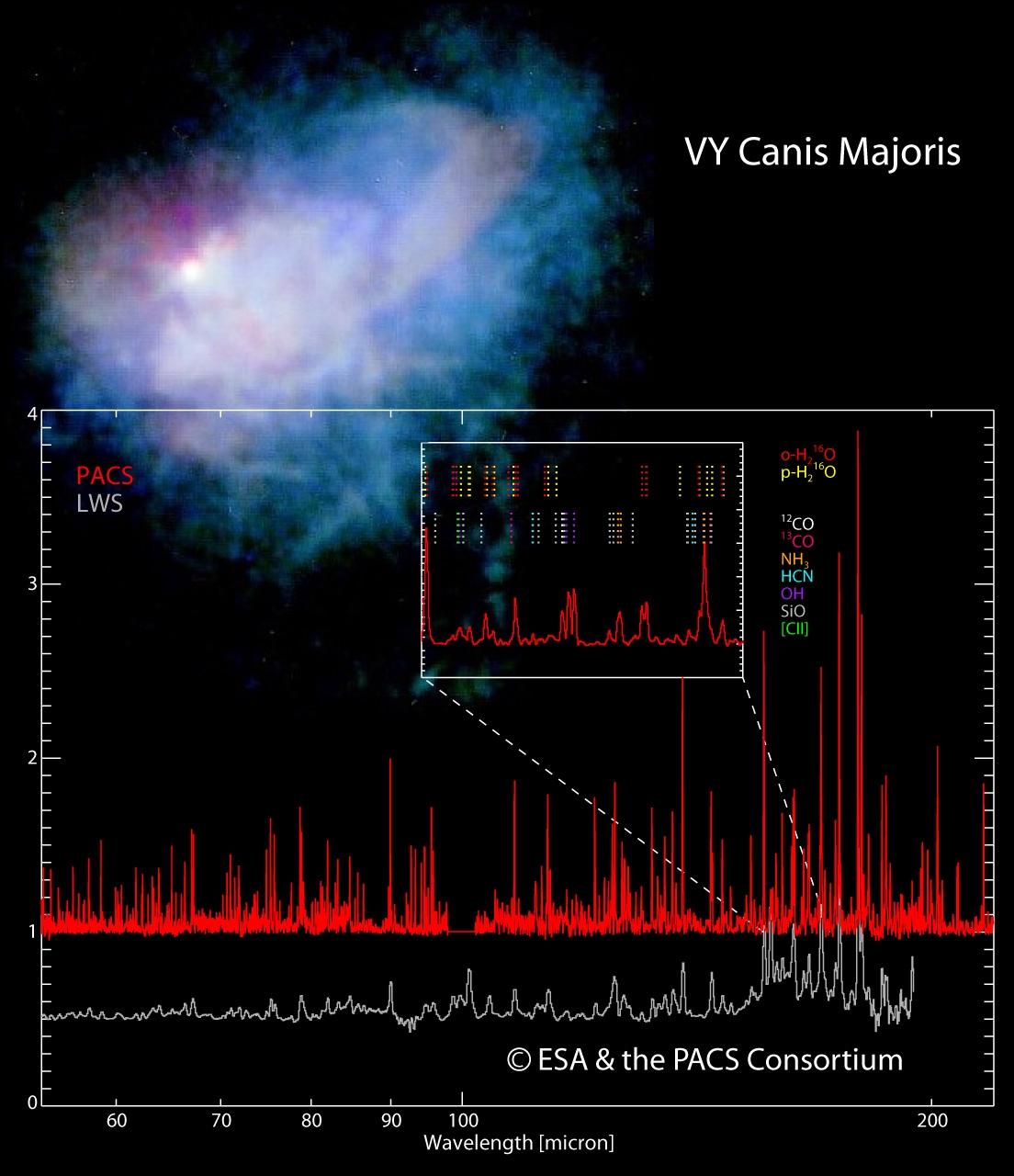
PACS spectrum of VY Canis Majoris
 Date: 26 November 2009
Satellite: Herschel
Copyright: ESA and the PACS consortium; inset: NASA, ESA, N. Smith et al. 2001
Show in archive: true
This is one of the early spectra obtained with the PACS integral field spectrometer on Herschel. Shown here (in red) is the spectrum of the red supergiant VY CMa between 50 and 210 micron. Depicted in gray, and offset by -0.5, is the observation from the ISO Long Wavelength Spectrometer (LWS).
The inset shows a zoom into the 156 to 172 micrometer wavelength range. In this short wavelength region, 44 different molecular lines are identified (indicated by coloured thick marks).
In the background is an optical and near-infrared image from the Hubble Space Telescope.
Date: 26 November 2009
Satellite: Herschel
Copyright: ESA and the PACS consortium; inset: NASA, ESA, N. Smith et al. 2001
Show in archive: true
This is one of the early spectra obtained with the PACS integral field spectrometer on Herschel. Shown here (in red) is the spectrum of the red supergiant VY CMa between 50 and 210 micron. Depicted in gray, and offset by -0.5, is the observation from the ISO Long Wavelength Spectrometer (LWS).
The inset shows a zoom into the 156 to 172 micrometer wavelength range. In this short wavelength region, 44 different molecular lines are identified (indicated by coloured thick marks).
In the background is an optical and near-infrared image from the Hubble Space Telescope.
Last Update: 1 September 2019