• → European Space Agency

    • About Science & Technology

    • For Public

    • For Educators

    • ESA

    • Science & Technology

    • Herschel

    • Missions
    • Show All Missions
    • Mission Home
    • Summary
    • Fact Sheet
    • Objectives
    • Participants
    • Mission Team
    • Industrial Team
    • Spacecraft
    • 3D Model
    • Instruments
    • Test Campaign
    • Mission Operations
    • Launch Information
    • Orbit/Navigation
    • Launch Vehicle
    • Launch Campaign
    • Status Reports
    • Science Operations
    • Science Ground Segment
    • Data Archive
    • Astronomers' Website
    • Outreach Resources
    • Resources
    • News Archive
    • Multimedia Gallery
    • Publication Archive
    • Status Report Archive
    • Calendar of Events
    • Services
    • Contact Us
    • Subscribe
    • Terms and Conditions
    • Bookmark and Share

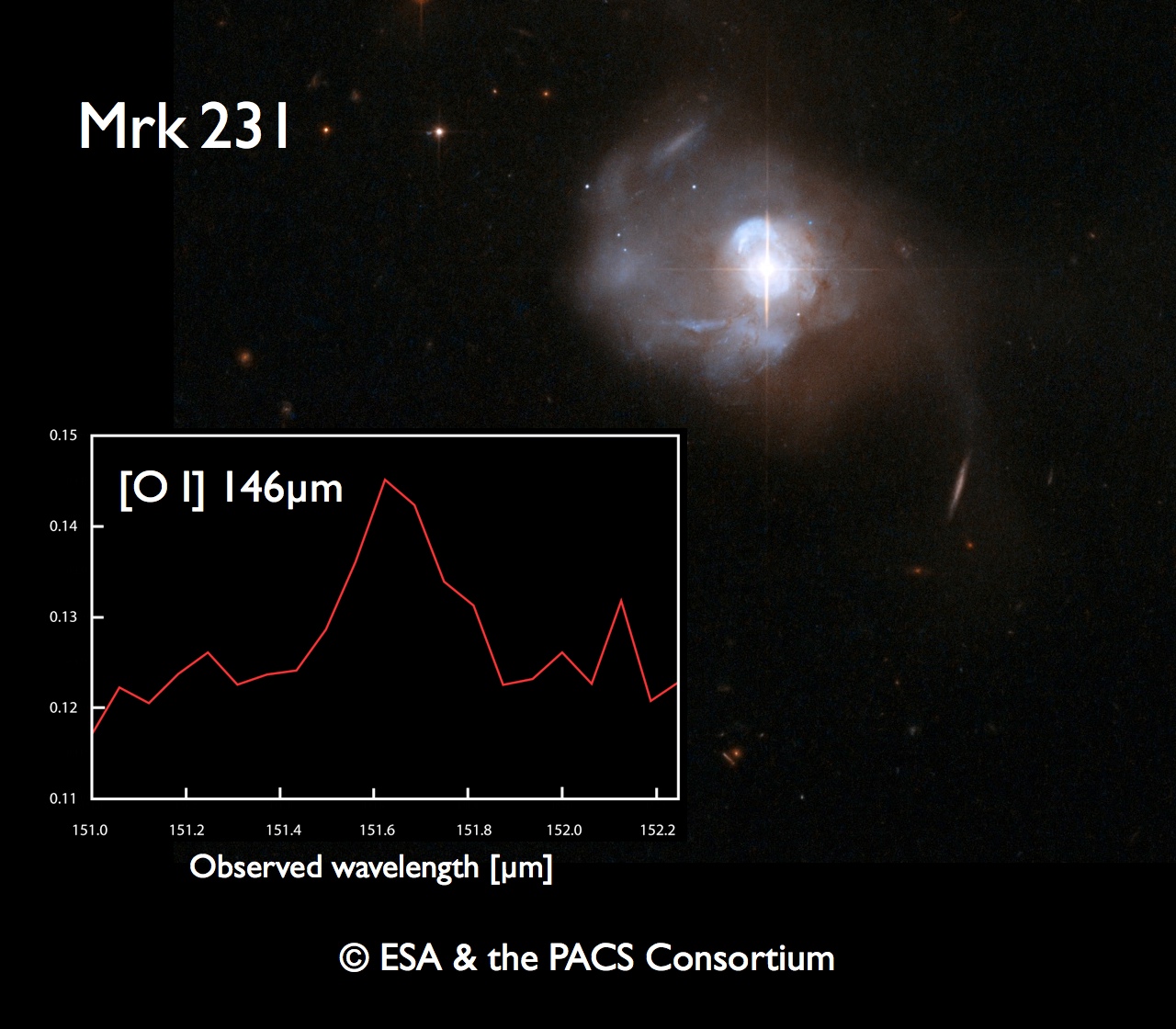
    PACS spectrum of the active galaxy Mrk 231

    Date: 27 Nov 2009
    Satellite: Herschel
    Copyright: ESA and the PACS consortium; background image: NASA, ESA, the Hubble Heritage Team (STScI/AURA)-ESA/Hubble Collaboration and A. Evans (University of Virginia, Charlottesville/NRAO/Stony Brook University)

    This is one of the early spectra obtained with the PACS integral field spectrometer on Herschel. Shown here is a spectral scan of one of the emission lines detected by PACS in the Ultraluminous Infrared Galaxy (ULIRG) known as Markarian 231.

    PACS has detected a weak emission line, never before detected in a ULIRG, originating from neutral oxygen located in the interstellar medium of this galaxy. Its ratio with a stronger line of ionized carbon is a good diagnostic of the power source and the conditions in the interstellar medium of the galaxy.

    Previous infrared space missions discovered that collisions and mergers of gas-rich galaxies glow with the luminosity of a quasar. The far-infrared luminosity of these dust-shrouded mergers, known as Ultraluminous Infrared Galaxies (ULIRGs), is caused by extremely energetic starbursts, producing hundreds of new stars every year, as well as by accreting super-massive black holes in their active nuclei.

    In addition to immense continuum and strong molecular line emission, starburst galaxies also emit weak far-infrared spectral lines. This line emission from different atoms and ions is a signature from the neutral and ionized interstellar medium in galaxies and is important to diagnose the dust-enshrouded power sources in ULIRGs.

    Markarian (Mrk) 231 has long tidal tails and a disturbed shape, a typical signature of colliding galaxies. It is located about 600 million light-years from Earth (in the constellation of Ursa Major).


    Last Update: 27 Nov 2009

    • Shortcut URL
    • http://sci.esa.int/jump.cfm?oid=45981
    • Latest selection
    • Mapping Invisible Pools of Gas in Our Galaxy (Illustration)
    • Tracers of molecular gas across the plane of the Milky Way
    • Artist's impression of molecular gas across the Milky Way's plane
    • Image Hi-Res Versions
    • Hi-Res [jpeg]
      376.77 kb.
    • See also
    • Herschel's splendid spectra

    Connect with us

    • RSS
    • Youtube
    • Twitter
    • Flickr
    • Google Buzz
    • Livestream
    • Subscribe
    • App Store
    • ESA Science Twitter

    Follow ESA science

    • Copyright 2000 - 2013 © European Space Agency. All rights reserved.

    • Terms and Conditions