• → European Space Agency

    • About Science & Technology

    • For Public

    • For Educators

    • ESA

    • Science & Technology

    • XMM-Newton

    • Missions
    • Show All Missions
    • Mission Home
    • Summary
    • Fact Sheet
    • Objectives
    • Orbit View
    • Spacecraft
    • Spacecraft
    • 3D Model
    • Instruments
    • X-ray Mirrors
    • Engineering
    • Mission Operations
    • Launch Vehicle
    • Launch Campaign
    • Orbit/Navigation
    • Science Operations
    • Slew Survey and Catalogue
    • SOC
    • Data Archive
    • Resources
    • News Archive
    • Multimedia Gallery
    • Publication Archive
    • Calendar of Events
    • Services
    • Contact Us
    • Subscribe
    • Terms and Conditions
    • Bookmark and Share

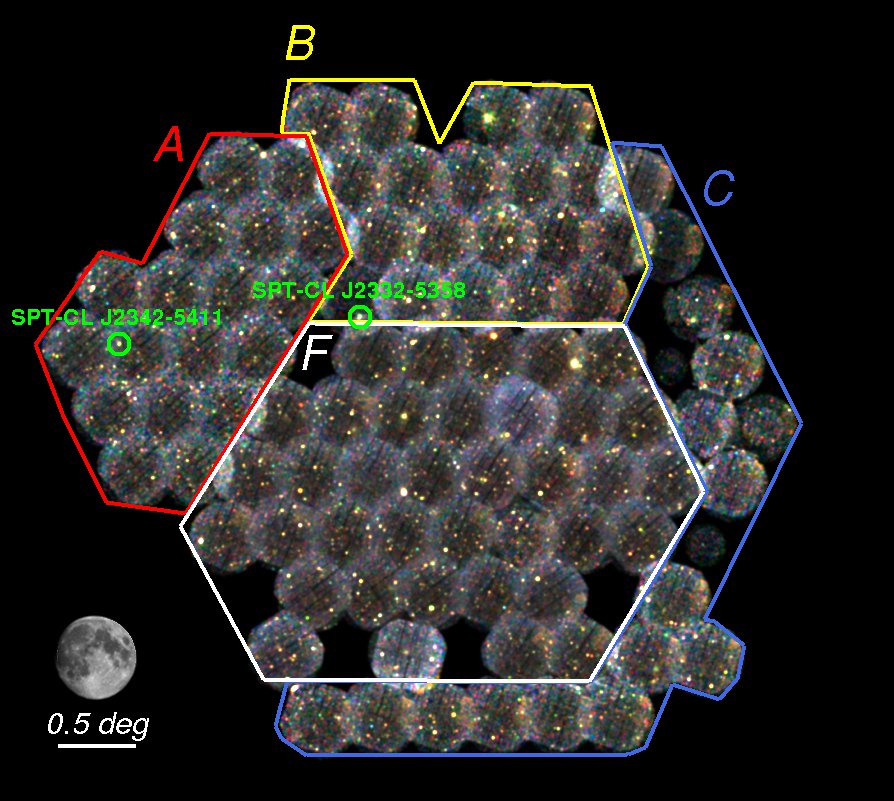
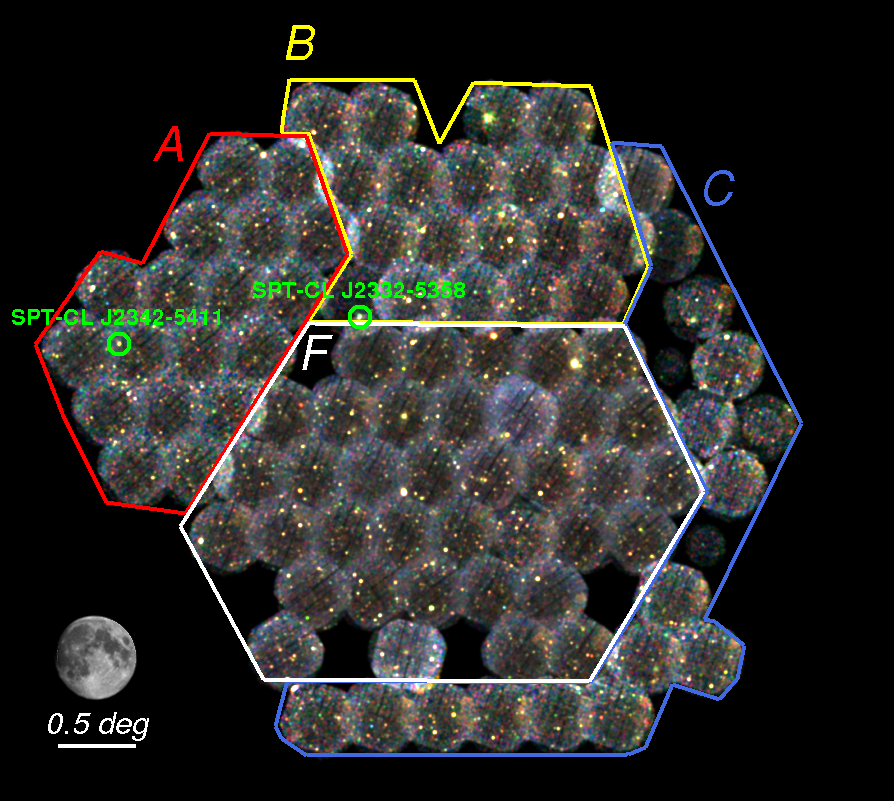
    Mosaic mode XMM-Newton image of the entire XMM-BCS survey field

    Date: 31 May 2010
    Satellite: XMM-Newton
    Copyright: ESA/XMM-Newton

    This XMM-Newton image, obtained using the new mosaic mode of observations, shows the extent of the XMM-BCS survey. The survey targeted a patch of the sky of 14 square degrees, about 70 times the area of the full Moon - the angular size of the Moon is also shown for comparison.

    The green circles, with a radius of 4 arc minutes each, mark the positions of the two galaxy clusters SPT-CL J2332-5358 and SPT-CL J2342-5411. More than 100 other galaxy clusters have been found in this field.

    This false-colour image was constructed from X-ray surface brightness images in 3 bands: 0.3-0.5 keV (red), 0.5-2.0 keV (blue) and 2.0-4.5 keV (green), respectively. Most of the - over 3000 - point sources visible in the fields are Active Galactic Nuclei (AGN).

    Regions A, B and C mark the three large fields covered by mosaic mode observations, each amounting to about 2.7 square degrees, for a total of about 8 square degrees. Each of the three mosaics consists of 19 stable pointings, each with a 3.5 ks exposure, and the slews between them, for a total time of about 90 ks per mosaic.

    Region F covers about 6 square degrees and identifies the deeper core of the survey, consisting of 42 individual and partially overlapping pointings; each pointing corresponds to a 12 ks long exposure.

    As a result of the new mosaic observing mode, it has been possible to survey an area of the sky (regions A, B and C) larger than the original survey area (region F) in only a fraction of the time that was required to observe the latter using the standard mode.
    Last Update: 31 May 2010

    • Shortcut URL
    • http://sci.esa.int/jump.cfm?oid=47092
    • Latest selection
    • Rapidly rotating black hole accreting matter
    • New view of stellar winds
    • A pulsar in X-ray-bright/radio-quiet mode
    • Image Hi-Res Versions
    • Hi-Res [png]
      708.66 kb.
    • Hi-Res [jpg]
      151.66 kb.
    • Related Links
    • Technical details about the new observing mode
    • XMM-Newton Science Operations Centre
    • South Pole Telescope
    • Blanco Cosmology Survey
    • See also
    • XMM-Newton opens new perspectives on galaxy clusters

    Connect with us

    • RSS
    • Youtube
    • Twitter
    • Flickr
    • Google Buzz
    • Livestream
    • Subscribe
    • App Store
    • ESA Science Twitter

    Follow ESA science

    • Copyright 2000 - 2013 © European Space Agency. All rights reserved.

    • Terms and Conditions