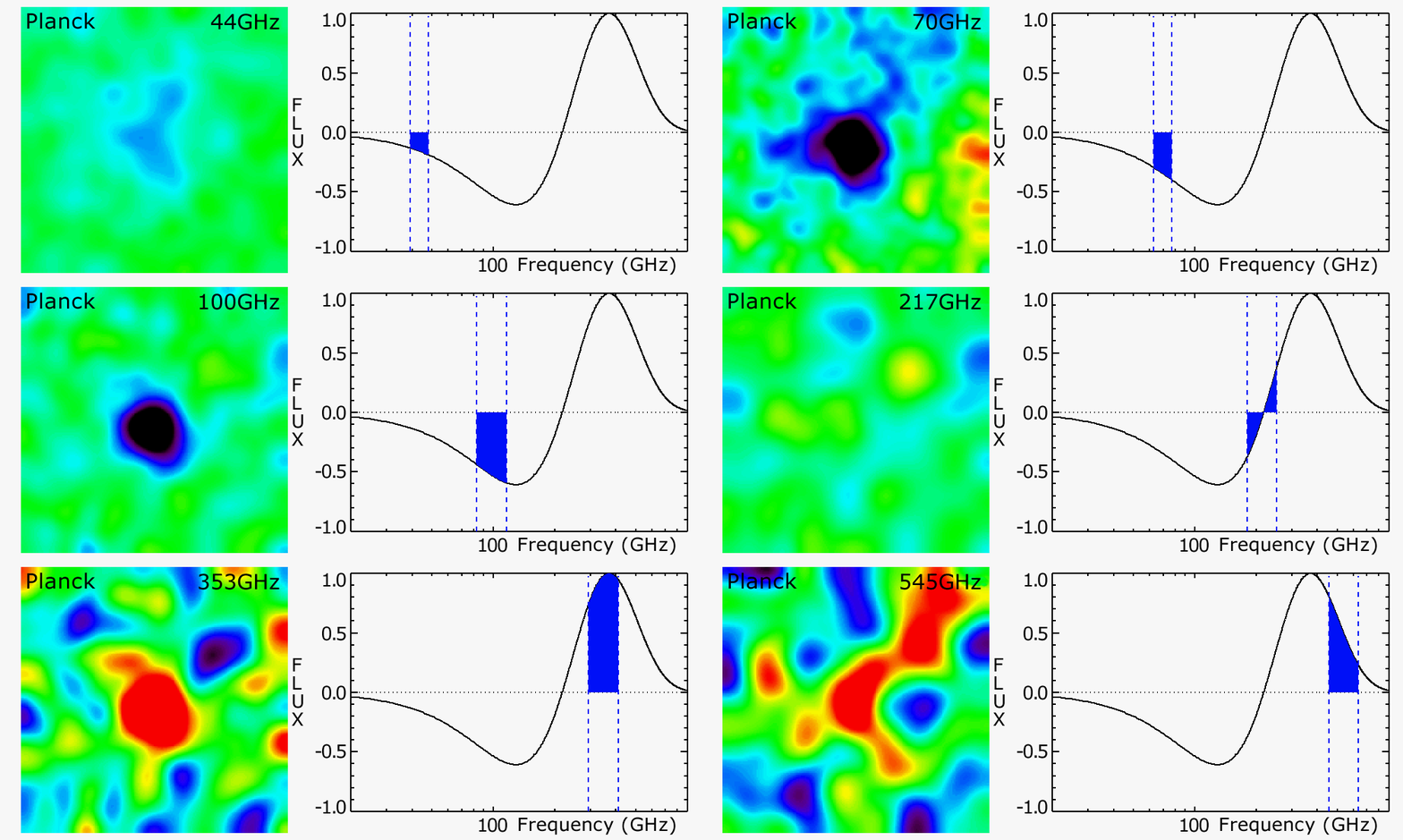
Animation of the Sunyaev-Zel'dovich effect
Date: 11 Jan 2011
The left panel shows how the same patch of the sky, along the line of sight to a galaxy cluster, appears when observed through various frequency channels, after careful removal of the dominant signals due to the Cosmic Microwave Background (CMB) and to the emission from our Galaxy. The right panel shows a graph displaying the corresponding frequency channel along the electromagnetic spectrum. As a result of the SZE, the CMB, when observed along the line of sight of a galaxy cluster, appears fainter at low frequencies and brighter at high frequencies, with the transition value corresponding to 217 GHz. This is translated into a negative signal (visible in the graph on the right side and represented in blue in the image on the left side) for frequencies below the threshold and a positive signal (visible in the graph on the right side and represented in red in the image on the left side) for frequencies above it, with the absence of any signal at the null-point frequency of 217 GHz. This characteristic signature of the SZE allows astronomers to identify galaxy clusters and superclusters from observations of the sky in the microwave region of the spectrum. Planck's frequency channels probe the electromagnetic spectrum both below and above this threshold, with one of them centred exactly on 217 GHz, thus making Planck an excellent hunter for galaxy clusters and superclusters, the largest structures in the Universe, through the SZE.
Last Update: 11 Jan 2011
|