• → European Space Agency

    • About Science & Technology

    • For Public

    • For Educators

    • ESA

    • Science & Technology

    • Herschel

    • Missions
    • Show All Missions
    • Mission Home
    • Summary
    • Fact Sheet
    • Objectives
    • Participants
    • Mission Team
    • Industrial Team
    • Spacecraft
    • 3D Model
    • Instruments
    • Test Campaign
    • Mission Operations
    • Launch Information
    • Orbit/Navigation
    • Launch Vehicle
    • Launch Campaign
    • Status Reports
    • Science Operations
    • Science Ground Segment
    • Data Archive
    • Astronomers' Website
    • Outreach Resources
    • Resources
    • News Archive
    • Multimedia Gallery
    • Publication Archive
    • Status Report Archive
    • Calendar of Events
    • Services
    • Contact Us
    • Subscribe
    • Terms and Conditions
    • Bookmark and Share

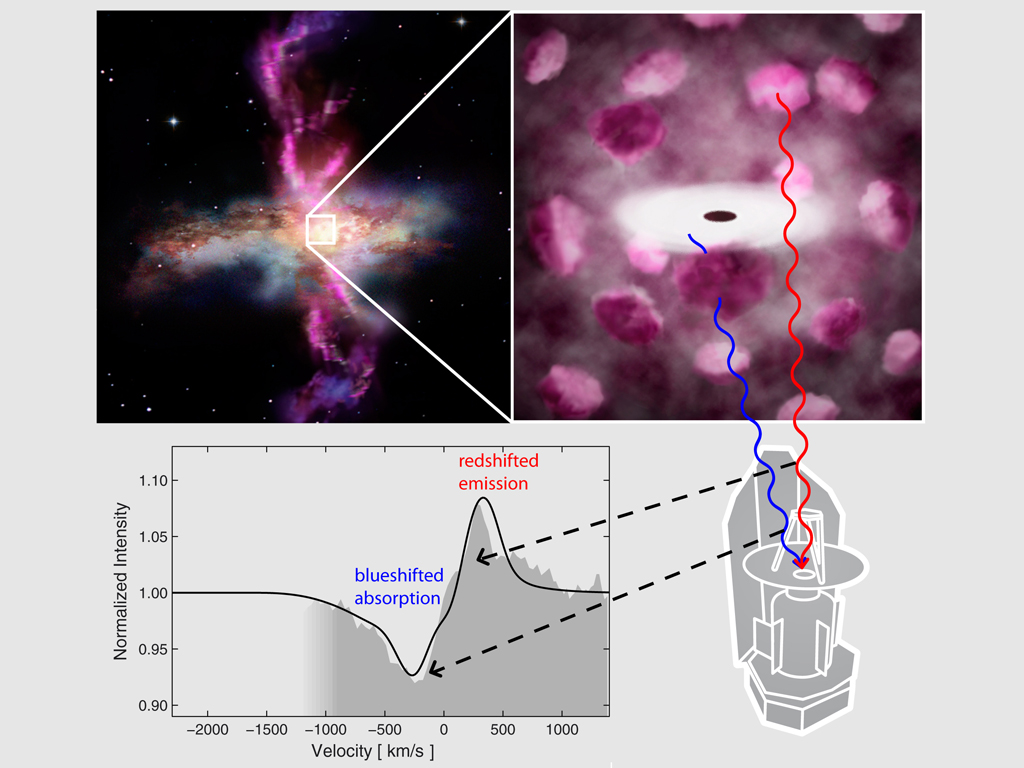
    Illustration of the detection of molecular gas outflows in galaxies with Herschel

    Date: 09 May 2011
    Satellite: Herschel
    Depicts: Detecting molecular gas outflows in galaxies with Herschel
    Copyright: ESA/AOES Medialab

    This illustration shows how outflows of molecular gas can be detected in the spectra of galaxies (here OH at 79 μm in Mrk 231) with Herschel.

    The outflows are traced via the spectral lines of the hydroxyl molecule (OH) that exhibit a distinctive blue- and red-shifted profile due to the geometry of the system.

    As the gas flows out from the galactic centre in virtually all directions, to a distant observer some gas clouds will appear to be approaching and others receding, while the clouds moving perpendicularly to the observer's line of sight will exhibit no apparent motion along the direction of the line of sight.

    Light originating from the bright disc of accreting material around the black hole is absorbed by OH present in the clouds along the line of sight to the observer and, as these clouds are moving towards the observer, the resulting absorption lines are blueshifted. Clouds that are off this line of sight give rise to OH emission only: among these clouds, those that are moving away from the observer will give rise to redshifted emission lines.

    The composite shape of the spectrum depicted here — obtained with measurements from the Herschel Space Observatory — is due to the fact that neither the central source nor the individual clouds can be spatially resolved by Herschel, and photons coming from the various components all fall on one single pixel.

    Last Update: 09 May 2011

    • Shortcut URL
    • http://sci.esa.int/jump.cfm?oid=48675
    • Latest selection
    • Multi-wavelength view of the merging galaxy pair HXMM01
    • Herschel view of the merging galaxy pair HXMM01
    • Merging galaxies in the young Universe discovered with Herschel
    • Image Hi-Res Versions
    • Hi-Res [jpg]
      369.87 kb.
    • See also
    • Caught in the act by Herschel: galactic storms sweep away the gas

    Connect with us

    • RSS
    • Youtube
    • Twitter
    • Flickr
    • Google Buzz
    • Livestream
    • Subscribe
    • App Store
    • ESA Science Twitter

    Follow ESA science

    • Copyright 2000 - 2013 © European Space Agency. All rights reserved.

    • Terms and Conditions