
Herschel confirms Enceladus as primary water supply for Saturn's atmosphere
26 July 2011
Observing Saturn, Herschel has detected evidence of water molecules in a huge torus surrounding the planet and centred on the orbit of its small moon, Enceladus. The water plumes on Enceladus, which were detected by the Cassini-Huygens mission, inject the water into the torus and part of it eventually precipitates into Saturn's atmosphere. The new study has identified Enceladus as the primary water supply to Saturn's upper atmosphere; this is the first example in the Solar System of a moon directly influencing the atmosphere of its host planet. |
|
Water plumes emanating from Saturn's moon Enceladus as observed by Cassini. |
Astronomers have detected water, which is a fundamental molecule on Earth, in many different environments throughout the Universe. Given its key role during the formation and evolution of the Solar System, determining the abundance and investigating the origin of this molecule on and around planets can provide crucial insight into the history of our cosmic neighbourhood.
The origin of the water in the upper atmosphere of the giant planets – Jupiter, Saturn, Uranus and Neptune – as well as in that of Titan, the largest moon of Saturn, is particularly enigmatic. The first evidence of this water was found by ESA's Infrared Space Observatory (ISO) in 1997 and confirmed, a couple of years later, by NASA's Submillimeter Wave Astronomy Satellite (SWAS).
These bodies have chemically reducing atmospheres; oxidation reactions do not occur – due to the lack of oxygen – and astronomers do not expect large amounts of water there. Reducing atmospheres are similar in composition to the nebula from which the Solar System originated; the early Earth also had such an atmosphere, which was later supplied with oxygen by the first living organisms that appeared on the planet.
Although chemically reducing, the outer planets' atmospheres do contain traces of water in their warm, deep layers; however, the cold temperatures present at cloud level, which cause water to condense, prevent its transport to higher layers. Thus, the existence of water in the upper atmospheres of these objects calls for an external supply of such molecules, which may vary from planet to planet.
A new study, based on data taken with ESA's Herschel Space Observatory, offers a first answer to the puzzle in the case of Saturn. The main water provider to this planet's upper atmosphere appears to be its small moon Enceladus, whose plumes of water vapour and ice were detected by the NASA/ESA/ASI Cassini-Huygens mission in 2005.
"This is the first time we see a moon directly acting on its host planet's atmosphere and modifying its chemical composition," comments Paul Hartogh from the Max-Planck-Institut für Sonnensystemforschung (MPS) in Katlenburg-Lindau, Germany, who led the study. Hartogh is the Principal Investigator of the Herschel Key Programme Water and related chemistry in the Solar System, within which the observations have been performed. "This unique situation has not previously been observed in the Solar System," he adds.
 |
|
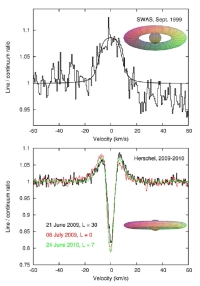
Water detection in the spectra of Saturn taken with SWAS in 1999 and Herschel in 2009-2010. |
"The best explanation suggests that the water detected by Herschel is distributed in the Enceladus torus, a tenuous ring of material fed by this moon's plumes and centred on its orbit," explains co-author Emmanuel Lellouch from the Laboratoire d'Études Spatiales et d'Instrumentation en Astrophysique (LESIA) of the Observatoire de Paris, at Meudon, in France, who performed the modelling of the observations. The Enceladus torus is located at a distance from the centre of the planet of nearly four times Saturn's radius.
The first sign of absorption was found in spectra taken during Herschel's calibration phase, in the summer of 2009. Further observations performed in 2010 confirmed the earlier detection at various wavelengths. The fact that no absorption was detected by SWAS over ten years ago is due to the varying geometry of Saturn's system of rings and satellites as viewed from the Earth and its vicinity. The rings and satellites are currently seen almost edge-on, whereas the configuration was much more oblique at the time of the SWAS observations. "This is a further clue implying that the absorbing water revealed by Herschel is distributed in a torus along the planet's equatorial plane," adds Lellouch.
 |
|
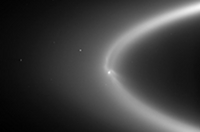
Cassini observes water plumes feeding the Enceladus torus. |
"After Cassini's detection of Enceladus' plumes, Herschel has finally shown where the water emanating from this moon ends up – a nice piece of team work exploiting the complementarity of two very different missions in ESA's Science programme," comments Göran Pilbratt, ESA Herschel Project Scientist. "We now look forward to hopefully shedding new light on the origin of water in the atmosphere of Titan and the other giant planets as well," he concludes.
Notes for editors
The study presented here is based on observations performed with the HIFI instrument on board Herschel, within the Key Programme Water and related chemistry in the Solar System.
Herschel is an ESA space observatory with science instruments provided by European-led Principal Investigator consortia and with important participation from NASA.
HIFI, or the Heterodyne Instrument for the Far Infrared, has been designed and built by a consortium of institutes and university departments from across Europe, Canada, and the United States under the leadership of SRON Netherlands Institute for Space Research, Groningen, The Netherlands, and with major contributions from Germany, France, and the US. Consortium members are: Canada: CSA, U. Waterloo; France: CESR, LAB, LERMA, IRAM; Germany: KOSMA, MPIfR, MPS; Ireland: NUI Maynooth; Italy: ASI, IFSI-INAF, Osservatorio Astrofisico di Arcetri-INAF; Netherlands: SRON, TUD; Poland: CAMK, CBK; Spain: Observatorio Astronómico Nacional (IGN), Centro de Astrobiología (CSIC-INTA); Sweden: Chalmers University of Technology - MC2, RSS & GARD, Onsala Space Observatory, Swedish National Space Board, Stockholm University – Stockholm Observatory; Switzerland: ETH Zurich, FHNW; USA: Caltech, JPL, NHSC.
Related publications
P. Hartogh, E. Lellouch, et al., 'Direct detection of the Enceladus water torus with Herschel', Astronomy & Astrophysics, 2011, 532, L2, DOI: 10.1051/0004-6361/201117377
Contacts
Paul Hartogh
Max-Planck-Institut für Sonnensystemforschung
Katlenburg-Lindau, Germany
Email: hartogh mps.mpg.de
Phone: +49-5556-979342
Emmanuel Lellouch
Laboratoire d'études spatiales et d'instrumentation en astrophysique (LESIA)
Observatoire de Paris
Meudon, France
Email: emmanuel.lellouchobspm.fr
Phone: +33-1-45077672
Göran Pilbratt
ESA Herschel Project Scientist
Research and Scientific Support Department
Science and Robotic Exploration Directorate
ESA, The Netherlands
Email: gpilbrattrssd.esa.int
Phone: +31-71-565-3621

