• → European Space Agency

    • About Science & Technology

    • For Public

    • For Educators

    • ESA

    • Science & Technology

    • Hubble

    • Missions
    • Show All Missions
    • Mission Home
    • Summary
    • Fact Sheet
    • About Hubble
    • Orbit View
    • Spacecraft
    • Spacecraft
    • 3D Model
    • Hubble instruments
    • Engineering
    • Mission Operations
    • Operating Hubble
    • Launch
    • SM 1
    • SM 2
    • SM 3A
    • SM 3B
    • SM 4
    • Timeline
    • Science Operations
    • Science Archive
    • Resources
    • News Archive
    • Multimedia Gallery
    • Publication Archive
    • Calendar of Events
    • Services
    • Contact Us
    • Subscribe
    • Terms and Conditions
    • Bookmark and Share

    A swarm of dark matter around the Milky Way

    Date: 10 Jul 2012
    Satellite: Hubble Space Telescope
    Depicts: Dark matter simulations
    Copyright: J. Tumlinson (STScI)

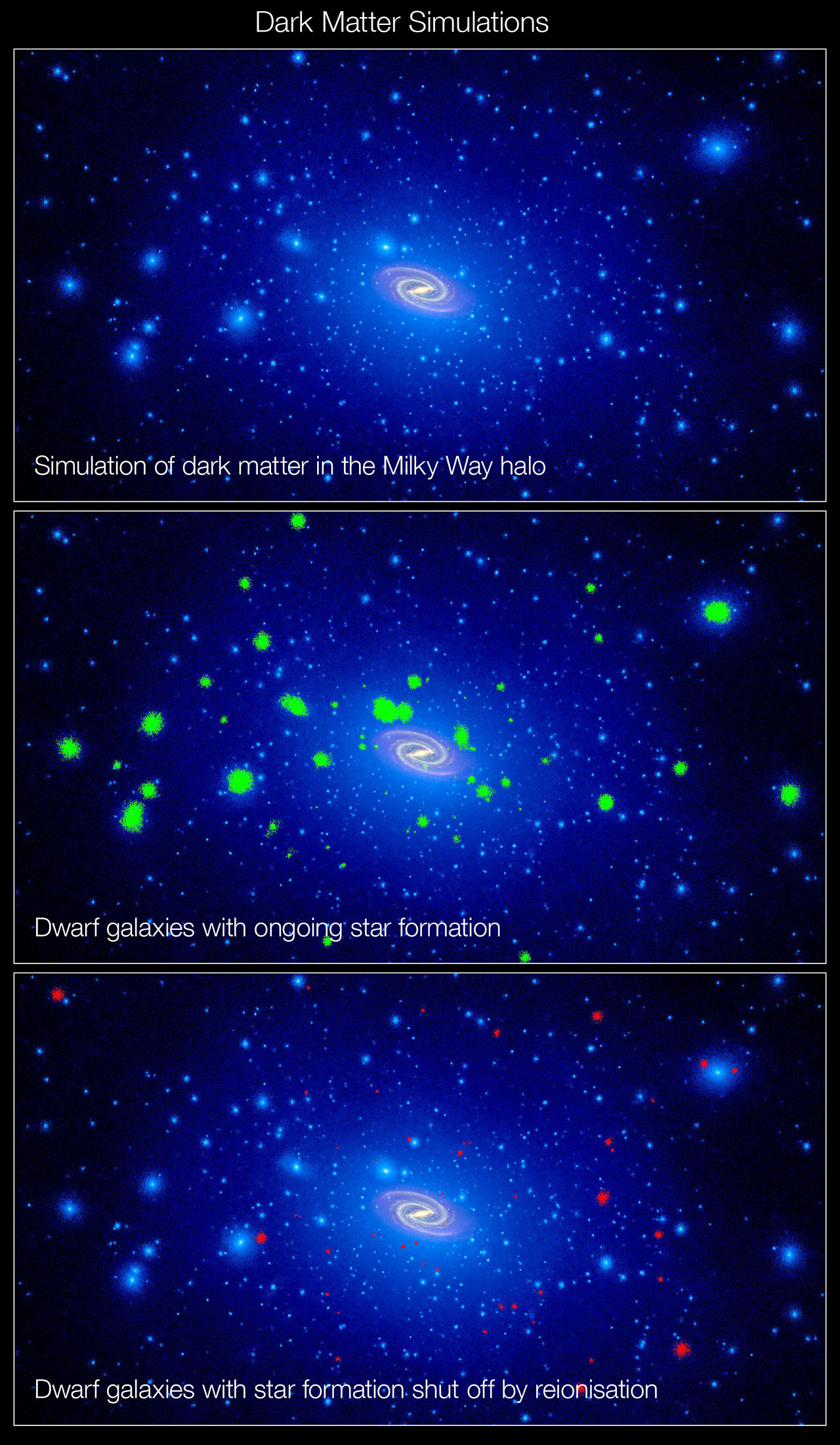
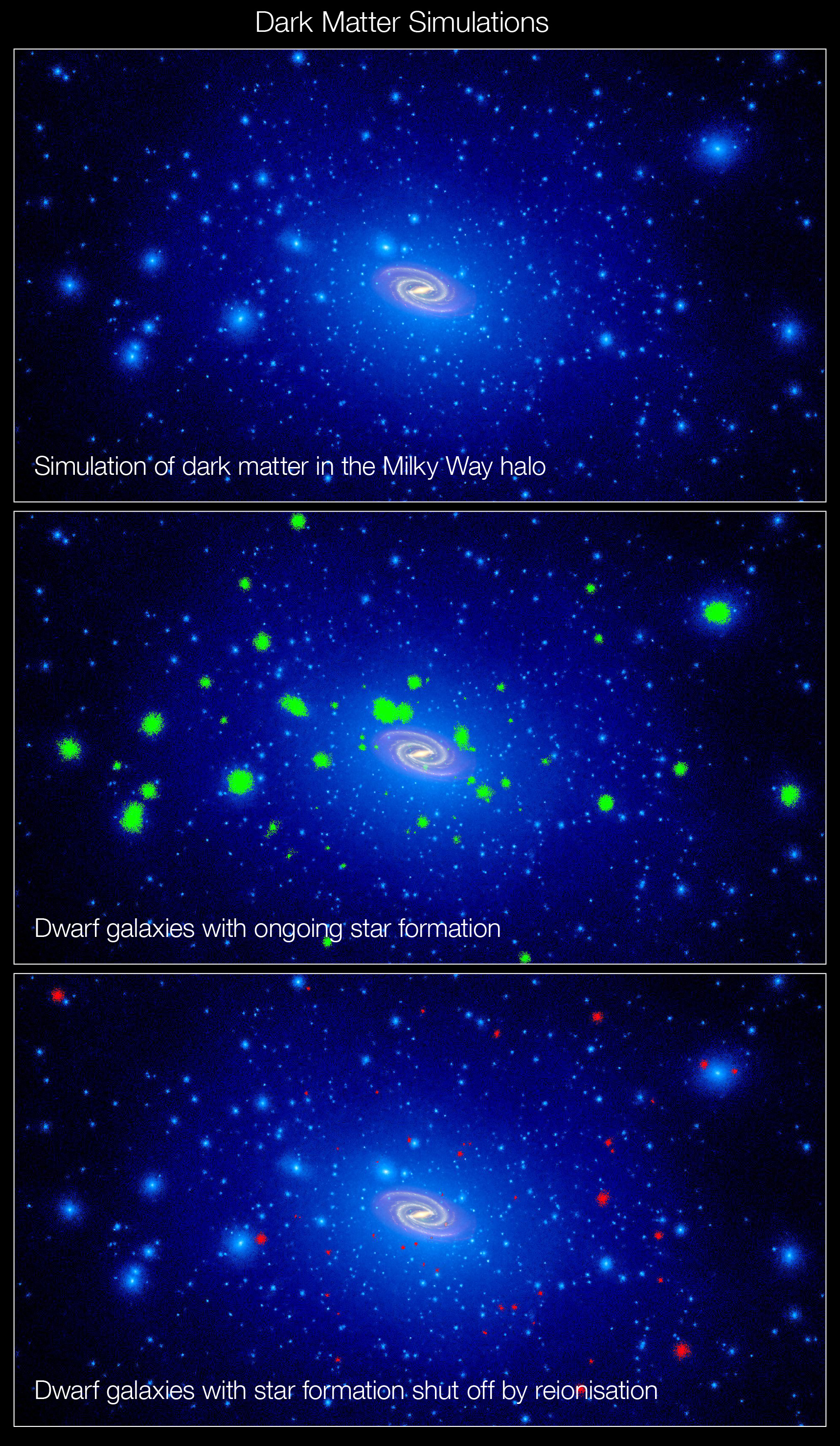
    These illustrations, taken from computer simulations, show a swarm of dark matter clumps around our Milky Way galaxy. Some of the dark-matter concentrations are massive enough to spark star formation. Dark matter is an invisible substance that accounts for most of the universe's mass.

    In the first panel, thousands of clumps of dark matter coexist with our Milky Way galaxy, shown in the center.

    The green blobs in the second panel are those dark-matter chunks massive enough to obtain gas from the intergalactic medium and trigger ongoing star formation, eventually creating dwarf galaxies.

    In the third panel, the red blobs are ultra-faint dwarf galaxies that stopped forming stars long ago. New Hubble Space Telescope observations of three of the puny galaxies reveal that star-making in these faint galaxies shut down more than 13 billion years ago.

    The synchronised shutdown is evidence that a global event, such as reionisation, swept through the early universe. Reionisation is a transitional phase in the early universe when the first stars burned off a fog of cold hydrogen.

    Popular theory predicts that most of the Milky Way's satellites contain few, if any, stars and are instead dominated by dark matter. More than a dozen small-fry galaxies have been found so far, all by the Sloan Digital Sky Survey, which scanned just a quarter of the sky.
    Last Update: 11 Jul 2012

    • Shortcut URL
    • http://sci.esa.int/jump.cfm?oid=50560
    • Latest selection
    • Wide-field image of the Ring Nebula (ground-based image)
    • The geometry and structure of the Ring Nebula
    • The region around the Ring Nebula (Hubble/LBT composite)
    • Image Hi-Res Versions
    • Hi-Res [tif]
      15,272.97 kb.
    • Hi-Res [jpg]
      2,298.92 kb.
    • Hi-Res [jpg]
      721.31 kb.
    • See also
    • Hubble unmasks ghost galaxies [heic1211]

    Connect with us

    • RSS
    • Youtube
    • Twitter
    • Flickr
    • Google Buzz
    • Livestream
    • Subscribe
    • App Store
    • ESA Science Twitter

    Follow ESA science

    • Copyright 2000 - 2013 © European Space Agency. All rights reserved.

    • Terms and Conditions