Violent Birth of Stars in Galaxy NGC 253
 Date: 19 February 1995
Depicts: NGC 253, IRAS 00450-2533
Copyright: Jay Gallagher (University of Wisconsin-Madison), Alan Watson (Lowell Observatory, Flagstaff, AZ) and NASA
Show in archive: true
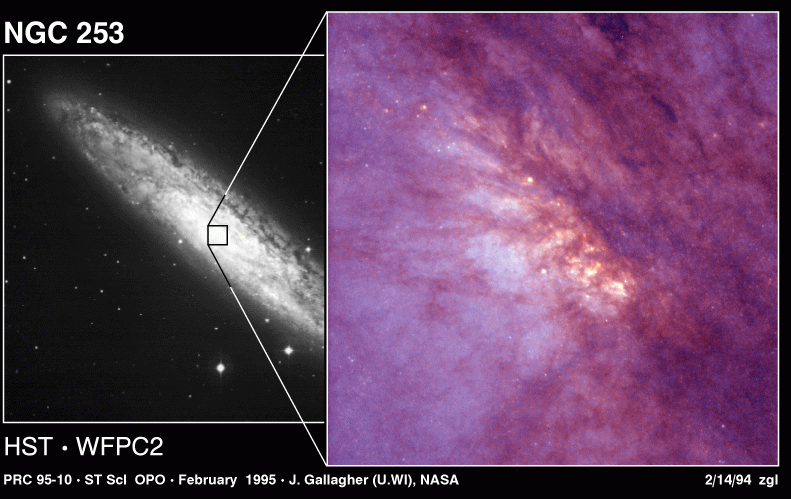
This Hubble telescope image of the core of the nearest starburst spiral galaxy, NGC 253, reveals violent star formation within a region 1,000 light-years across.
Hubble's sharp vision allows astronomers to see complex structures in the starburst core for the first time, including luminous star clusters, filaments of glowing gas, and dust lanes that trace regions of dense gas. Hubble identifies several regions of intense star formation, including a bright, super-compact star cluster. The entire galaxy is shown in the left-hand image, taken by a ground-based telescope.
Date: 19 February 1995
Depicts: NGC 253, IRAS 00450-2533
Copyright: Jay Gallagher (University of Wisconsin-Madison), Alan Watson (Lowell Observatory, Flagstaff, AZ) and NASA
Show in archive: true
This Hubble telescope image of the core of the nearest starburst spiral galaxy, NGC 253, reveals violent star formation within a region 1,000 light-years across.
Hubble's sharp vision allows astronomers to see complex structures in the starburst core for the first time, including luminous star clusters, filaments of glowing gas, and dust lanes that trace regions of dense gas. Hubble identifies several regions of intense star formation, including a bright, super-compact star cluster. The entire galaxy is shown in the left-hand image, taken by a ground-based telescope.
Last Update: 1 September 2019