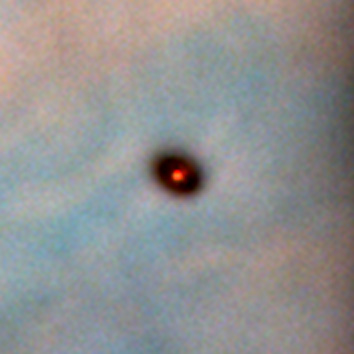
Protoplanetary Disc in the Orion Nebula
 Depicts: M42, NGC 1976, The Great Nebula in Orion
Copyright: Mark McCaughrean (Max-Planck-Institute for Astronomy), C. Robert O'Dell (Rice University), and NASA
Show in archive: true
Disks around young stars (also known as circumstellar or protoplanetary disks) are thought to be made up of 99% gas and 1% dust. Even that small amount of dust is enough to make the disks opaque and dark at visible wavelengths. The dark disk is seen in this image because they are silhouetted against the bright backdrop of the hot gas of the Orion nebula.
Depicts: M42, NGC 1976, The Great Nebula in Orion
Copyright: Mark McCaughrean (Max-Planck-Institute for Astronomy), C. Robert O'Dell (Rice University), and NASA
Show in archive: true
Disks around young stars (also known as circumstellar or protoplanetary disks) are thought to be made up of 99% gas and 1% dust. Even that small amount of dust is enough to make the disks opaque and dark at visible wavelengths. The dark disk is seen in this image because they are silhouetted against the bright backdrop of the hot gas of the Orion nebula.
Last Update: 1 September 2019