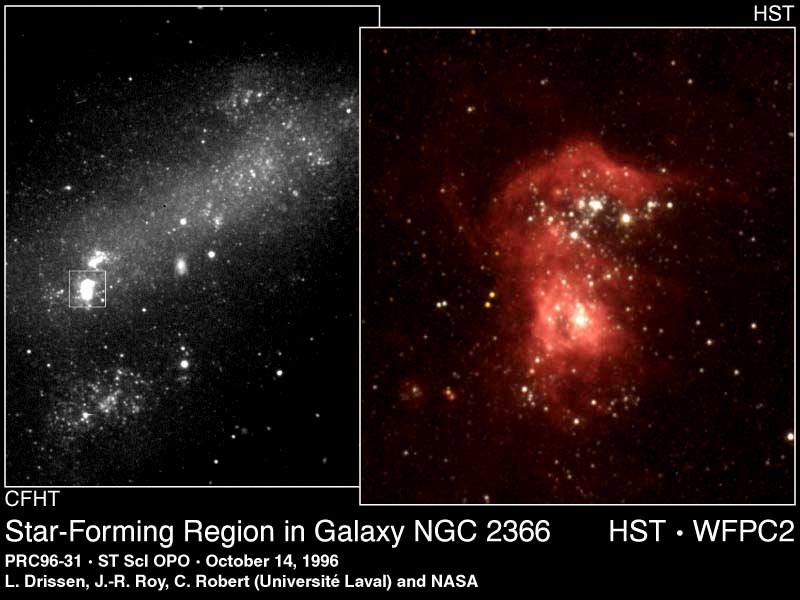
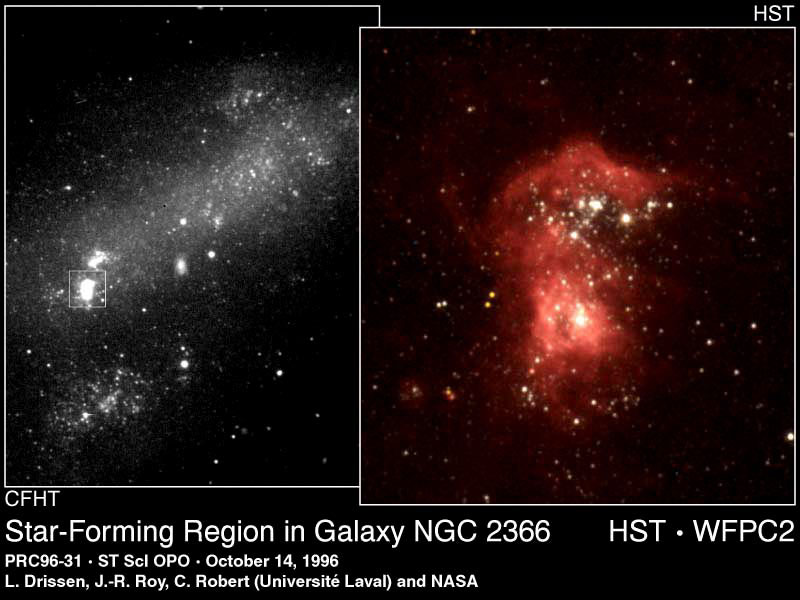
Star-Forming Region in Galaxy NGC 2366
 Depicts: NGC 2363, NGC 2366, The Magellanic Galaxy, IRAS 07233+6917
Copyright: Laurent Drissen, Jean-Rene Roy, Carmelle Robert, Yvan Dutil, CHFT and NASA
Show in archive: true
Clusters of stars and a fishhook-shaped cloud of luminescent gases
glow brilliantly in NGC 2363, a giant star-forming region in the Magellanic
galaxy NGC 2366. Even though the nebula is 10 million light-years away, the
Hubble Space Telescope resolves details comparable to such nebulae in our own
galaxy. This region is as bright as the gigantic 30 Doradus nebula in the
Large Magellanic Cloud, a satellite galaxy to our Milky Way.
Depicts: NGC 2363, NGC 2366, The Magellanic Galaxy, IRAS 07233+6917
Copyright: Laurent Drissen, Jean-Rene Roy, Carmelle Robert, Yvan Dutil, CHFT and NASA
Show in archive: true
Clusters of stars and a fishhook-shaped cloud of luminescent gases
glow brilliantly in NGC 2363, a giant star-forming region in the Magellanic
galaxy NGC 2366. Even though the nebula is 10 million light-years away, the
Hubble Space Telescope resolves details comparable to such nebulae in our own
galaxy. This region is as bright as the gigantic 30 Doradus nebula in the
Large Magellanic Cloud, a satellite galaxy to our Milky Way.
Last Update: 1 September 2019