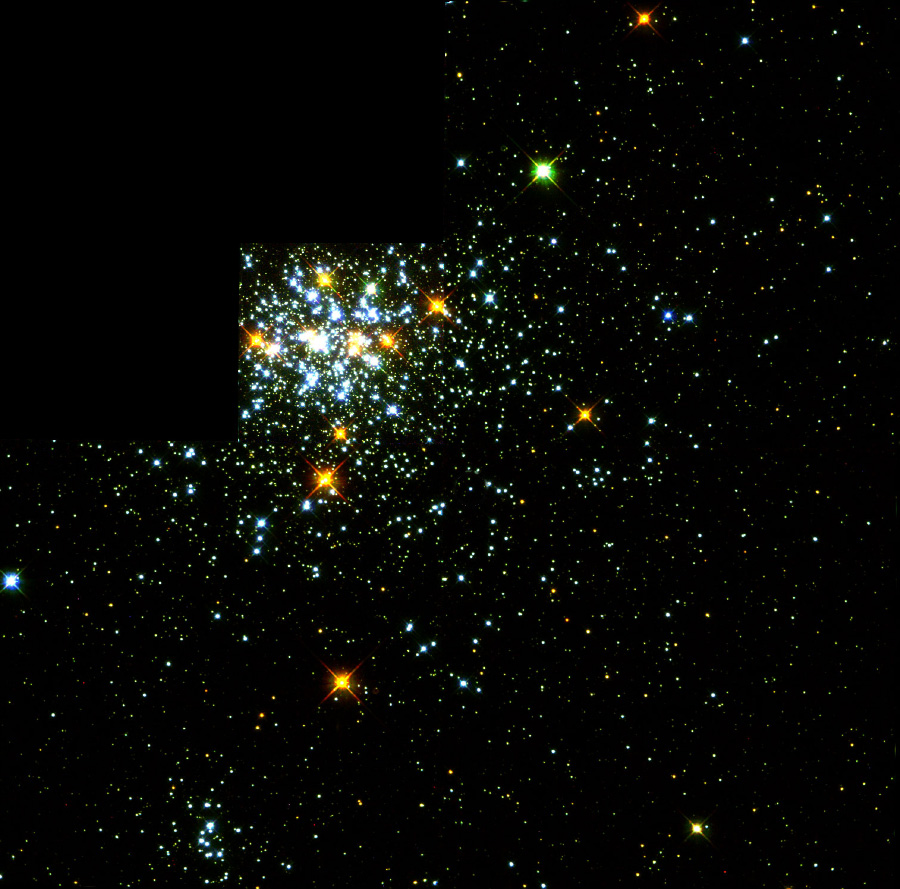
Hot White Dwarf Shines in Young Star Cluster
 Depicts: NGC 1818
Copyright: Rebecca Elson and Richard Sword, Cambridge UK, and NASA (Original WFPC2image courtesy J. Westphal, Caltech)
Show in archive: true
A dazzling "jewel-box" collection of over 20,000 stars can be seen in
crystal clarity in this NASA/ESA Hubble Space Telescope image, taken with
the Wide Field and Planetary Camera 2. The young (40 million year old)
cluster, called NGC 1818, is 164,000 light-years away in the Large
Magellanic Cloud (LMC), a satellite galaxy of our Milky Way.
The LMC, a site of vigorous current star formation, is an ideal nearby
laboratory for studying stellar evolution.
Depicts: NGC 1818
Copyright: Rebecca Elson and Richard Sword, Cambridge UK, and NASA (Original WFPC2image courtesy J. Westphal, Caltech)
Show in archive: true
A dazzling "jewel-box" collection of over 20,000 stars can be seen in
crystal clarity in this NASA/ESA Hubble Space Telescope image, taken with
the Wide Field and Planetary Camera 2. The young (40 million year old)
cluster, called NGC 1818, is 164,000 light-years away in the Large
Magellanic Cloud (LMC), a satellite galaxy of our Milky Way.
The LMC, a site of vigorous current star formation, is an ideal nearby
laboratory for studying stellar evolution.
Last Update: 1 September 2019