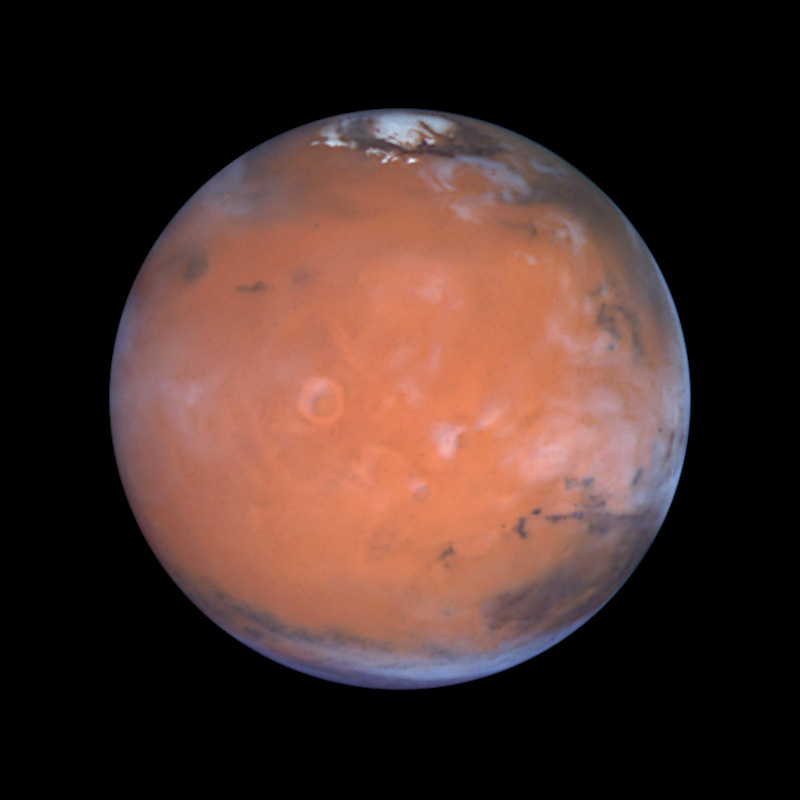
Mars at Opposition (the Tharsis Region)
 Depicts: Mars, Tharsis
Copyright: Steve Lee (University of Colorado), Jim Bell (Cornell University), Mike Wolff (Space Science Institute), and NASA
Show in archive: true
This image is centered on the region of the planet known as Tharsis, home of the largest volcanoes in the solar system. The bright, ring-like feature just to the left of center is the volcano Olympus Mons, which is more than 340 miles (550 kilometers) across and 17 miles (27 kilometers) high. Thick deposits of fine-grained, windblown dust cover most of this hemisphere. The colors indicate that the dust is heavily oxidized ("rusted"), and millions (or perhaps billions) of years of dust storms have homogenized its composition. Prominent late afternoon clouds along the right limb of the planet can be seen.
Depicts: Mars, Tharsis
Copyright: Steve Lee (University of Colorado), Jim Bell (Cornell University), Mike Wolff (Space Science Institute), and NASA
Show in archive: true
This image is centered on the region of the planet known as Tharsis, home of the largest volcanoes in the solar system. The bright, ring-like feature just to the left of center is the volcano Olympus Mons, which is more than 340 miles (550 kilometers) across and 17 miles (27 kilometers) high. Thick deposits of fine-grained, windblown dust cover most of this hemisphere. The colors indicate that the dust is heavily oxidized ("rusted"), and millions (or perhaps billions) of years of dust storms have homogenized its composition. Prominent late afternoon clouds along the right limb of the planet can be seen.
Last Update: 1 September 2019