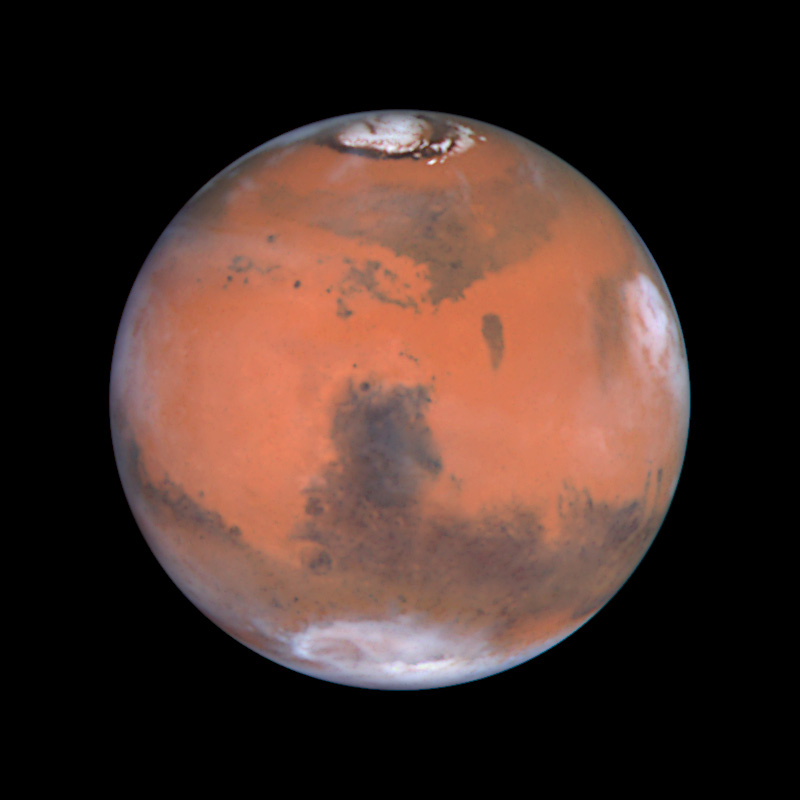
Mars at Opposition (the Syrtis Major Region)
 Depicts: Mars, Syrtis Major
Copyright: Steve Lee (University of Colorado), Jim Bell (Cornell University), Mike Wolff (Space Science Institute), and NASA
Show in archive: true
This image is centered on the dark feature known as Syrtis
Major, first seen telescopically by the astronomer Christiaan Huygens in
the 17th century. Many small, dark, circular impact craters can be seen
in this region, attesting to the Hubble telescope's ability to reveal
fine detail on the planet's surface. To the south of Syrtis is a large
circular feature called Hellas. Viking and more recently Mars Global
Surveyor have revealed that Hellas is a large and deep impact crater.
These Hubble telescope pictures show it to be filled with surface frost
and water ice clouds. Along the right limb, late afternoon clouds have
formed around the volcano Elysium.
Depicts: Mars, Syrtis Major
Copyright: Steve Lee (University of Colorado), Jim Bell (Cornell University), Mike Wolff (Space Science Institute), and NASA
Show in archive: true
This image is centered on the dark feature known as Syrtis
Major, first seen telescopically by the astronomer Christiaan Huygens in
the 17th century. Many small, dark, circular impact craters can be seen
in this region, attesting to the Hubble telescope's ability to reveal
fine detail on the planet's surface. To the south of Syrtis is a large
circular feature called Hellas. Viking and more recently Mars Global
Surveyor have revealed that Hellas is a large and deep impact crater.
These Hubble telescope pictures show it to be filled with surface frost
and water ice clouds. Along the right limb, late afternoon clouds have
formed around the volcano Elysium.
Last Update: 1 September 2019