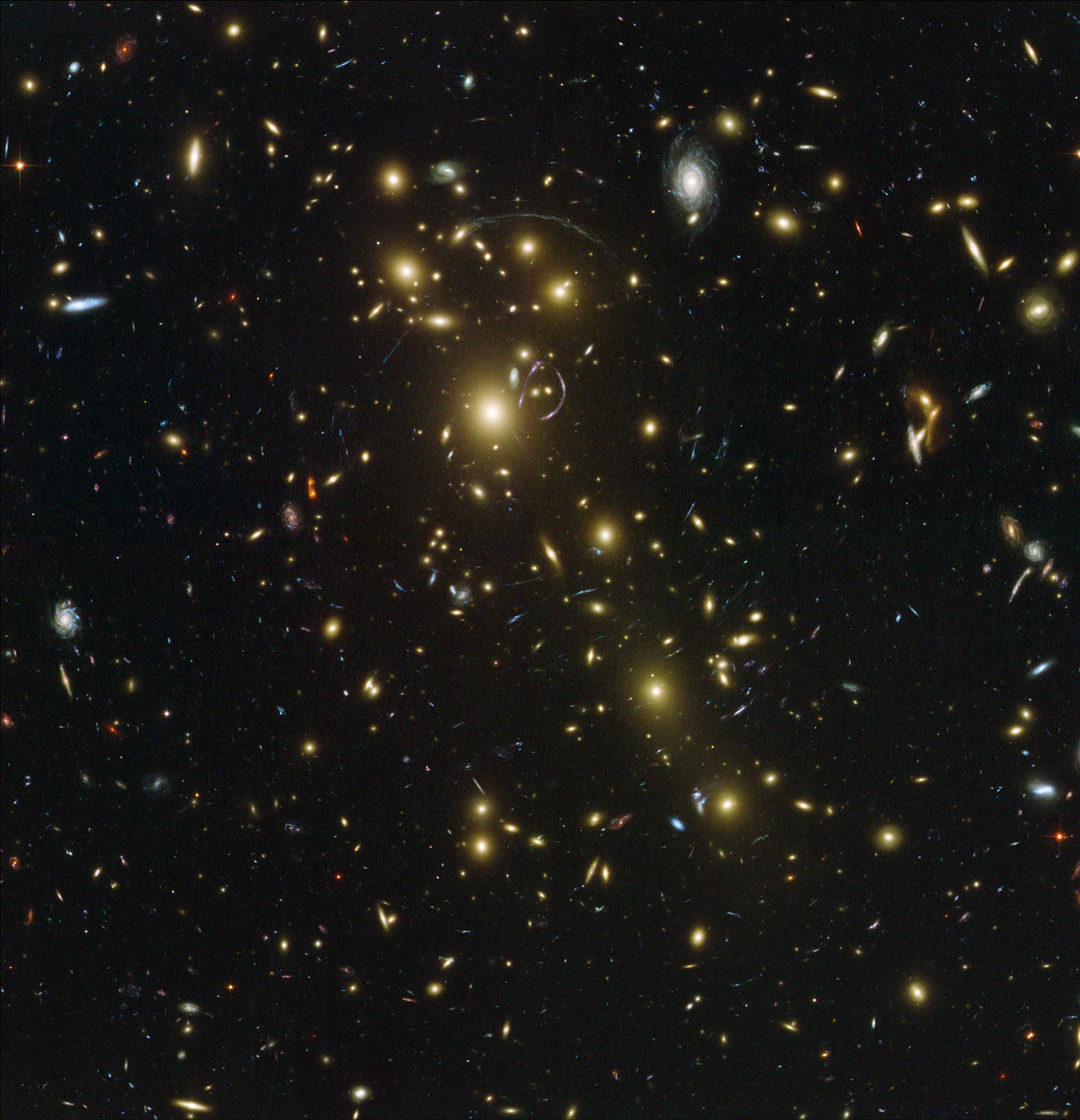
Abell 1703
 Date: 25 July 2008
Satellite: Hubble Space Telescope
Depicts: ACS image of Abell 1703
Copyright: NASA, ESA, and Johan Richard (Caltech, USA)
Date: 25 July 2008
Satellite: Hubble Space Telescope
Depicts: ACS image of Abell 1703
Copyright: NASA, ESA, and Johan Richard (Caltech, USA)
Acknowledgement: Davide de Martin & James Long (ESA/Hubble)
Show in archive: true
Located in the northern celestial hemisphere, Abell 1703 is composed of over one hundred different galaxies that act as a powerful cosmic telescope, or gravitational lens. The gravitational lens produced by the massive galaxy cluster in the foreground (the yellow mostly elliptical galaxies scattered across the image) bends the light rays in a way that can stretch the images and so amplify the brightness of the light rays from more distant galaxies. In the process it distorts their shapes and produces multiple banana-shaped images of the original galaxies. The result is the stunning image seen here - a view deeper into the Universe than possible with current technology alone. Abell 1703 is located at 3 billion light-years from the Earth (redshift 0.26).
Last Update: 1 September 2019