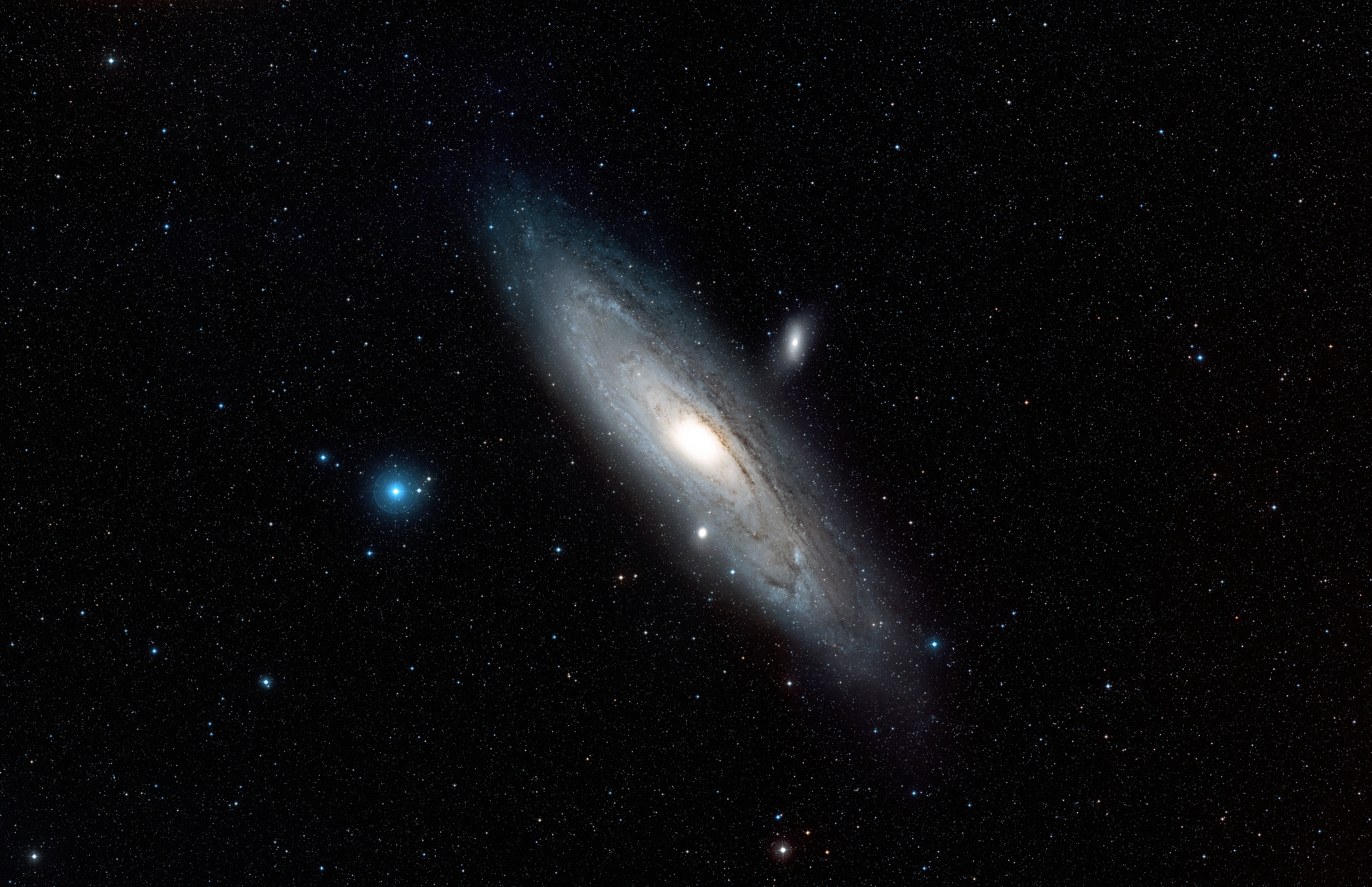
Wide-field view of the Andromeda Galaxy
 Date: 21 July 2011
Depicts: Andromeda Galaxy, Messier 31
Copyright: ESA/Hubble & Digitized Sky Survey 2. Acknowledgment: Davide De Martin (ESA/Hubble)
Show in archive: true
This ground-based image shows the full extent of the Andromeda Galaxy, also known as Messier 31 or M31. The Andromeda Galaxy appears very large in the sky - several times the size of the full Moon (although much fainter). Hubble is designed to make highly detailed observations of much smaller patches of sky: the space telescope's observations of the Andromeda Galaxy show individual stars and clusters rather than the broad spiral structure visible here. Wide-field images like this one give a broad overview.
Date: 21 July 2011
Depicts: Andromeda Galaxy, Messier 31
Copyright: ESA/Hubble & Digitized Sky Survey 2. Acknowledgment: Davide De Martin (ESA/Hubble)
Show in archive: true
This ground-based image shows the full extent of the Andromeda Galaxy, also known as Messier 31 or M31. The Andromeda Galaxy appears very large in the sky - several times the size of the full Moon (although much fainter). Hubble is designed to make highly detailed observations of much smaller patches of sky: the space telescope's observations of the Andromeda Galaxy show individual stars and clusters rather than the broad spiral structure visible here. Wide-field images like this one give a broad overview.
Last Update: 1 September 2019