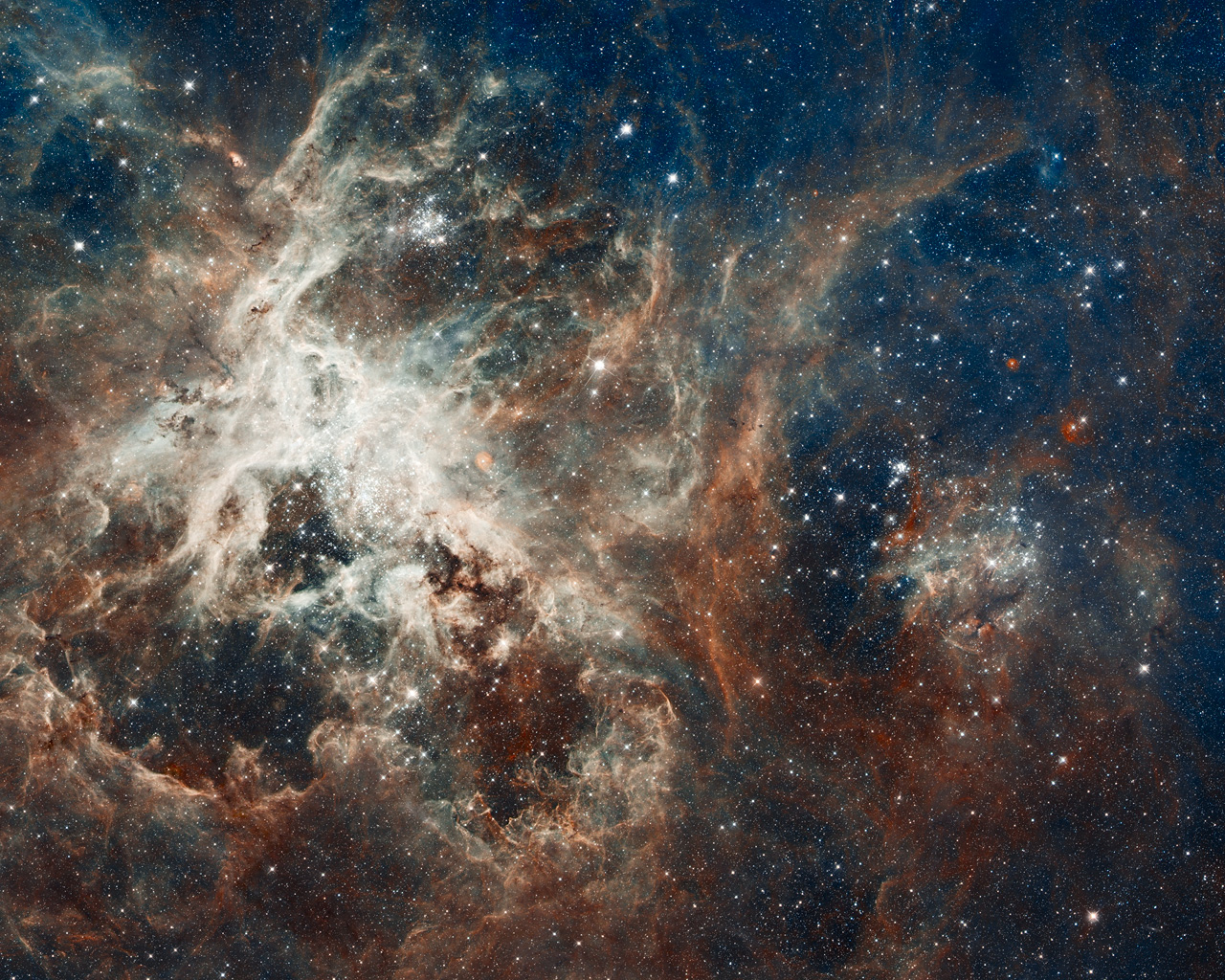
Hubble's panoramic view of a star-forming region

Date: 17 April 2012
Satellite: Hubble Space Telescope
Depicts: 30 Doradus, Tarantula Nebula
Copyright: see below
30 Doradus is the brightest star-forming region in our galactic neighbourhood and home to the most massive stars ever seen. The nebula resides 170 000 light-years away in the Large Magellanic Cloud, a small, satellite galaxy of our Milky Way. No known star-forming region in our galaxy is as large or as prolific as 30 Doradus.
The image comprises one of the largest mosaics ever assembled from Hubble photos and includes observations taken by Hubble's Wide Field Camera 3 and Advanced Camera for Surveys, combined with observations from the European Southern Observatory's MPG/ESO 2.2-metre telescope which trace the location of glowing hydrogen and oxygen.
The image is being released to celebrate Hubble's 22nd anniversary.
Credit: NASA, ESA, ESO, D. Lennon and E. Sabbi (ESA/STScI), J. Anderson, S. E. de Mink, R. van der Marel, T. Sohn, and N. Walborn (STScI), N. Bastian (Excellence Cluster, Munich), L. Bedin (INAF, Padua), E. Bressert (ESO), P. Crowther (Sheffield), A. de Koter (Amsterdam), C. Evans (UKATC/STFC, Edinburgh), A. Herrero (IAC, Tenerife), N. Langer (AifA, Bonn), I. Platais (JHU) and H. Sana (Amsterdam)