ESA   HOME   SCIENCE OUTREACH   RESEARCH  EDUCATIONAL SUPPORT   DIRECTOR'S DESK   PRODEX 
 SEARCH 
 SOLAR SYSTEM  ASTROPHYSICS  FUNDAMENTAL PHYSICS  ADVANCED STUDIES & PAYLOADS   
 

A Cool Solar Core?

Date: 24 Apr 1998
Satellite: SOHO
Depicts: Solar Interior
Copyright: See below

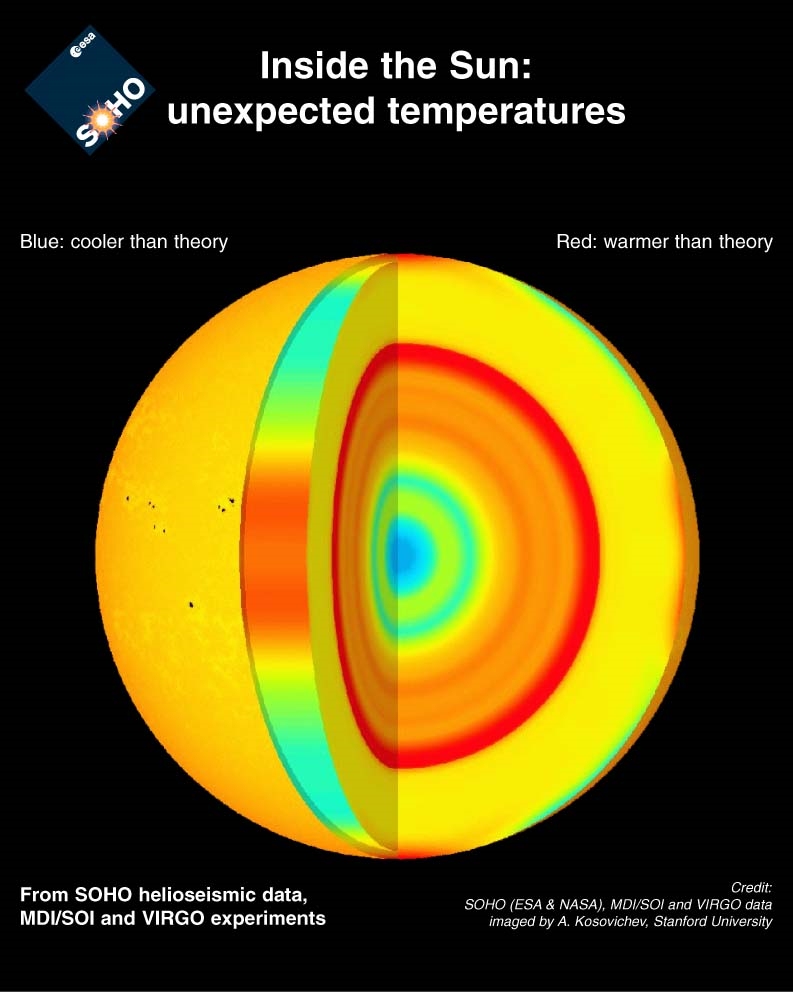
Concentric layers in a cutaway image show oddities in the speed of sound in the deep interior of the Sun, as gauged by two instruments on the SOHO spacecraft. MDI/SOI measures vertical motions due to sound waves reverberating through the Sun, at a million points on the visible surface. VIRGO detects the solar oscillations by rhythmic variations in the Sun's brightness.

From long-lasting observations by these instruments, scientists deduce information about the Sun's interior precise enough to put the theories of how the Sun works to a severe test.

In red coloured layers, sound travels faster than predicted by the theories, implying that the temperature is higher then expected. The conspicuous red layer, about a third of the way down from the surface to the Sun's centre, shows unexpectedly high temperatures at the transition zone between the turbulent outer region (convection zone) and the more stable region inside it (radiative zone).

Here MDI/SOI has measured a rapid change in the speed of rotation about the Sun's axis, between the faster-turning outer region and the slower interior. This shear layer may generate the magnetism that battles with the gas in the outer layer and causes frenzied activity at the visible surface, where MDI/SOI also charts sunspots (left). Resulting storms in the solar atmosphere can affect the Earth.

In blue coloured layers the sound speed is lower than expected, and temperatures are lower too. Most notable in this respect is the very core of the Sun, where the temperature may be 0.1 per cent cooler than the expected 15 million degrees C. Although the discrepancy seems small, it implies that the thermonuclear reactions in the core that power the Sun could be underperforming at present. If confirmed by prolonged observations by SOHO, the cool core may leave theorists wondering if the Sun varies its power-generation over long periods.

Built in Europe for the European Space Agency, SOHO carries twelve sets of instruments provided by European and American investigators and it was despatched into space on 2 December 1995 by a NASA launcher. SOHO is a project of international cooperation between ESA and NASA.

Credit: SOHO (ESA & NASA), MDI/SOI and VIRGO data imaged by A. Kosovichev, Stanford University


____________________________________
Last Update: 25 May 2005
LATEST SELECTION
SOHO/VIRGO integrated sunlight
LASCO Captures Four Planets
Active Region No. 905
IMAGE HI-RES VERSIONS
Hi-Res [jpg] 203.39 kb.
SEE ALSO
INFO 15-1998: Surprises from SOHO include tornadoes on the Sun
 
 LEGAL DISCLAIMER   SITEMAP  GLOSSARY  SUBSCRIBE   CONTACT FAQ 
  Copyright 2000 - 2010 © European Space Agency. All rights reserved.