
Jovian Minisat Explorer
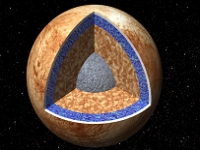
The scientific interest in Europa
 |
|
Schematic of the interior of Europa (Image credit: JPL) |
For the purpose of this study, the main scientific objective is to perform detailed remote sensing of Europa, with the potential deployment of a microprobe for in-situ analysis. The selected top-level scientific objectives include:
- Determination of the presence of a subsurface ocean
- Mapping of the ice thickness
- Measurement of the global topography and the tidal effects at Europa
- Characterisation of the global geology and surface composition
- Observation of the moon's magnetic field
- Measurement of the radiation environment
The Spacecraft
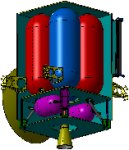
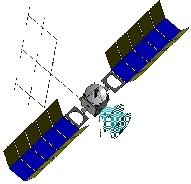
The current scenario foresees two relatively small spacecraft (~400/600 kg), the Jovian Relay Spacecraft and the Jovian Europa Orbiter.
 |
|
Jovian Relay Spacecraft |
 |
|
Jovian Europa Orbiter |
Jovian Relay Spacecraft (JRS)
The JRS will act as a relay spacecraft in a highly elliptical orbit around Jupiter, (outside the highest radiation zones). It will carry all subsystems that are not directly required for the Europa observation mission, such as the communication system providing the link between Earth and the JEO as well as a small, highly integrated scientific payload suite dedicated to the study of the Jovian system.
Jovian Europa Orbiter (JEO)
The JEO will orbit Europa. It will carry another highly integrated remote sensing payload suite and a communication system for communications with the JRS and Earth.
Microprobe
The feasibility of a compact microprobe (<1 kg) to perform in-situ measurement of the ice crust is also being assessed. If feasible it would be added to the JEO payload to be released from the Europa orbit.
Mission Architecture
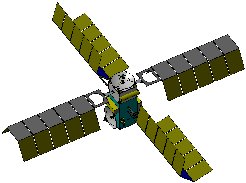
The JEO and the JRS will be stacked for launch in a Soyuz Fregat 2B launch vehicle from Kourou. This composite configuration will be maintained for the 6-year transfer phase as well as the Jupiter Orbit Insertion. Following the insertion manoeuvre the two spacecraft will be separated, after which the two spacecraft will perform their separate tours of the Jovian system to reach their final orbits (these JRS and JEO tours will last between 1 and 1.5 years, respectively).
 |
|
The JRS-JEO composite (EADS Astrium) |
Payload
A strawman payload has been conceived for the Jovian Minisat Explorer TRS and a breakdown for each spacecraft is given in the tables below.
| JEO Instrument | Mass (kg) |
Power (W) |
JRS Instrument | Mass (kg) |
Power (W) |
| Ground Penetrating Radar | 6.0 |
20 |
Radiation Environment Monitor | 1.5 |
1.7 |
| Stereo Camera | 0.6 |
1.2 |
Plasma Wave Instrument | 3.5 |
1.6 |
| Spectrometer | 2.0 |
2 |
Narrow Angle Camera | 1.5 |
1 |
| Radiometer | 2.0 |
1 |
Magnetometer | 1.2 |
0.95 |
| Laser Altimeter | 2.0 |
2.5 |
Dust Detector | 1.0 |
1 |
| Magnetometer | 1.4 |
0.45 |
Data & CPU | 2.0 |
3.25 |
| Spectrometer | 3.1 |
1 |
Shielding (20%) | 2.1 |
- |
| Radiation Environment Monitor | 1.5 |
1 |
Structures | 2.0 |
- |
| Units | 2.5 |
3.83 |
|||
| Shielding (20%) | 4.2 |
- |
|||
| Structures | 2.0 |
- |
|||
| Margin (20%) | 5.5 |
6.6 |
Margin (20%) | 2.9 |
1.9 |
| Total | 32.7 |
39.6 |
Total | 17.7 |
11.4 |
Table 1: Sample Strawman Payloads for the Jovian Europa Orbiter (JEO) and the Jovian Relay Spacecraft (JRS)
Mass Budget
| |||||||||||||||||||||||||||||||
|
Table 2: JME Mass Budget |
The Challenges
The JME Technology Reference Study is intended to identify the technologies required for a mission to the Jovian system or other outer planets. The following issues have been identified as enabling for such a mission:
Radiation: The spacecraft electronics need protection against radiation levels in excess of 5 Mrad (after 4 mm of Al shielding). Radiation hardening of the components to a level of 1 Mrad is envisaged, the remaining radiation protection will be provided by shielding.
Power generation: The 5.2 AU (average) distance from the Sun results in 1/25th of the solar flux received in Earth orbit, which significantly reduces the available power leading to the requirement of low resource systems and payloads. The solar power generator will also need to be compatible with this low intensity solar flux as well as with the low temperature (GaAs LILT cells with solar concentrators are foreseen). Should these developments prove to be inadequate, Radioisotope Thermoelectric Generator (RTG) technology will have to be taken into consideration.
Thermal: The spacecraft must be compatible with both hot (Venus fly-by) and cold (Jovian system) temperatures. The use of active heat transfer (fluid loop) as well as Radioisotope Heater Units (RHU's) might be required.
Communications: New developments will be required to operate in both X- and Ka-band to facilitate the inter spacecraft and Earth-spacecraft communications. High data rate (1 Mbps) KA-X transponders for both TC and TM and high efficiency Ka-band Solid State Power Amplifiers (SSPA) (3.5 W RF, 30% efficient) are envisioned.
Planetary protection: COSPAR planetary protection requirements for Europa are of the highest level. As JEO will impact on Europa, this will impose serious restrictions for the spacecraft. It will limit the selection of materials and will require complex and costly integration and decontamination procedures. In-flight decontamination by the severe radiation in the Jovian system must also be exploited as much as possible.
Spacecraft autonomy: The long mission duration and hostile environment call for a highly autonomous mission capability. A robust autonomous system will reduce costs by significantly reducing the need for operations control from Earth. A high degree of autonomy will also be required for time critical manoeuvres (i.e. gravity assist, orbit insertion) and error recovery as the communication lag time could lead to mission failure before control input from the ground could be received.
Microprobe impact: The deployment of microprobes on atmosphereless bodies, without a descent stage, leads to very high impact velocities (in the order of several km/s). Therefore, materials and subsystems capable of withstanding very high decelerations (> 100 000 g) will be required if a low mass microprobe is to be deployed on Europa or any other Jovian moon.
Study details
This study was completed in 2005. It was performed by SRE-PAP in cooperation with EADS Astrium (spacecraft design and mission analysis), Cosine Research B.V. (payload design) and ESA/ESOC (mission analysis).
Contact Information
For further information about this study please contact the study manager:
Dr. Peter FalknerHead of Planetary and Solar System Exploration Studies Section (SRE-PAP)
Advanced Studies and Technology Preparation Division (SRE-PA)
European Space Agency, ESA-ESTEC
Postbus 299, NL-2200 AG Noordwijk, The Netherlands
tel: +31 71 565 5363
e-mail: Peter.Falkner
 esa.int