
Laser Mass Spectrometer
Built around a miniature mass spectrometer and a laser ablation system; the LMS was designed initially to be deployed on an airless body, in the frame of the rover of the BepiColombo mission to Mercury. But the concept can easily be adapted for planets with an atmosphere such as Mars, for example.
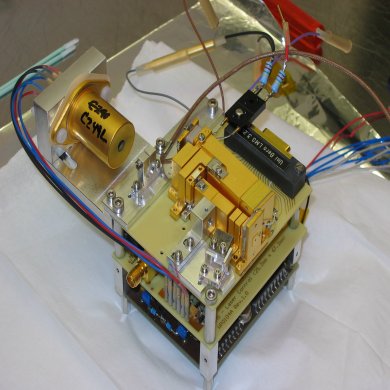 |
|
Prototype LMS Instrument |
Its purpose is to measure the elemental and isotopic composition of solids, for example: rocks and soils in a single instrument. It combines a mass analyzer and an ion source where the ions are directly coupled into the mass analyzer after they have been formed by green laser ablation.
The key characteristics of the LMS are:
- A small size and weight to allow its accommodation in a rover
- A limited power consumption (an estimated 3 W for the flight instrument)
- A laser ablation system as the ion source which avoids the need for the preparation of the sample
- A spatial resolution of 10 microns, better than the regolith grain size on Mercury. It should be noted that this resolution is lateral as well as vertical which would give an accurate insight of the mineralogy on Mercury and therefore helps to constraint the different evolution model of the planet.
The latest prototype, which will be tested in the SCI-A lab, has a demonstrated mass resolution m/∆m of 180 and a high dynamic range. Its size is roughly 100 × 80 × 70 mm at the moment but the flight instrument is expected to have a size of 70 × 30 × 40 mm and a mass of 280 g.
The developing team members are from the University of Berne (lead institution), the Swedish Institute of Space Physics, the Max-Planck Institute fur Aeronomie and Cosine.