
Annular Eclipse 2005
The eclipse path of totality runs from the North Atlantic, across southern Europe (Portugal and Spain) and Africa to the Indian Ocean.
|
Time (UT) |
Location |
|
08:41 |
North Atlantic - start point |
|
08:56 |
Madrid, Spain |
|
09:05 |
Algiers, Algeria |
|
10:31 |
Central Sudan - greatest eclipse |
|
11:10 |
Lake Rudolf, Kenya |
|
11:30 |
South Somalia |
|
12:22 |
Indian Ocean - end point |
|
Time and location of points lying on the path of totality | |
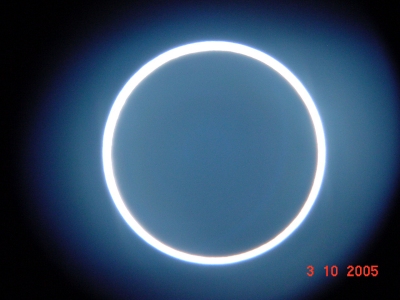
The condition for an annular eclipse to occur, apart from the Earth, Moon and Sun lining up, is that the apparent diameter of the Moon is smaller than the apparent diameter of the Sun. At the point of totality when the Moon lines up exactly with the Sun, the Moon will not fully cover the solar disk, leaving a ring of light (annulus) still visible around the Moon.
This condition can be met, because the Moon's apparent diameter varies with time as its orbit around the Earth is not a perfect circle, but an ellipse. At the furthest point in its orbit, or apogee, the Moon appears ~14% smaller than when it is at its nearest point in its orbit, or perigee. Because the apparent size of the Sun varies only by ~3% due to the ellipticity of the Earth's orbit, when the Moon is near apogee it will not cover the full solar disk during an eclipse resulting in an annular eclipse.
Images from ESAC, Madrid, Spain
Astronomers from the European Space Astronomy Centre (ESAC) gathered just 30 km outside of Madrid to observe the event.
|
|
|
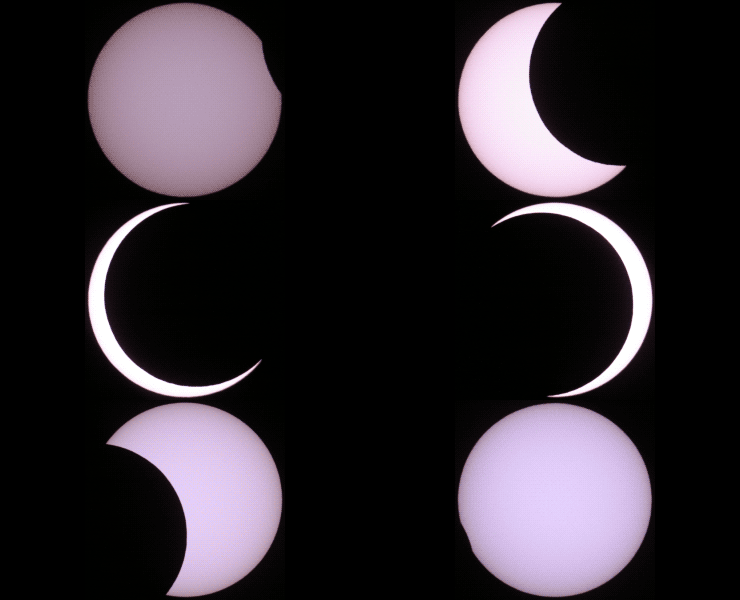
Movie of over 400 images taken by the observers near Madrid. |
 | |
|
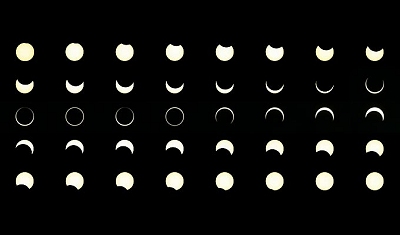
Overview of the event with 40 images showing the different phases of the eclipse. | |
 | |
|
The annular phase. | |
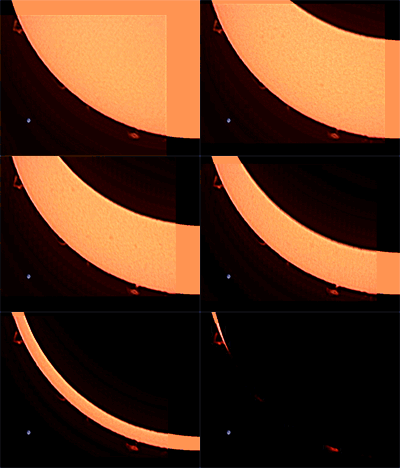 |
Sequence of images taken through an H-alpha filter, showing part of the solar disk with prominences. The movie was recorded with a Coronado Personal Solar Telescope (PST) and webcam. Observers: Metcalfe, Baskill, Breitfellner, and the ESAC Astronomy Club. |
 | |
|
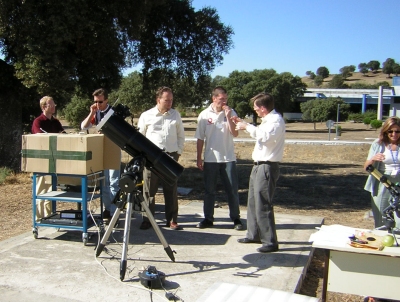
Eclipse watchers from ESAC at the observing location near Madrid. | |
More images from Spain
 |
|
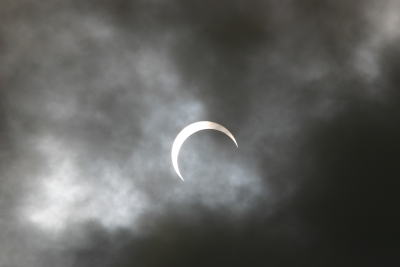
The eclipse seen from Spain. Courtesy Jorge Caetano Alves |
Images from ESTEC, Noordwijk, the Netherlands
|
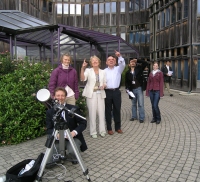
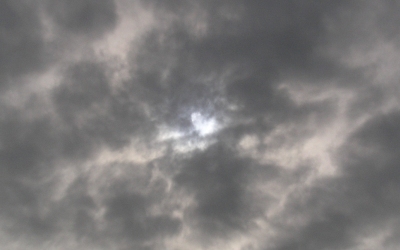
A desperate group of eclipse observers tried to get a glimpse of the partial solar eclipse today, 3 October 2005. However, all they saw was the clouds... Detlef Koschny reported having seen about 3 seconds of the Sun, with the Moon clearly obscuring the lower 40% of it, just after the maximum coverage. Alas, it wasn't even time enough to hand over the special eclipse glasses to anybody else. |
 |
 | |
Images from SMART-1 team in Portugal
After a SMART-1 science team meeting and outreach event at Coimbra university from 29 September to 1 October, members of the SMART-1 team moved to the eclipse central line in the north of Portugal.
There were people of all ages and from everywhere in Portugal, from the city of Beja, Lisbon, Coimbra, Aveiro, Porto and many other places. The locals all participated and were very excited with the activity that the event caused in their quite town of Argoselo which is situated south of Bragança in north east Portugal.
 |
|
|
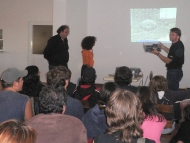
SMART-1 public outreach at the eclipse site in Argoselo. |
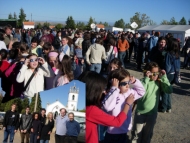
The young public watching the eclipse from Argoselo , Portugal. SMART-1 team members in inserted picture. |
On a plateau at 1020 metres, different tents were set up for public outreach in astronomy, meteorites and the SMART-1 mission. The outreach activities mainly took place on Sunday 2 October. The team gave three talks for an inquisitive public: Manuel Grande presented SMART-1, Jean-Luc Josset presented the AMIE instrument and Barry Kellet presented the D-CIXS instrument. Beforehand, Vera Fernandes gave a talk about what we know and don't know about the Moon, to set up the stage for SMART-1, and a talk about hunting meteorites in Antartica.
On 3 October, the partial eclipse started at 07:00 and the total annular solar eclipse occurred at 09:54 Portuguese time.
During the eclipse, about 300 people were at Argoselo looking at the heavens. The children patiently awaited the rare natural phenomenon, and when the 90% annular solar eclipse took place everyone clapped. The instructions to look at the Sun only with dark glasses were followed by everyone, and one man even brought his big welder mask to look at the Sun.
