
Fairing Installation
17 October 2005
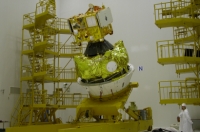
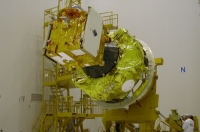
Today, Monday 17 October 2005, the payload fairing has been successfully installed on the nose block (composite of Fregat Upper Stage and Venus Express spacecraft). The first part of the activity was the tilting of the nose block from vertical to horizontal position. With both the spacecraft and the Upper Stage being fully fuelled the activity is classified as hazardous, and was hence conducted with the minimum number of personnel present in the clean room.
 |
 |
|
Lowering of the nose block to horizontal position | |
Once the nose block was fixed in horizontal position a couple of tasks had to be finished by the spacecraft AIT team before the installation of the fairing could start. All red tag items, such as the spacecraft's hoisting points, protective covers for the payloads, startrackers and solar array wings, had to be removed to get the spacecraft into its final flight-ready status. This was followed by the final visual inspection of the spacecraft to give the clearance for fairing installation, after which the spacecraft would not be physically accessible from the outside anymore.
 |
 |
|
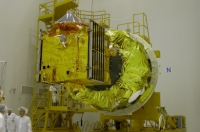
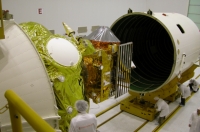
Installation of the fairing over the nose block | |
With all this completed the Russian specialist team eventually proceeded with the installation of the fairing on the nose block. For this activity the nose block remains statically in its horizontal position. The fairing is horizontally installed on a movable piece of MGSE (Mechanical Ground Support Equipment), and is slowly moved over the nose block until it finally covers the Venus Express spacecraft as well as the Fregat upper stage and eventually makes contact with the Interstage section which constitutes the interface between Fregat and the Soyuz 3-stage launch vehicle. With the fairing in place the Russian team proceeded with the installation of specific hinges and pushers that will in flight control the jettison of the fairing just a couple of minutes after liftoff.
All activities were successfully completed, and the newly constituted Upper Composite (Fregat, spacecraft and Fairing, including interstage section and the Launch Vehicle Adapter) is now awaiting tomorrow's final preparations for the 40-kilometre train transfer from the MIK-112 integration hall to the launch vehicle integration building MIK-40 in the launch pad area.
