
Sun-Earth Day 2001
| Sun-Earth Day The European Space Agency invites you to join with us in promoting Sun-Earth Day, on 27-28 April. This is an exciting opportunity to ponder our links with the nearest star and to celebrate the discoveries of ESA's solar observatories, SOHO, Cluster and Ulysses. Read More. |
|
| What happened on Sun-Earth Day? To celebrate Sun-Earth Day (27 - 28 April 2001), special events were organised throughout Europe, the USA and Canada. Here are local reports of some of these events. Read More. |
|
|
Biggest solar flare on record is seen by SOHO |
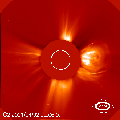 |
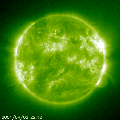
| What's happening on the Sun? Another powerful X-class flare was fired off by the Sun on Tuesday, 10 April. X-class flares are the most powerful classification, and this flare, rated X2, was the most recent in a series that included the X20 flare from 2 April. Read More on the 2 April flare. Read More on the 10 April flare. |
 |
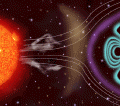
| Space weather Our Sun plays a central role in daily life, by warming and lighting the world, and powering the growth of living plants. Learn more about space weather and its effects. Read More. |
 |
| Five years of discoveries with SOHO have made the Sun transparent Anyone troubled by storms on the Sun will now have an extra week's early warning of eruption risks, by courtesy of the SOHO spacecraft. Learn more about SOHO's SWAN instrument and MDI instrument and their different ways of detecting activity on the Sun's far side. Read More. |
|
| SOHO SOHO is a project of international cooperation between ESA and NASA. Stationed 1.5 million kilometres out, on the sunward side of the Earth, it enjoys an uninterrupted view of the Sun and can thus make observations that would be impossible to obtain from ground. SOHO homepage |
|
| Cluster Cluster is the most recent of ESA's solar missions to begin observing the Sun and is part of an international programme to find out more about how the Sun and Earth interact. The four satellites which make up the Cluster flotilla join an armada of spacecraft from many countries which are already studying the Sun. Cluster homepage |
|
| Ulysses A joint ESA and NASA mission, Ulysses is charting the previously unknown reaches of space above and below the poles of the Sun. Exploring our star's environment is vital if scientists are to build a complete picture of the Sun, how it works and its effect on the Solar System. Ulysses homepage |
|
| Exhibition and artwork by 'Art Race In Space' / Pour "Le Roi Soleil" As a new approach to communicate the current understanding of solar science as revealed by ESA's solar fleet (SOHO, Ulysses and Cluster), ESA and 'Art Race In Space' have initiated the process of updating solar iconography. Read More. |
Last Update: 1 September 2019