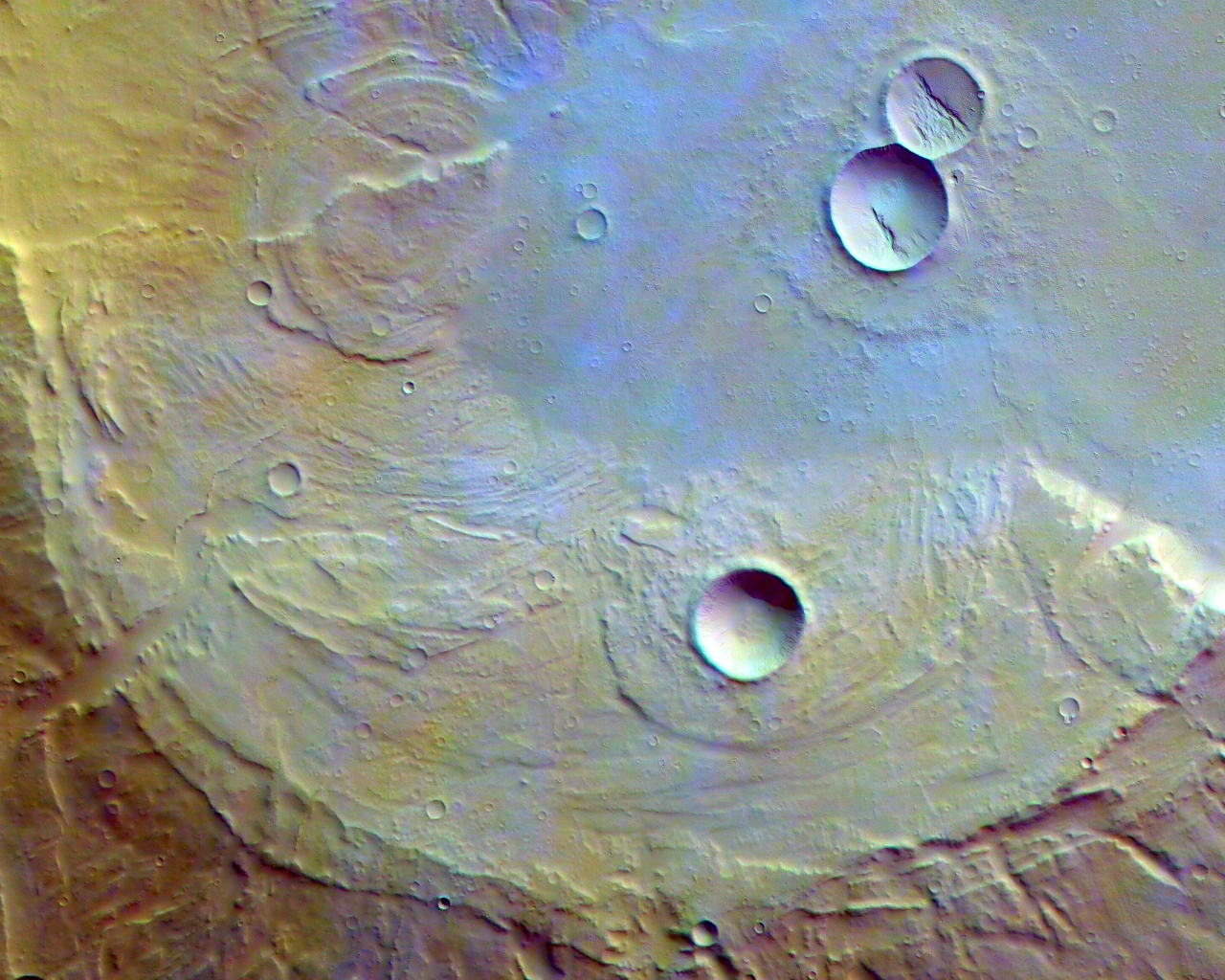
Apollinaris Patera Caldera

Date: 09 June 2006
Satellite: Mars Express
Depicts: Celdera of Apollinaris Patera shield volcano
Copyright: ESA/DLR/FU Berlin, CC BY-SA IGO 3.0
This image taken by the High Resolution Stereo Camera (HRSC) shows the caldera of Apollinaris Patera. The image was obtained during orbit 987 with a ground resolution of approximately 11.1 metres per pixel. North is to the right.
Apollinaris Patera lies at approximately 7.2° South and 174.6° East and is an ancient shield volcano located at the northern edge of the Southern Highlands, lying to the south-east of Elysium Planitia and to the north of Gusev Crater. The volcano measures approximately 180 by 280 kilometres at its base and rises to a maximum of 5 kilometres above the surrounding terrain.
Shield volcanos are large volcanic structures with gently sloping flanks. The caldera of Apollinaris Patera takes the form of a large crater approximately 80 kilometres in diameter and up to 1 kilometre deep. Volcanic calderas are formed when a volcano explodes or when the cone collapses.
In this image, the terrain is partly covered by thin, diffuse, whitish-appearing clouds. The western region (top of the image) is characterized by brighter material, which seems to be layered and could be the result of sedimentary deposition. Distinct layering, causing a terrace-like appearance, is also visible east of this brighter material and in the relatively flat region located in the northwest (top right).
The colour scene has been derived from the three HRSC-colour channels and the nadir channel. Image resolution has been decreased for use on the internet.
This work is licensed under a Creative Commons Attribution-ShareAlike 3.0 IGO License.