
Double Star Mission Extension
9 November 2006
On 8 November 2006, the Science Programme Committee (SPC) of the European Space Agency (ESA) has approved a 9 months extension of ESA involvement in the Double Star Programme (DSP) operations from 1 January 2007 to 30 September 2007.
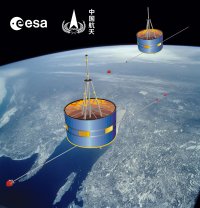 |
ESA contributed to the construction/refurbishment and pre-integration of the eight European instruments, and is now acquiring data for 4 hours per day using the VILSPA-2 ground station near Madrid, Spain. ESA also co-ordinates the scientific operations for the European instruments. China's contribution included the two spacecraft buses, eight scientific experiments, and the launch. China also conducts the spacecraft and Chinese instrument operations.
The orbits have been designed to complement the Cluster mission by maximizing the time when both Cluster and Double Star are sampling the same scientific regions at different distances from the Earth. The two missions allow simultaneous observations of the Earth's magnetosphere from six points in space. To facilitate the comparison of data, half of the Double Star payload (with the exception of the NUADU instrument) is made up of spares or duplicates of Cluster experiments; the other half consists of new Chinese instruments.
Scientific highlights
The 2.5 years of DSP mission has brought many new perspectives concerning the boundaries of the magnetosphere and the fundamental processes that are playing a role in the transport of mass, momentum and energy into the magnetosphere. Double Star is providing new results thanks to its orbits skimming many key plasma regions (bow shock, magnetopause and near Earth plasma sheet), with its new instrumentation (neutral atom imager) and high telemetry rate for the particle instruments (allowing 3D electron and ion distribution function up to 4 s resolution). We can also see, for the first time, the evolution of structures and physical processes at small scales within the Cluster tetrahedron, and then at large scales with Double Star. Among the main science results obtained during the first extension are:
Density holes in the solar wind
- Ion density holes were discovered near the bow shock that can play a role in bow shock formation
http://sci.esa.int/jump.cfm?oid=39559
Magnetic reconnection
- Characterisation of shape and motion of flux transfer events for the first time with five spacecraft
http://sci.esa.int/jump.cfm?oid=40340 - Confirmation that a special type of so-called "component-reconnection" can take place, even when the interplanetary magnetic field and the geomagnetic field are not completely opposite (using a statistic of more than 130 cases of magnetopause crossings)
- Detection of flux ropes in the tail showing that reconnection is taking place at multiple points along the magnetotail
Geomagnetic substorms
- Relation between magnetospheric dipolarisation observed by Double Star near the Earth and bursty bulk flows observed further down the magnetotail by Cluster
Plasma entry in the magnetosphere
- Role of Kelvin-Helmholtz vortices and double lobe reconnection
- Magnetopause motion and deformation measured over large scales
- Low-latitude boundary layer formed by three distinct plasma layers and their equivalent into the polar cusp
Inner magnetosphere and energetic particles
- Chorus emissions further away from Earth during high geomagnetic activity
- New technique developed to derive ENA images at different L shells
- Extent of ion structures in local time and changes of the ring current population after a storm
- Loss of energetic electrons and associated whistler waves in the inner magnetosphere
Astronomy
- Magnetar (SGR 1806) - biggest starquake ever fully recorded with the electron instruments, while almost all instruments on dedicated astronomy satellites equipped to observe Gamma-rays were saturated at the onset of this event
http://sci.esa.int/jump.cfm?oid=38091
Scientific rationale to extend the mission
A large number of papers have appeared in refereed literature since the Double Star launch. A special issue of Annales Geophysicae on the first Double Star results was published in November 2005 and contained 24 papers. Since most Double Star papers are associated with Cluster data, Double star papers are counted with the Cluster list of publications, and as of November 2006, this list contains 531 papers.
The principal goal for extending the mission a further 9 months (January 2007 to September 2007) is to complete the dayside season with new conjunctions between Cluster and Double Star. During the proposed second extension period, the orbital planes of Cluster and Double Star TC-1, which were originally aligned, will become separated by around 60 deg. in azimuth or 'local time', providing new Cluster-Double Star conjunctions, or rather constellations. Many magnetospheric processes that take place on the dayside and nightside magnetosphere are believed to extend in local time, but there has been paucity in observations to fully characterize them. For instance:
- the azimuthal extent of the phenomena of reconnection and resultant magnetospheric reconfiguration (e.g. flux transfer events), a fundamental process of plasma transfer into the magnetospheric system
- the longitudinal extent of magnetic field dipolarization on the nightside and of associated bursty bulk flows, the understanding of which would aid in characterizing and better modelling of geomagnetic substorms
The new large separations between Cluster and Double Star will also enable the study of the effect of big solar events like large coronal mass ejections or high speed solar wind streams on the magnetosphere on a global scale. Having Cluster on the dawnside and Double Star on the duskside during a large part of the extension will facilitate the monitoring of the impact of such events on the magnetosphere, and the resultant magnetospheric compression, in particular the level of symmetry between the dawn and dusk flanks.
Furthermore, after the malfunction of the IMAGE spacecraft in December 2005, Double Star TC-2 is presently the only Earth orbiting spacecraft with a Neutral Imager. During the proposed 9 month extension, a few solar storms are expected to occur and could be particularly well studied with the Neutral Atom Imager instrument NUADU.
Finally, new solar terrestrial missions are just being prepared for launch and they will certainly enhance the scientific objectives of Double Star as well as benefit from the Double Star extension. First, the recently launched NASA Stereo spacecraft will look at the Sun's explosive events, like Coronal Mass Ejections (CMEs), and characterize their propagation in the heliosphere. Double Star will simultaneously look at the interaction of these CMEs with the Earth's bow shock and magnetopause. THEMIS, another new NASA mission will study the origin of the geomagnetic substorms. The five THEMIS satellites have apogees opposite to Cluster's and the Double Star TC-1 apogee is located approximately in between. About half of the magnetosphere and its environment will be covered simultaneously with these three missions, making a total of 11 spacecraft.
"This will be the first time in history of Space Physics that such a high number of spacecraft is in operation simultaneously and represents an unprecedented scientific opportunity to study the global solar-magnetospheric environment and the physical processes involved", comments Philippe Escoubet, Double Star and Cluster project scientist of the European Space Agency.
Contact
Philippe Escoubet
SCI-SM division, RSSD, ESA, The Netherlands
e-mail: Philippe.Escoubet esa.int
phone: +31-71-565-3454