• → European Space Agency

    • About Science & Technology

    • For Public

    • For Educators

    • ESA

    • Science & Technology

    • Herschel

    • Missions
    • Show All Missions
    • Mission Home
    • Summary
    • Fact Sheet
    • Objectives
    • Participants
    • Mission Team
    • Industrial Team
    • Spacecraft
    • 3D Model
    • Instruments
    • Test Campaign
    • Mission Operations
    • Launch Information
    • Orbit/Navigation
    • Launch Vehicle
    • Launch Campaign
    • Status Reports
    • Science Operations
    • Science Ground Segment
    • Data Archive
    • Astronomers' Website
    • Outreach Resources
    • Resources
    • News Archive
    • Multimedia Gallery
    • Publication Archive
    • Status Report Archive
    • Calendar of Events
    • Services
    • Contact Us
    • Subscribe
    • Terms and Conditions
    • Bookmark and Share

    Herschel Cryostat Cooldown

    20 Mar 2008 13:23

    The Herschel spacecraft is set up in the ESTEC cleanroom where it is going through a cooldown, with the main helium tank in the cryostat vacuum vessel (CVV) slowly being filled with liquid helium. The setup for this carefully monitored process was started end January with a smooth cooldown of the helium tank to a temperature of about 4 K and complete filling with more than 2000 litres of liquid helium.
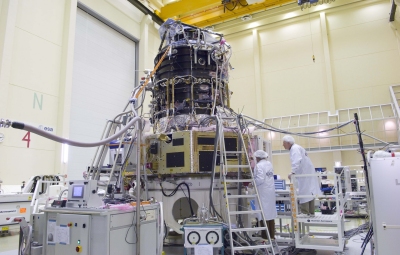
    Preparations for the cooldown of the CVV, 22 January 2008

    The gradual cooldown proceeded at a rate of about -2 degrees per hour to achieve similar cooling rates throughout the cryostat especially for the very sensitive focal plane units of the scientific instruments.

    The CVV comprises two helium tanks: the large superfluid helium II tank (HTT) and the smaller helium I tank (HOT). The main HTT will hold ~2300 litres of superfluid helium used to cool the payload to the required operational temperatures.

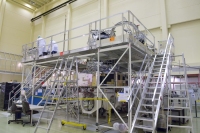
    The setup of the cryostat cooldown with the access scaffolding to the CVV that (mated onto the Service Module) is resting on the vertical integration stand, 15 February 2008

    With the main HTT at 4 K, several tests, also essential functional tests of the scientific instruments, are being performed on the spacecraft.

    After completion of these tests and the completion of the spacecraft integration, with the most spectacular ones the mounting of the telescope and the solar array, the satellite will enter the mechanical test phase with vibration and acoustic noise testing in May.


    Last Update: 20 Mar 2008

    • Shortcut URL
    • http://sci.esa.int/jump.cfm?oid=42444
    • Journal
    • Archives
    • Images and Videos
    • Cryostat Cooldown Setup
    • Cryostat Cooldown
    • Cryostat Cooldown

    Connect with us

    • RSS
    • Youtube
    • Twitter
    • Flickr
    • Google Buzz
    • Livestream
    • Subscribe
    • App Store
    • ESA Science Twitter

    Follow ESA science

    • Copyright 2000 - 2013 © European Space Agency. All rights reserved.

    • Terms and Conditions