
Looking at Jupiter to understand Earth
5 December 2008
Magnetic substorms observed at Jupiter have recently been compared with those that occur at Earth, shedding new light on this phenomenon. This study was based on data obtained with the ESA Cluster and NASA Galileo spacecraft.Periodic Substorms at Earth
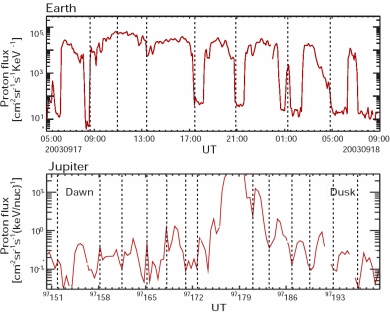
One such aspect is their occurrence. While terrestrial substorms are often observed as isolated events, sequences of substorms can also occur with a quasi-periodic repetition time between 2 and 3 hours. Figure 1a illustrates this behaviour with measurements collected by the RAPID experiment onboard one of the four ESA Cluster satellites. More than the duration itself, the central question is whether the main driver of a periodic substorm is internal to the magnetosphere or external (of solar origin). Several case studies have been reported on this subject using data collected in the Earth's environment but none so far was able to resolve this debate. An original approach was taken by Elena Kronberg and colleagues (Max-Planck-Institut für Sonnensystemforschung, Germany) to tackle this problem: can we learn something from other planets?
Comparing Jupiter and Earth
In terms of energetic particles at Earth, a periodic substorm is characterized by gradual decreases (flux dropouts) followed by rapid increases (injections) of proton fluxes with a 2-3 hours periodicity (Figure 1a). A similar behaviour is observed at Jupiter with a 2-3 days periodicity (Figure 1b). This longer duration is at least partly due to the stronger internal magnetic field emanating from Jupiter that induces a larger magnetosphere.
 |
|
Figure 1a. [Earth] Energetic protons (28 - 64 keV) measured by Cluster SC1 in the terrestrial magnetotail from DOY 259 to DOY 260 in 2003. |
Detailed analysis of data collected by several missions (Cluster, Geotail, LANL, Galileo) reveal that, both at Earth and Jupiter, the reconfiguration of the magnetic field undergoes the same three step evolution during each cycle of a periodic substorm: growth phase, expansion phase and recovery phase. Moreover, both the periodic substorms at Earth and Jupiter undergo similar processes leading to the high-energy flux dropouts during the growth phase (Figure 1).
Jovian and terrestrial phenomena driven by same process?
In a paper published in 2007, Kronberg and co-authors reported that periodic substorms at Jupiter were connected to the constant release of matter by the Jovian satellite, Io. In other words, the driver of this phenomenon is internal to the (Jovian) magnetosphere.
"The comparison of the periodic substorms at Earth and Jupiter shows a striking similarity," reports Kronberg in her more recent paper published 12 April 2008 in the Journal of Geophysical Research.
As a lesson learned from the Jovian magnetosphere, Kronberg and co-authors propose in their recent paper that under certain conditions periodic magnetospheric substorms at Earth can be driven also internally by mass-loading from the plasmasphere (see also "Cluster takes a new look at the plasmasphere", in the right-hand menu).
"The Cluster mission, and its nearly 900 refereed papers, has significantly increased our knowledge of the various physical processes occurring in the environment of Earth. This has enabled a better understanding of data collected around planets of our Solar System. But we are delighted to get such scientific feedback from Jupiter!" says Philippe Escoubet, Cluster project scientist at the European Space Agency.
Reference publication
Kronberg, E. A., et al., (2008), Comparison of periodic substorms at Jupiter and Earth, J. Geophys. Res., 113, A04212, doi:10.1029/2007JA012880
Related publication
Kronberg, E. A., et al., (2007), A possible intrinsic mechanism for the quasi-periodic dynamics of the Jovian magnetosphere, J. Geophys. Res., 112, A05203, doi:10.1029/2006JA011994
Contact
Dr. Elena Kronberg
Max-Planck-Institut für Sonnensystemforschung, Max-Planck-Str. 2, 37191 Katlenburg-Lindau, Germany, phone:+495556979481
kronberg mps.mpg.de
Web story author and co-editor
Arnaud Masson
Science and Robotic Exploration Directorate, ESA, The Netherlands
Arnaud.Massonesa.int, phone: +31-71-565-5634
Web story editors
Philippe Escoubet
Science and Robotic Exploration Directorate, ESA, The Netherlands
Philippe.Escoubetesa.int, phone: +31-71-565-4564
Matt Taylor
Science and Robotic Exploration Directorate, ESA, The Netherlands
Mtaylorrssd.esa.int, phone: +31-71-565-8009
