• → European Space Agency

    • About Science & Technology

    • For Public

    • For Educators

    • ESA

    • Science & Technology

    • Planck

    • Missions
    • Show All Missions
    • Mission Home
    • Summary
    • Fact Sheet
    • Objectives
    • Participants
    • Mission Team
    • Industrial Team
    • Spacecraft
    • Spacecraft
    • 3D Model
    • Instruments
    • Cooling system
    • Mission Operations
    • Launch Information
    • Orbit/Navigation
    • Launch Vehicle
    • Launch Campaign
    • Science Operations
    • Science Ground Segment
    • Planck Legacy Archive
    • Outreach Resources
    • Outreach Resources
    • Resources
    • News Archive
    • Multimedia Gallery
    • Publication Archive
    • Calendar of Events
    • Services
    • Contact Us
    • Subscribe
    • Terms and Conditions
    • Bookmark and Share

    Planck spacecraft check-outs near completion

    11 Mar 2009 09:59

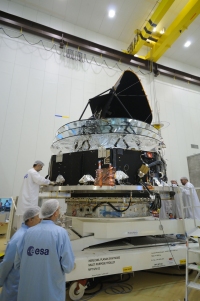
    Recent activities around the Planck spacecraft have included the installation of multi-layer insulation on the solar array, preparations for helium filling, several sub-system functional tests and the final cleaning of the spacecraft before launch.

    MLI thermal covering is installed

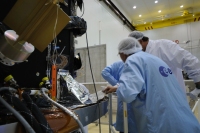
    On Wednesday, 4 March, the multi-layer insulation (MLI) was secured to the outer part of the solar array at the base of the service module. The final inspections of the MLI and solar array were performed immediately after this operation.

    Below and to the right: Inspection of the solar array's MLI after installation, 4 March 2009

    To the left and above: Installation of the MLI on the solar array, 4 March 2009

    Preparations for helium filling

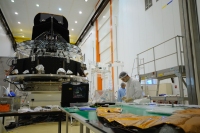
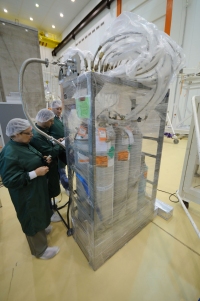
    Preparation of the helium supply cylinders in the S1B clean room, 4 March 2009

    The LFI and HFI instruments on Planck will operate at extremely low temperatures, down to 20K for the LFI and 0.1 K for HFI. In order to achieve the low temperatures certain elements are cooled using 3He and 4He. This helium is stored on board in dedicated tanks under very high pressure at launch and slowly depleted during the mission. The pressurisation equipment used in the helium filling operation was placed in the S1B clean room in the middle of last week. The supply cylinders containing the pressurised helium were inspected as part of the activities to ensure that everything would be in place for the actual filling activities that have started on Monday 9 March.

    Functional tests

    In the second half of last week several system reference tests (SRT), part of the series of ongoing functional tests, were successfully completed. These verified the health of the spacecraft's four major sub-systems, responsible for power conditioning, thermal control, attitude measurement and control, and for command and data management. One more SRT is scheduled for next week, this time to verify the telemetry and tele-command subsystem (TT&C).

    Spacecraft cleaning
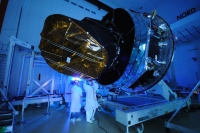
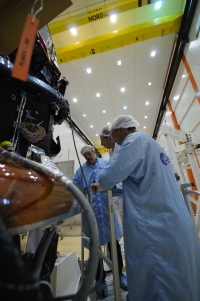
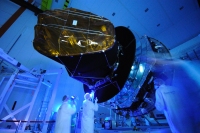
    On Friday 6 March, the spacecraft was meticulously cleaned with a special vacuum hoover. The spacecraft's surface was inspected using UV light to detect dust particles that fluoresce after UV illumination. During the operation the spacecraft was slowly rotated on its spin-axis in order to be able to inspect every corner.
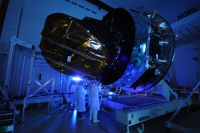
    Inspection and cleaning of the spacecraft using UV light to detect fluorescing dust particles, 6 March 2009

    Note: All photographs on this page are copyright ESA. Larger versions of the photographs can be accessed by clicking on the images.


    Last Update: 12 Mar 2009

    • Shortcut URL
    • http://sci.esa.int/jump.cfm?oid=44380
    • Journal
    • Archives
    • See also
    • Launch campaign entries
    • Images and Videos
    • MLI installation on the solar array
    • MLI installation on the solar array
    • Inspection of the solar array's MLI
    • Inspection of the solar array's MLI
    • Helium filling preparations
    • Final cleaning of the spacecraft
    • Final cleaning of the spacecraft
    • Final cleaning of the spacecraft

    Connect with us

    • RSS
    • Youtube
    • Twitter
    • Flickr
    • Google Buzz
    • Livestream
    • Subscribe
    • App Store
    • ESA Science Twitter

    Follow ESA science

    • Copyright 2000 - 2013 © European Space Agency. All rights reserved.

    • Terms and Conditions