
Cluster & Double Star: 1000 publications
18 June 2009
The Cluster and Double Star missions have reached the milestone of 1000 scientific publications in peer-reviewed journals. After almost nine years in space, the four Cluster spacecraft, which are still in good health, continue to produce new science and cross new regions of space. Last year, 2008, produced the most publications in a single year since launch.The Sun-Earth connection in 3D
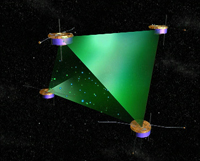 |
| Image 1. The Cluster satellites in tetrahedron configuration. Credit: ESA |
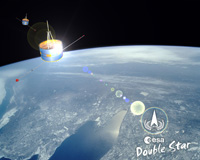 |
| Image 2. The Double Star mission. Credit: ESA |
Launched in 2000, Cluster is the first space mission composed of four identical spacecraft orbiting the Earth in a tetrahedron configuration (Image 1). Together, these spacecraft are able to perform pioneering studies of the impact of the Sun on the Earth’s space environment in three dimensions (3D).
Some of the Cluster flight spare instruments were also used to make up half of the scientific instrument payload of the Double Star Programme (DSP): the first Chinese scientific space mission. DSP is. composed of two spacecraft (Image 2), launched in 2003 and 2004.
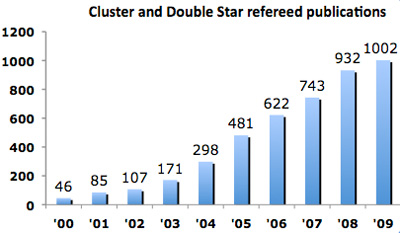
These two coordinated missions have led to a wealth of scientific results (see scientific highlights). The total number of publications based on Cluster/DSP data has now reached 1000. Image 3 displays the cumulative sum of papers published in the past nine years. Note that more than 25 % of all these papers have been published over the past 18 months, reflecting the increased usage of these data. Part of this growing interest is due to the online availability of the Cluster data. The fully calibrated, high time resolution data sets, are provided together with software tools and value-added products.
 |
|
Image 3. Cluster & Double Star cumulative sum of peer-reviewed publications up until May 2009. Note that the publication number in 2000 takes into account all papers prior to, and including, the year 2000. Credit: ESA |
The Cluster scientific community
The Cluster and Double Star scientific community, based on authors and co-authors of papers, numbers around 1000 people. Of these scientists, the most prolific in terms of publications as first author are:
| Top 10 scientists in terms of the number (#) of peer-reviewed articles published as first author and using Cluster/Double Star data | ||
| Top 10 scientists | # | Institutes |
| Zong, Q.G. | 16 | School of Earth and Space Sciences, Peking University, Beijing, China and Center for Atmospheric Research, University of Massachusetts-Lowell, USA |
| Nakamura, R. | 14 | Austrian Academy of Sciences, Space Research Institute, Graz, Austria |
| Dunlop, M.W. | 12 | Rutherford Appleton Laboratory and Imperial College, UK |
| Eastwood, J.P. | 11 | Space Science Laboratory, UC Berkeley, USA |
| Santolík, O. | 11 | Institute of Atmospheric Physics and Charles University, Faculty of Mathematics and Physics, Prague, Czech Republic |
| Volwerk, M. | 11 | Austrian Academy of Sciences, Space Research Institute, Graz |
| Runov, A. | 10 | Austrian Academy of Sciences, Space Research Institute, Graz, now working at UCLA, USA |
| De Keyser, J. | 9 | BIRA-IASB, Belgian Institute for Space Aeronomy, Brussels, Belgium |
| Sonnerup, B. | 9 | Dartmouth College, Hanover, New Hampshire, USA |
| Vörös, Z. | 9 | Austrian Academy of Sciences, Space Research Institute, Graz, now at University of Innsbruck, Austria. |
The range of journals in which the Cluster/Double Star community publish is broad (see "Distribution of Cluster publications", linked in the right-hand menu). It is noteworthy that 10% of the Cluster & Double Star papers have been accepted in journals not dedicated to space physics such as, Nature or Physical Review Letters, with a recent increase of Cluster/Double Star publications in these more general physics journals. This reflects a trend of the science of the Cluster mission moving to a broader appeal beyond magnetospheric science.
Cluster and Double Star science highlights
3D vision of magnetic reconnection in space
The first observation of two linked magnetic reconnection sites was made using data collected by the four Cluster spacecraft. This pioneering discovery help constrain theoretical models of magnetic reconnection, a universal phenomenon in space related to star formation, solar explosions and the entry of solar wind energy into the near-Earth environment (see related ESA top story).
First direct measurement of the ring current
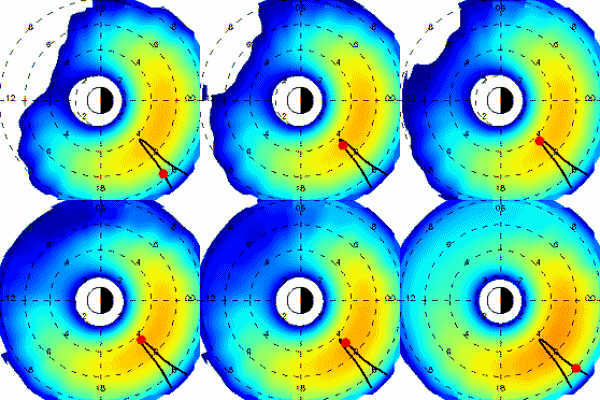 |
The first current density measurements in the ring current region, based on data acquired simultaneously by four spacecraft, have been derived by Cluster. Analysis of five months of data allowed a partial mapping of the ring current region under various geomagnetic conditions. This information is of prime importance to quantitatively estimate the changes occurring in the ring current (for example the input of particles, amount of current created, etc.) during the development of magnetic storms (see related ESA top story).
Giant vortices of plasma at the edge of Earth’s magnetosphere
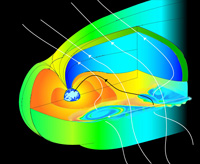 |
Cluster, ESA's quartet of space-weather watchers, has discovered vortices of ejected solar material high above the Earth. The superheated gases trapped in these structures are probably tunnelling their way into the Earth’s magnetic 'bubble', the magnetosphere. This discovery solved a 17-year mystery of how the magnetosphere is constantly topped up with electrified gases when it should be acting as a barrier (see ESA top story).
Discovery of the extent of surface waves in the 'magnetotail'
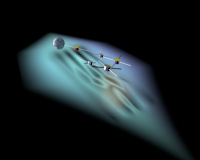 |
For the first time, neutral sheet oscillations observed simultaneously at tens of thousands kilometres distance are reported, thanks to observations by five satellites of the Cluster and the Double Star Programme missions. This observational first provides further constraints for models of this large-scale phenomenon in the magnetotail (see ESA top story).
Beamed radio emission from Earth
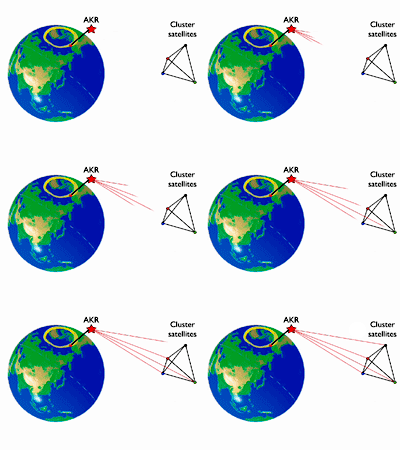 |
A Cluster study revealed how the most powerful emission of terrestrial origin, the Auroral Kilometric Radiation (AKR), is beamed into space. These Cluster data were found to be inconsistent with two leading AKR beaming theories developed 30 years ago, but support a more recent one. The result has important implications for radio studies of planetary magnetospheres, including radio searches for exoplanets (see ESA top story).
"This milestone of 1000 publications would not be possible without the interest, dedication and excellence of the Cluster science community, whose time and effort makes the mission such a success. In particular, after the tragic failure of the first Cluster mission in 1996, this milestone is a testament to those involved in resurrecting the phoenix from the ashes and securing the re-build of the Cluster spacecraft and mission", says Matt Taylor, ESA Cluster Project Scientist.
"Cluster is the first mission to capture space plasma physics in three dimensions and it has paved the way for the future of space plasma physics, a future that necessitates a larger fleet of spacecraft sampling many different scales simultaneously. Such missions are in progress (NASA’s Magnetospheric Multiscale mission) or being studied (Cross-Scale by ESA) and would not have been possible without the implementation and success of the Cluster mission", says Philippe Escoubet, ESA Cluster Mission Manager.
Contacts
Arnaud Masson, Science and Robotic Exploration Directorate, ESA, The Netherlands.
Arnaud.Masson esa.int, phone: +31-71-565-5634
Matt Taylor, Science and Robotic Exploration Directorate, ESA, The Netherlands.
Matthew.Tayloresa.int, phone: +31-71-565-8009
Philippe Escoubet, Science and Robotic Exploration Directorate, ESA, The Netherlands.
Philippe.Escoubetesa.int, phone: +31-71-565-4564
Melvyn Goldstein, NASA Cluster project scientist, NASA Headquarters, Washington DC, USA.
melvyn.l.goldsteinnasa.gov