• → European Space Agency

    • About Science & Technology

    • For Public

    • For Educators

    • ESA

    • Science & Technology

    • Herschel

    • Missions
    • Show All Missions
    • Mission Home
    • Summary
    • Fact Sheet
    • Objectives
    • Participants
    • Mission Team
    • Industrial Team
    • Spacecraft
    • 3D Model
    • Instruments
    • Test Campaign
    • Mission Operations
    • Launch Information
    • Orbit/Navigation
    • Launch Vehicle
    • Launch Campaign
    • Status Reports
    • Science Operations
    • Science Ground Segment
    • Data Archive
    • Astronomers' Website
    • Outreach Resources
    • Resources
    • News Archive
    • Multimedia Gallery
    • Publication Archive
    • Status Report Archive
    • Calendar of Events
    • Services
    • Contact Us
    • Subscribe
    • Terms and Conditions
    • Bookmark and Share

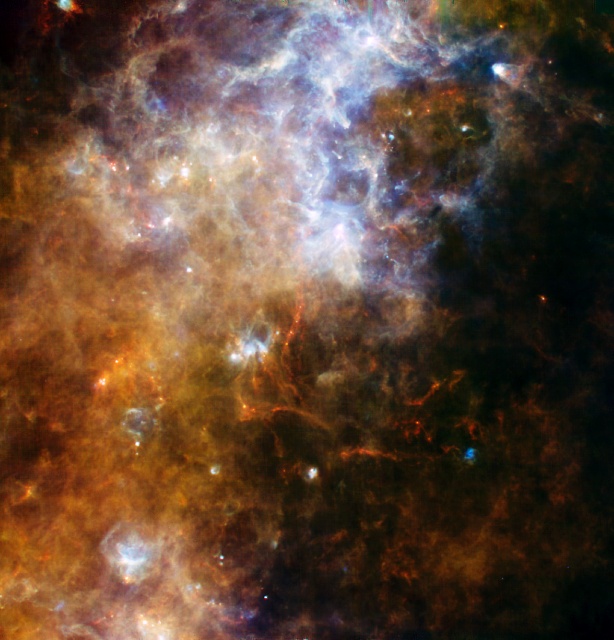
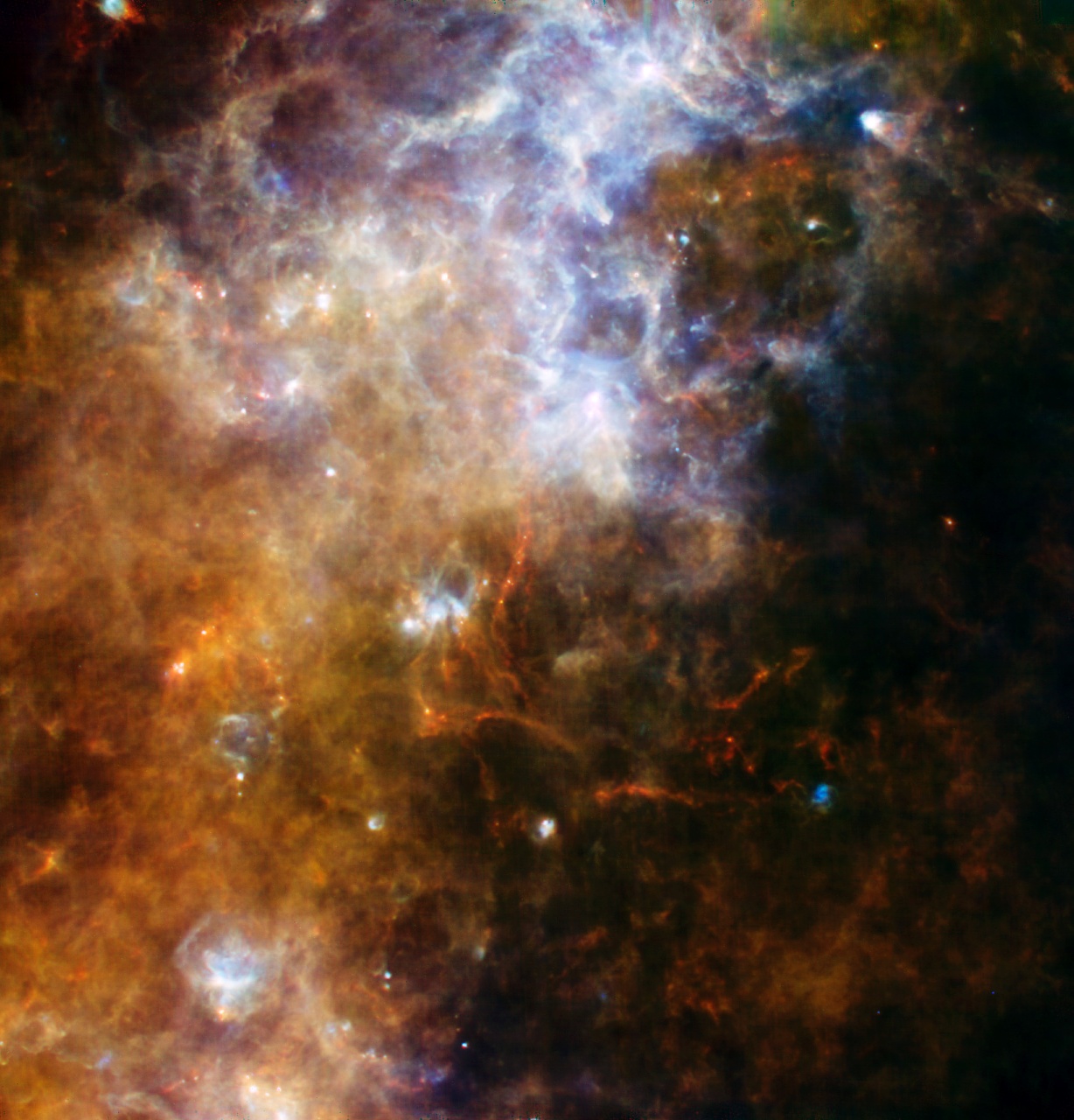
    SPIRE/PACS parallel mode observation from performance verification phase

    Date: 02 Oct 2009
    Satellite: Herschel
    Copyright: ESA and the SPIRE & PACS consortia

    This composite image has been constructed from individual SPIRE and PACS images which have been combined by colour coding the different observed wavelengths: here blue denotes 70 µm and green 160 µm emission, while red is the combination of the emission from all three SPIRE bands at 250/350/500 µm.

    The images are of a 2×2 degree field in an area near the Galactic Plane, 60 degrees from the Galactic Centre, in the constellation of the Southern Cross. This region is considered to be a good test case for verification and demonstration purposes as it is typical of crowded fields where there may be many molecular clouds along the line-of-sight. The images shown here were obtained on 3 September 2009 and are based on just over 6 hours of observations.

    This image clearly demonstrates how the colour-coding allows us to differentiate material that is extremely cold (red) from that which is slightly warmer. Since stars form in cold, dense environments, the composite image easily locates the star-forming filaments that would be very difficult to isolate from a map made at a single far-infrared or submillimetre wavelength. This is especially important in a very crowded field like this, which is likely to include many molecular clouds along the line of sight. The image contains an incredible network of filamentary structures with surprising features indicative of a chain of near-simultaneous star-formation events, glittering rather like beads of water on a string in the sunlight.
    Last Update: 22 Mar 2013

    • Shortcut URL
    • http://sci.esa.int/jump.cfm?oid=45626
    • Latest selection
    • Multi-wavelength view of the merging galaxy pair HXMM01
    • Herschel view of the merging galaxy pair HXMM01
    • Merging galaxies in the young Universe discovered with Herschel
    • Image Hi-Res Versions
    • Hi-Res [jpg]
      127.77 kb.
    • Hi-Res [jpg]
      377.16 kb.
    • Hi-Res [jpg]
      1,222.72 kb.
    • See also
    • Herschel images reveal new detail in the Milky Way

    Connect with us

    • RSS
    • Youtube
    • Twitter
    • Flickr
    • Google Buzz
    • Livestream
    • Subscribe
    • App Store
    • ESA Science Twitter

    Follow ESA science

    • Copyright 2000 - 2013 © European Space Agency. All rights reserved.

    • Terms and Conditions