• → European Space Agency

    • About Science & Technology

    • For Public

    • For Educators

    • ESA

    • Science & Technology

    • Planck

    • Missions
    • Show All Missions
    • Mission Home
    • Summary
    • Fact Sheet
    • Objectives
    • Participants
    • Mission Team
    • Industrial Team
    • Spacecraft
    • Spacecraft
    • 3D Model
    • Instruments
    • Cooling system
    • Mission Operations
    • Launch Information
    • Orbit/Navigation
    • Launch Vehicle
    • Launch Campaign
    • Science Operations
    • Science Ground Segment
    • Planck Legacy Archive
    • Outreach Resources
    • Outreach Resources
    • Resources
    • News Archive
    • Multimedia Gallery
    • Publication Archive
    • Calendar of Events
    • Services
    • Contact Us
    • Subscribe
    • Terms and Conditions
    • Bookmark and Share

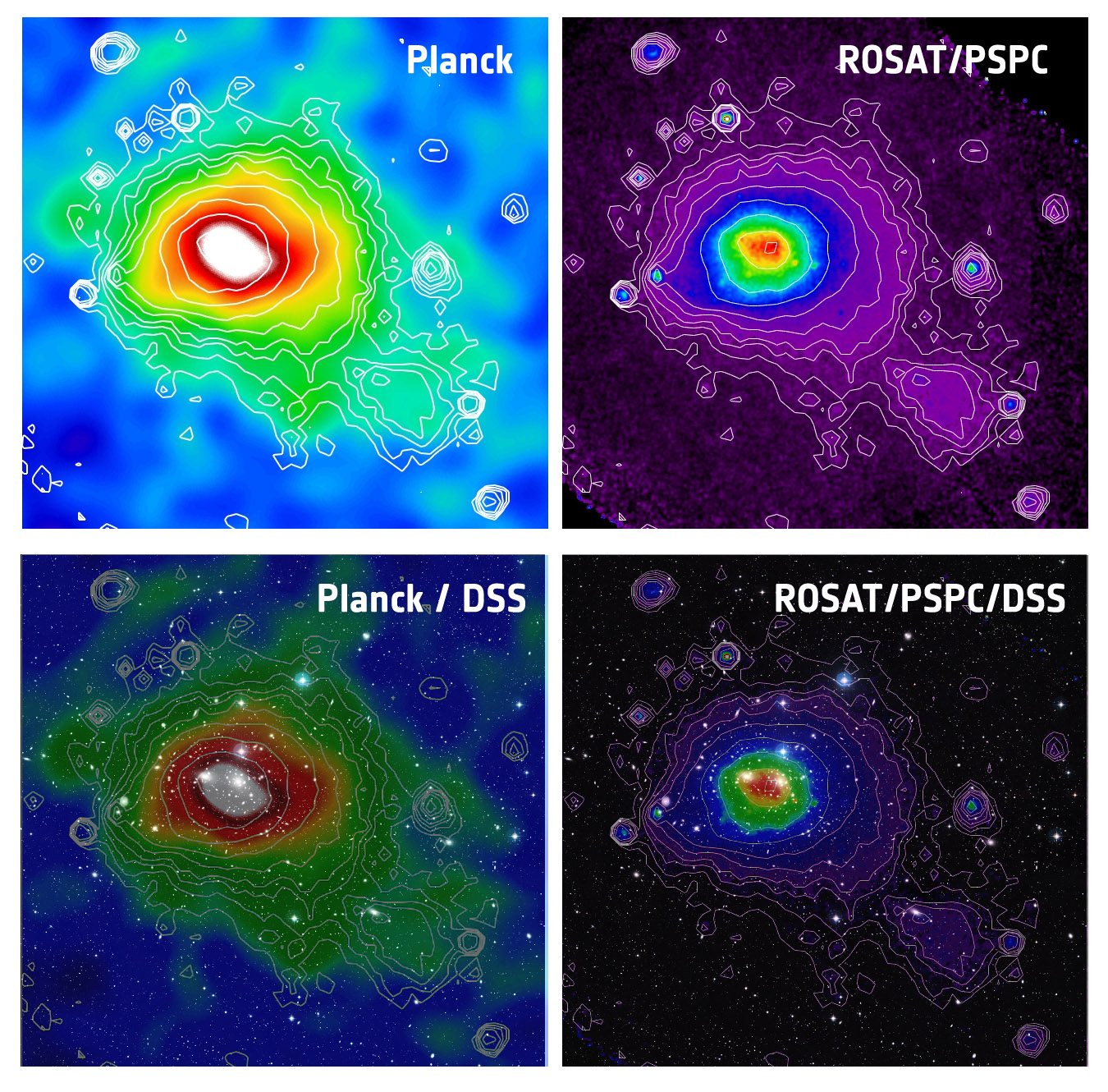
    The Coma cluster

    Date: 15 Sep 2010
    Satellite: Planck
    Copyright: Planck image: ESA/ LFI & HFI Consortia; ROSAT image: Max-Planck-Institut für extraterrestrische Physik; DSS image: NASA, ESA, and the Digitized Sky Survey 2. Acknowledgment: Davide De Martin (ESA/Hubble)

    These images of the Coma cluster (also known as Abell 1656), a very hot and nearby cluster of galaxies, show how it appears through the Sunyaev-Zel'dovich Effect (top left) and X-ray emission (top right).

    The top-left panel shows the Sunyaev-Zel'dovich image of the Coma cluster produced by Planck, and the top-right panel shows the same cluster imaged in X-rays by the ROSAT satellite. The colours in both images map the intensity of the measured signals. The X-ray contours are also superimposed on the Planck image as a visual aid.

    As a comparison, the images are shown superimposed on a wide-field optical image of the Coma cluster from the Digitised Sky Survey in the two lower panels.

    Located at a distance of about 300 million light-years from us, the Coma cluster extends over more than two degrees on the sky, corresponding to over 4 times the angular size of the full Moon. This image of the Coma cluster highlights Planck's ability to observe objects on very large scales, thanks to its all-sky survey strategy.

    The region depicted in each image is slightly larger than 2 degrees.

    Last Update: 15 Sep 2010

    • Shortcut URL
    • http://sci.esa.int/jump.cfm?oid=47695
    • Image Hi-Res Versions
    • Hi-Res [jpg]
      695.29 kb.
    • See also
    • Planck's first glimpse at galaxy clusters & a new supercluster

    Connect with us

    • RSS
    • Youtube
    • Twitter
    • Flickr
    • Google Buzz
    • Livestream
    • Subscribe
    • App Store
    • ESA Science Twitter

    Follow ESA science

    • Copyright 2000 - 2013 © European Space Agency. All rights reserved.

    • Terms and Conditions