• → European Space Agency

    • About Science & Technology

    • For Public

    • For Educators

    • ESA

    • Science & Technology

    • Herschel

    • Missions
    • Show All Missions
    • Mission Home
    • Summary
    • Fact Sheet
    • Objectives
    • Participants
    • Mission Team
    • Industrial Team
    • Spacecraft
    • 3D Model
    • Instruments
    • Test Campaign
    • Mission Operations
    • Launch Information
    • Orbit/Navigation
    • Launch Vehicle
    • Launch Campaign
    • Status Reports
    • Science Operations
    • Science Ground Segment
    • Data Archive
    • Astronomers' Website
    • Outreach Resources
    • Resources
    • News Archive
    • Multimedia Gallery
    • Publication Archive
    • Status Report Archive
    • Calendar of Events
    • Services
    • Contact Us
    • Subscribe
    • Terms and Conditions
    • Bookmark and Share

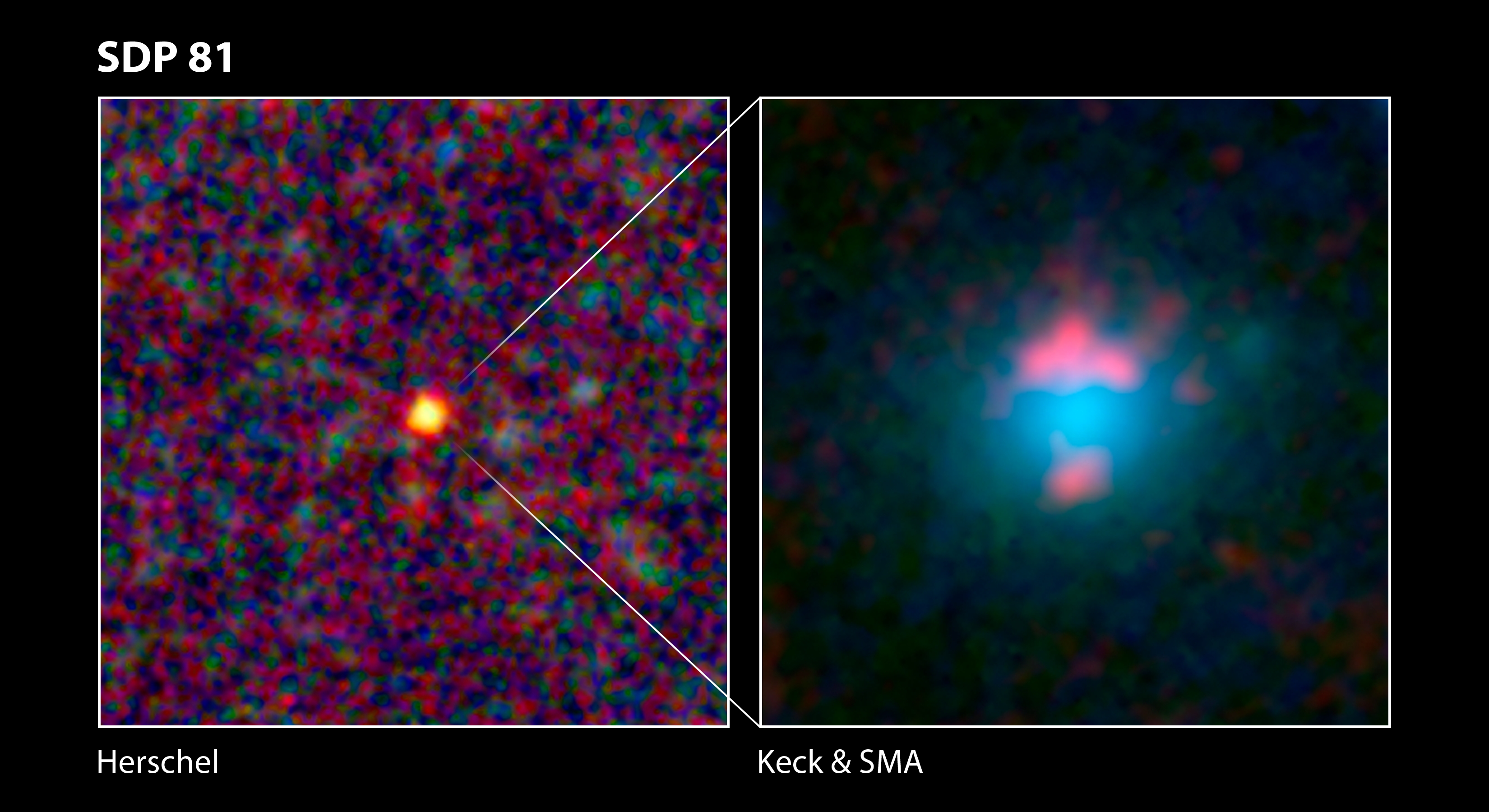
    A gravitational lens system discovered by Herschel

    Date: 04 Nov 2010
    Satellite: Herschel
    Depicts: Gravitational lens system
    Copyright: ESA/NASA/JPL-Caltech/Keck/SMA

    SDP 81 (left) is one of five distant sub-millimetre galaxies that were identified by the Herschel Space Observatory as being peculiar by virtue of appearing as particularly bright objects at sub-millimetre wavelengths. Closer observation at higher resolution using ground-based telescopes (right) revealed that Herschel had found a sub-millimetre galaxy being gravitationally lensed by another, foreground galaxy.

    In the right-hand panel, the foreground galaxy (blue) is seen at optical wavelengths by the W. M. Keck Observatory in Hawaii. The background galaxy (pink) shines brightly at much longer wavelengths, and was imaged using the sub-millimetre observations of the Smithsonian Astrophysical Observatory's Submillimeter Array, also in Hawaii. The light coming from the background galaxy is deflected by the mass of the foreground galaxy, producing a highly magnified and distorted image. The background galaxy is actually imaged more than once: the pink arc in the upper part of the image is in fact composed of three, merged images of the same galaxy, and the pink blob in the lower part is another additional image. Multiple images are a consequence of strong gravitational lensing.

    SDP 81 is one of five gravitational lens systems found in the first set of data released from the Herschel-ATLAS survey.

    Last Update: 04 Nov 2010

    • Shortcut URL
    • http://sci.esa.int/jump.cfm?oid=47893
    • Latest selection
    • Multi-wavelength view of the merging galaxy pair HXMM01
    • Herschel view of the merging galaxy pair HXMM01
    • Merging galaxies in the young Universe discovered with Herschel
    • Image Hi-Res Versions
    • Hi-Res [jpg]
      1,544.15 kb.
    • Hi-Res [tif]
      4,625.51 kb.
    • Related Images
    • Gravitational lenses in part of the Herschel-ATLAS survey field
    • Illustration of gravitational lensing
    • Part of the Herschel-ATLAS survey field
    • Scale reference for the Herschel-ATLAS survey field
    • Related Links
    • More on the Herschel-ATLAS survey
    • First data release of the Herschel-ATLAS survey
    • More about Herschel Key Programmes
    • See also
    • New method reveals gravitationally lensed galaxies in Herschel-ATLAS first survey

    Connect with us

    • RSS
    • Youtube
    • Twitter
    • Flickr
    • Google Buzz
    • Livestream
    • Subscribe
    • App Store
    • ESA Science Twitter

    Follow ESA science

    • Copyright 2000 - 2013 © European Space Agency. All rights reserved.

    • Terms and Conditions