Billion pixel Gaia camera starts to take shape
6 July 2011
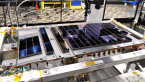
Another milestone in the development of Gaia, ESA's ultra-sensitive space astrometry mission, was passed on 1 June when the 106 electronic detectors of its billion pixel camera were assembled like a large mosaic for the first time.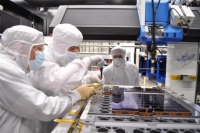 |
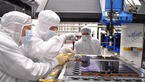
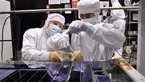
| Technicians carefully bolting and aligning each of the CCDs onto the support structure. Credit: Astrium |
During its ambitious mission to map one thousand million stars, the spinning Gaia spacecraft will monitor each of these pinpoints of light up to 70 times over a five year period. In order to detect distant stars about one million times fainter than the eye can see, Gaia will carry 106 charge coupled devices (CCDs), each of which is, effectively, a miniature camera.
These rectangular detectors, each measuring 6 × 4.7 cm, with a thickness of only a few tens of microns, are precisely fitted together on the CCD support structure (CSS). The gap between each CCD package is about 1 millimetre.
Made of silicon carbide, a material that provides remarkable thermal and mechanical stability, the CSS weighs about 20 kg. The overall CCD mosaic, a key part of the complete focal plane assembly, measures 1 × 0.5 metres.
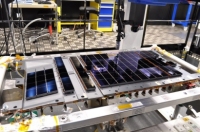 |
| The complete Gaia CCD mosaic. Credit: Astrium |
The contract to provide the Gaia CCDs was awarded to e2v Technologies of Chelmsford, UK, in summer 2005, and their production kept the company busy for more than 5 years. Each CCD converts incoming light into electrical charge and stores it as a tiny data package, or pixel, until it can be read by the onboard computer. The Gaia CCDs feature 4500 pixels in the along scan direction and 1966 pixels for across scan. With an overall total of about a thousand million pixels, Gaia's focal plane is the largest digital camera ever built for a space mission.
Over the past few weeks, technicians from the mission's prime contractor, Astrium France, have been carefully bolting and aligning each of the CCDs onto the support structure at the company's facility in Toulouse. Working in double shifts inside a Class 100 clean room, the rectangular focal plane mosaic has grown at a rate of about four CCDs per day.
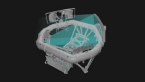
| The Gaia telescope elements and focal plane. Credit: ESA (For larger versions of this video click here) |
The completed focal plane is arranged in seven rows of CCDs. The main array, which comprises 102 detectors grouped into four fields, is dedicated to star detection. A further four CCDs are used for monitoring the stability of the 'basic angle' of 106.5 degrees between the two telescopes and the quality of the optical performances.
"The mounting and precise alignment of the 106 CCDs is a key step in the assembly of the flight model focal plane assembly," said Philippe Garé, ESA's Gaia Payload Manager.
As the two telescopes of the spinning Gaia spacecraft sweep across the sky, the images of stars in each field of view will move across the focal plane array. They will be detected first by the star mapper CCDs. Each of the two strips of seven CCDs detects star images only from its assigned telescope.
The confirmed star images will then move across a block of 62 astrometric field CCDs, where they are assigned tracking 'windows' and given a precise time stamp by a rubidium atomic clock.
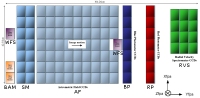 |
| Schematic of the Gaia focal plane. Credit: ESA - A. Short |
Next, the star images enter the photometric field where two rows of CCDs produce low-resolution spectra in different wavelength bands. The blue CCDs spread the light at wavelengths between 330 and 680 nm, while the spectrum created by the red CCDs goes from 640 to 1000 nm. These spectra are used for gathering colour information on the stars and for correction of the optical aberrations in the astrometric part of the instrument.
Finally, the star images enter the spectroscopic field where a spectrograph only allows light in the narrow band of 847 to 874 nm. The filtered light is then dispersed over 1100 pixels to detect characteristic spectral lines in this band. Subsequent analysis on the ground enables stellar velocities in the radial (line-of-sight) direction to be calculated, based on the red or blue shifts of the spectral lines.
Located 1.5 million km from Earth, Gaia will operate at a temperature of minus 110°C (163.15 K). This low temperature will be maintained by passive thermal control, including the cold radiator on the focal plane assembly and a giant sunshade attached to the top of the spacecraft.
"In parallel to the assembly of the CSS, Astrium is working on the cold radiator and the proximity electronics module. We are aiming to bring together all three parts of the focal plane assembly by October of this year," noted Garé.
Contact
Philippe Garé
Gaia Payload Manager
Email: Philippe.Gare esa.int
Phone: 31 (0)71 565 5671
Giuseppe Sarri
Gaia Project Manager
Email: giuseppe.sarriesa.int
Phone: +31 (0)71 565 4966
Timo Prusti
Gaia Project Scientist
Email: tprustirssd.esa.int
Phone: +31 (0)71 565 4794