• → European Space Agency

    • About Science & Technology

    • For Public

    • For Educators

    • ESA

    • Science & Technology

    • Herschel

    • Missions
    • Show All Missions
    • Mission Home
    • Summary
    • Fact Sheet
    • Objectives
    • Participants
    • Mission Team
    • Industrial Team
    • Spacecraft
    • 3D Model
    • Instruments
    • Test Campaign
    • Mission Operations
    • Launch Information
    • Orbit/Navigation
    • Launch Vehicle
    • Launch Campaign
    • Status Reports
    • Science Operations
    • Science Ground Segment
    • Data Archive
    • Astronomers' Website
    • Outreach Resources
    • Resources
    • News Archive
    • Multimedia Gallery
    • Publication Archive
    • Status Report Archive
    • Calendar of Events
    • Services
    • Contact Us
    • Subscribe
    • Terms and Conditions
    • Bookmark and Share

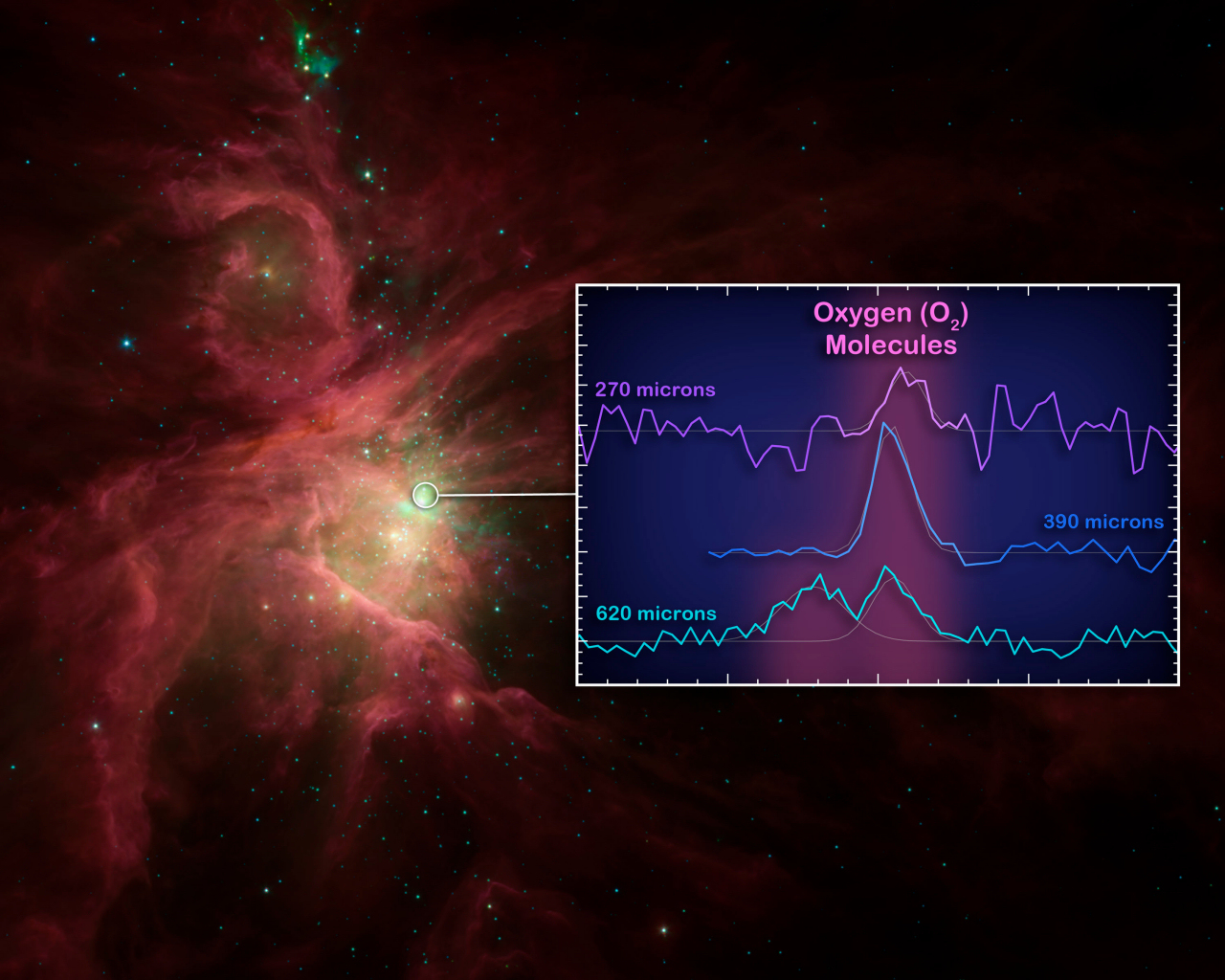
    Oxygen molecules detected in the Orion Nebula

    Date: 01 Aug 2011
    Satellite: Herschel
    Depicts: Detection of molecular oxygen in the Orion Nebula
    Copyright: ESA/NASA/JPL-Caltech

    This image shows the Orion Nebula, an iconic stellar nursery where stars are formed out of a dense mixture of gas and dust. A recent study, conducted with ESA's Herschel Space Observatory, has finally found the first robust evidence of molecular oxygen (O2), among the various chemical species in the nebula.

    The inset on the right-hand side shows three distinct lines emitted by oxygen molecules, at frequencies of 1121, 774 and 487 GHz, respectively, in the spectra taken with the HIFI spectrometer on board Herschel. As with many other molecules, O2 produces a number of lines at a distinct set of wavelengths, corresponding to energy released by the molecule as it undergoes changes in its rotation. These spectral lines are used by astronomers to track down the presence of a molecule in cosmic sources.

    Herschel data have revealed O2 in a dense patch of gas and dust adjacent to star-forming regions in the Orion Nebula. Astronomers believe that oxygen freezes out on dust grains in molecular clouds. However, in some spots, such as the one where O2 has been found, neighbouring newborn stars heat the icy grains, causing water ice to evaporate and re-establishing chemical reactions that result in the formation of O2.

    The image of the Orion Nebula was taken in infrared light by NASA's Spitzer Space Telescope.


    Last Update: 01 Aug 2011

    • Shortcut URL
    • http://sci.esa.int/jump.cfm?oid=49009
    • Latest selection
    • Herschel spectrum of the Galactic Centre
    • Artist's impression of the Galactic Centre
    • Jupiter after the impact of comet Shoemaker-Levy 9 in 1994
    • Image Hi-Res Versions
    • Hi-Res [jpg]
      574.19 kb.
    • See also
    • Herschel uncovers 'hidden' oxygen in Orion

    Connect with us

    • RSS
    • Youtube
    • Twitter
    • Flickr
    • Google Buzz
    • Livestream
    • Subscribe
    • App Store
    • ESA Science Twitter

    Follow ESA science

    • Copyright 2000 - 2013 © European Space Agency. All rights reserved.

    • Terms and Conditions