• → European Space Agency

    • About Science & Technology

    • For Public

    • For Educators

    • ESA

    • Science & Technology

    • Herschel

    • Missions
    • Show All Missions
    • Mission Home
    • Summary
    • Fact Sheet
    • Objectives
    • Participants
    • Mission Team
    • Industrial Team
    • Spacecraft
    • 3D Model
    • Instruments
    • Test Campaign
    • Mission Operations
    • Launch Information
    • Orbit/Navigation
    • Launch Vehicle
    • Launch Campaign
    • Status Reports
    • Science Operations
    • Science Ground Segment
    • Data Archive
    • Astronomers' Website
    • Outreach Resources
    • Resources
    • News Archive
    • Multimedia Gallery
    • Publication Archive
    • Status Report Archive
    • Calendar of Events
    • Services
    • Contact Us
    • Subscribe
    • Terms and Conditions
    • Bookmark and Share

    Detection of water vapour in the spectrum of TW Hydrae's protoplanetary disc
    Date: 20 Oct 2011
    Satellite: Herschel
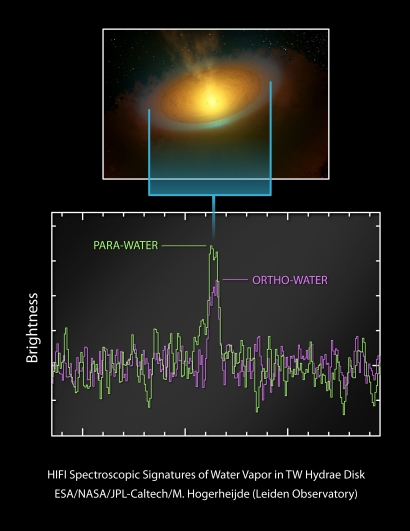
    Depicts: Artist's impression and spectrum of the TW Hydrae protoplanetary disc
    Copyright: ESA/NASA/JPL-Caltech/M. Hogerheijde (Leiden Observatory)

    This image shows an artist's impression of the icy protoplanetary disc around the young star TW Hydrae (upper panel) and the spectrum of the disc as obtained using the HIFI spectrometer on ESA's Herschel Space Observatory (lower panel).

    By analysing the spectrum, astronomers have detected the emission from cold water vapour in the planet-forming disc. The vapour arises when highly energetic radiation from the central star interacts with icy grains in the disc. The detection thus hints at a copious and otherwise undetectable supply of water ice hidden in the disc's deeper and colder layers.

    The graph in the lower panel shows the spectral signature of water vapour in the disc. Water molecules come in two "spin" forms, called ortho and para, in which the two spins of the hydrogen nuclei have different orientations. By comparing the relative amounts of ortho and para water, astronomers can determine the temperatures under which the water formed. Lower ratios indicate cooler temperatures, though in practice the analysis is much more complicated. The ratio of ortho to para water observed in TW Hydrae's protoplanetary disc is low enough to point to the presence of cold water vapour.


    Last Update: 20 Oct 2011

    • Shortcut URL
    • http://sci.esa.int/jump.cfm?oid=49514
    • Latest selection
    • Mapping Invisible Pools of Gas in Our Galaxy (Illustration)
    • Tracers of molecular gas across the plane of the Milky Way
    • Artist's impression of molecular gas across the Milky Way's plane
    • Image Hi-Res Versions
    • Hi-Res [jpg]
      1,196.68 kb.
    • Hi-Res [tiff]
      1,869.12 kb.
    • See also
    • Herschel discovers tip of cosmic iceberg around nearby young star

    Connect with us

    • RSS
    • Youtube
    • Twitter
    • Flickr
    • Google Buzz
    • Livestream
    • Subscribe
    • App Store
    • ESA Science Twitter

    Follow ESA science

    • Copyright 2000 - 2013 © European Space Agency. All rights reserved.

    • Terms and Conditions