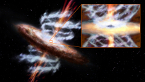
Evidence for ultra-fast outflows in radio-quiet AGNs. I. Detection and statistical incidence of Fe K-shell absorption lines
Publication date: 21 October 2010
Authors: Tombesi, F., et al.
Journal: Astronomy & Astrophysics
Volume: 521
Page: A57
Year: 2010
Copyright: ESO
Context: Blue-shifted Fe K absorption lines have been detected in recent years between 7 and 10 keV in the X-ray spectra of several radio-quiet AGNs. The derived blue-shifted velocities of the lines can often reach mildly relativistic values, up to 0.2-0.4c. These findings are important because they suggest the presence of a previously unknown massive and highly ionized absorbing material outflowing from their nuclei, possibly connected with accretion disk winds/outflows.
Aims: The scope of the present work is to statistically quantify the parameters and incidence of the blue-shifted Fe K absorption lines through a uniform analysis on a large sample of radio-quiet AGNs. This allows us to assess their global detection significance and to overcome any possible publication bias.
Methods: We performed a blind search for narrow absorption features at energies greater than 6.4 keV in a sample of 42 radio-quiet AGNs observed with XMM-Newton. A simple uniform model composed by an absorbed power-law plus Gaussian emission and absorption lines provided a good fit for all the data sets. We derived the absorption lines parameters and calculated their detailed detection significance making use of the classical F-test and extensive Monte Carlo simulations.
Results: We detect 36 narrow absorption lines on a total of 101 XMM-Newton EPIC pn observations. The number of absorption lines at rest-frame energies higher than 7 keV is 22.
- The remainder of the abstract is truncated -