• → European Space Agency

    • About Science & Technology

    • For Public

    • For Educators

    • ESA

    • Science & Technology

    • XMM-Newton

    • Missions
    • Show All Missions
    • Mission Home
    • Summary
    • Fact Sheet
    • Objectives
    • Orbit View
    • Spacecraft
    • Spacecraft
    • 3D Model
    • Instruments
    • X-ray Mirrors
    • Engineering
    • Mission Operations
    • Launch Vehicle
    • Launch Campaign
    • Orbit/Navigation
    • Science Operations
    • Slew Survey and Catalogue
    • SOC
    • Data Archive
    • Resources
    • News Archive
    • Multimedia Gallery
    • Publication Archive
    • Calendar of Events
    • Services
    • Contact Us
    • Subscribe
    • Terms and Conditions
    • Bookmark and Share

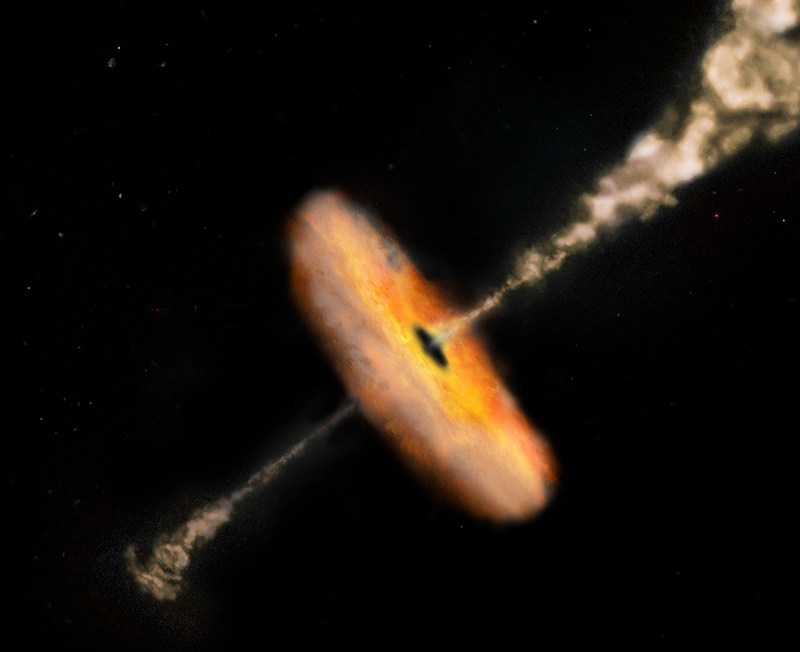
    Artist's impression of the X-ray binary XMMU J004243.6+412519

    Date: 12 Dec 2012
    Satellite: XMM-Newton
    Depicts: Artist's impression of the X-ray binary XMMU J004243.6+412519
    Copyright: ESA / AOES Medialab

    This illustration shows an artist's impression of XMMU J004243.6+412519, an X-ray binary system which consists of a stellar-mass black hole that is accreting matter from a low-mass companion star.

    This source was discovered with ESA's XMM-Newton space observatory in January 2012. About ten days after its first detection, the source underwent a dramatic boost in X-rays, indicating a transition to an accretion rate close to the black hole's Eddington limit, or even above it.

    Further observations at radio wavelengths were used to investigate the link between the transition to a higher mass accretion rate and the onset of radio jets – outflows of energetic particles that are launched from the vicinity of the black hole. The radio data exhibit multiple flares on timescales of just a few days, suggesting that the increase in the mass accretion rate might have triggered a 'ballistic' jet – a series of consecutive ejections of material.

    Last Update: 12 Dec 2012

    • Shortcut URL
    • http://sci.esa.int/jump.cfm?oid=51225
    • Latest selection
    • Rapidly rotating black hole accreting matter
    • New view of stellar winds
    • A pulsar in X-ray-bright/radio-quiet mode
    • Image Hi-Res Versions
    • Hi-Res [jpg]
      230.15 kb.
    • See also
    • Greedy black hole discovered in Andromeda

    Connect with us

    • RSS
    • Youtube
    • Twitter
    • Flickr
    • Google Buzz
    • Livestream
    • Subscribe
    • App Store
    • ESA Science Twitter

    Follow ESA science

    • Copyright 2000 - 2013 © European Space Agency. All rights reserved.

    • Terms and Conditions