
Herschel sizes up massive protoplanetary disc
30 January 2013
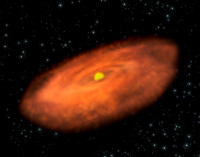
Astronomers using Herschel have detected heavy molecular hydrogen in the protoplanetary disc around the nearby star TW Hydrae. Detected for the first time in a protoplanetary disc, this molecule - which consists of one hydrogen and one deuterium atom - can be used as a tracer of the disc's main constituent - molecular hydrogen, consisting of two hydrogen atoms. The observations allowed the first accurate determination of the mass of a protoplanetary disc. With a mass equivalent to 50 times that of Jupiter, the disc around TW Hydrae is several times more massive than the primordial disc that gave birth to our Solar System, offering the tantalising prospect of the star hosting a complex planetary system in the future.
 |
|
Artist's impression of the protoplanetary disc around TW Hydrae. Credit: ESA - C. Carreau |
Planetary systems take shape around young stars from leftover material from the stellar formation process. This material consists mainly of molecular hydrogen (H2) gas and orbits the star in a protoplanetary disc for several millions of years before it condenses into planets or is dispersed away by winds driven by the radiation of the star. In addition, trace amounts of cosmic dust and other gas species are present in the disc.
The mass of a protoplanetary disc is key in determining the disc's ability to form a planetary system, as well as the mass and other properties of its future planets. Astronomers believe that the primordial disc that gave rise to our Solar System had a mass equivalent to at least 10 times the mass of Jupiter – corresponding to about one per cent of the Sun's mass. Observations of some exoplanetary systems suggest that those systems may have formed from discs with an even greater mass.
Although astronomers have observed around fifty protoplanetary discs in great detail, determining their masses is notoriously difficult. Even in the best studied case – the disc around nearby young star TW Hydrae – estimates of the disc's mass had ranged over two orders of magnitude. But that may all be changing.
New observations of TW Hydrae's protoplanetary disc, performed with ESA's Herschel Space Observatory, have allowed astronomers to assess this disc's mass using a new and much more precise method. The results of the study are published on January 31 in the journal Nature.
"Protoplanetary discs consist mainly of molecular hydrogen. Unfortunately, the conditions in most of the disc are such that molecular hydrogen hardly emits, making it impossible to detect," explains Edwin Bergin from the University of Michigan, USA, who led the new study.
 |
|
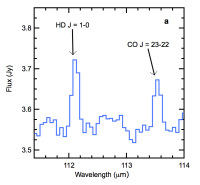
Herschel detects heavy molecular hydrogen in the protoplanetary disc around TW Hydrae. |
Astronomers have in the past used other species that are found in these discs to trace molecular hydrogen. Species such as carbon monoxide (CO), which is also a gaseous molecule, and dust grains, which are solid agglomerates of atoms and molecules, are present only in sparse quantities but radiate readily and so can be used to trace the more abundant but elusive molecular hydrogen. However, complex modelling and assumptions about the relative abundance of these proxies with respect to hydrogen are needed to convert the inferred mass of either CO or dust into an estimate of the disc's total mass, introducing a substantial degree of uncertainty. This has hindered astronomers from determining disc masses accurately.
"Our new estimate of the mass of TW Hydrae's disc is ten times more accurate than previous ones because we used a much more robust tracer of molecular hydrogen in the disc: hydrogen deuteride, also known as heavy molecular hydrogen," says Bergin.
Hydrogen deuteride (HD) is an isotopologue of molecular hydrogen: it contains one atom of hydrogen and one of deuterium. With its asymmetric structure, HD has a small electric dipole moment that causes it to radiate more strongly than molecular hydrogen, which consists of two hydrogen atoms.
"This is the first time we have observed the emission from heavy molecular hydrogen in a protoplanetary disc, and just the second time we have detected this molecule in space," notes co-author Ewine van Dishoeck from the University of Leiden, The Netherlands. "The great sensitivity of Herschel was fundamental to this discovery," she adds.
The astronomers calibrated the conversion from HD to molecular hydrogen using the relative abundance of deuterium and hydrogen, which is extremely well known from measurements in the local Solar neighbourhood.
"Based on the new data, we determined that the mass of TW Hydrae's disc is equivalent to about 50 times the mass of Jupiter – towards the high-mass end of the previous range of estimates. With such a large mass, this disc has the potential to build a planetary system like our own, or possibly even more complex and exotic than the Solar System," says Bergin.
At about ten million years, TW Hydrae is a relatively young star, but quite old to have retained a massive protoplanetary disc. Most stars of this age no longer have an observable gaseous disc, as they have already driven away most of the gas in their discs and planets may have already formed around them.
"In spite of its old age, TW Hydrae's protoplanetary disc is not atypical in the fact that it has not dispersed yet," comments co-author Thomas Henning from the Max-Planck-Institut für Astronomie in Heidelberg, Germany.
"Protoplanetary discs around young stars span a wide range in ages, and the one around TW Hydrae leans towards the older edge of this range, displaying a slower evolution than the majority of discs. In fact, the disc may have already started building up planets," Henning adds.
The extremely accurate estimate of the disc's mass will benefit future observations of TW Hydrae and its environment, as astronomers investigate the various scenarios that could eventually lead to the formation of planets around this star.
"Herschel observations have enabled us to determine the mass of a protoplanetary disc in a new and more accurate way," comments Göran Pilbratt, Herschel Project Scientist at ESA. "This is a new contribution by Herschel to the understanding of the formation of planetary systems," he concludes.
Notes for editors
The study relies on observations of the protoplanetary disc around the nearby young star TW Hydrae, a ten million-year old star located about 180 light-years away, towards the constellation Hydra, or the Sea Serpent. The observations were performed with the Photodetector Array Camera and Spectrometer (PACS) on board ESA's Herschel Space Observatory as part of the Herschel Open Time Programme "A New Method to Determine the Gas Mass in Protoplanetary Disks" which is led by Edwin Bergin (University of Michigan, Ann Arbor, Michigan, USA).
Herschel is an ESA space observatory with science instruments provided by European-led Principal Investigator consortia and with important participation from NASA. The PACS instrument contains an imaging photometer (camera) and an imaging spectrometer. The camera operates in three bands centred on 70, 100, and 160 μm, respectively, and the spectrometer covers the wavelength range between 51 and 220 μm. PACS has been developed by a consortium of institutes led by MPE (Germany) and including UVIE (Austria); KU Leuven, CSL, IMEC (Belgium); CEA, LAM (France); MPIA (Germany); INAF-IFSI/OAA/OAP/OAT, LENS, SISSA (Italy); IAC (Spain). This development has been supported by the funding agencies BMVIT (Austria), ESA-PRODEX (Belgium), CEA/CNES (France), DLR (Germany), ASI/INAF (Italy), and CICYT/MCYT (Spain).
Related publications
E. A. Bergin, et al., "An old disk still capable of forming a planetary system", 2013, Nature, 493, 7434, 644-646. DOI:10.1038/nature11805
Contacts
Edwin A. Bergin
Department of Astronomy
University of Michigan
Ann Arbor, Michigan, USA
Email: ebergin umich.edu
Phone: +1-734-615-8720
Thomas Henning
Max-Planck-Institut für Astronomie (MPIA)
Heidelberg, Germany
Email: henningmpia.de
Phone: +49-6221-528-200
Ewine van Dishoeck
Leiden Observatory
Leiden University, The Netherlands
and Max-Planck-Institut für extraterrestrische Physik (MPE)
Garching bei München, Germany
Email: ewinestrw.leidenuniv.nl
Phone: +31-71-527-5814
Göran Pilbratt
ESA Herschel Project Scientist
Research and Scientific Support Department
Directorate of Science and Robotic Exploration
ESA, The Netherlands
Email: gpilbrattrssd.esa.int
Phone: +31-71-565-3621
